Introduction
The aurora borealis is the closest thing our planet has to a live performance: sheets of green, violet, and crimson light rolling across a polar sky, never the same twice. It has pulled travellers north for centuries, and the next couple of winters are among the best in a generation to go. Solar Cycle 25 reached its maximum in 2024 and 2025, and that heightened solar activity carries through 2026 before the Sun gradually quietens toward the early 2030s. In practical terms, that means stronger, more frequent displays and a real chance of seeing the lights further south than usual.
This guide covers what the aurora borealis actually is, the best places to see the northern lights, the best time of year to go, and how to check whether the aurora is likely tonight before you head out into the cold.
Table of Contents
What is the aurora borealis?
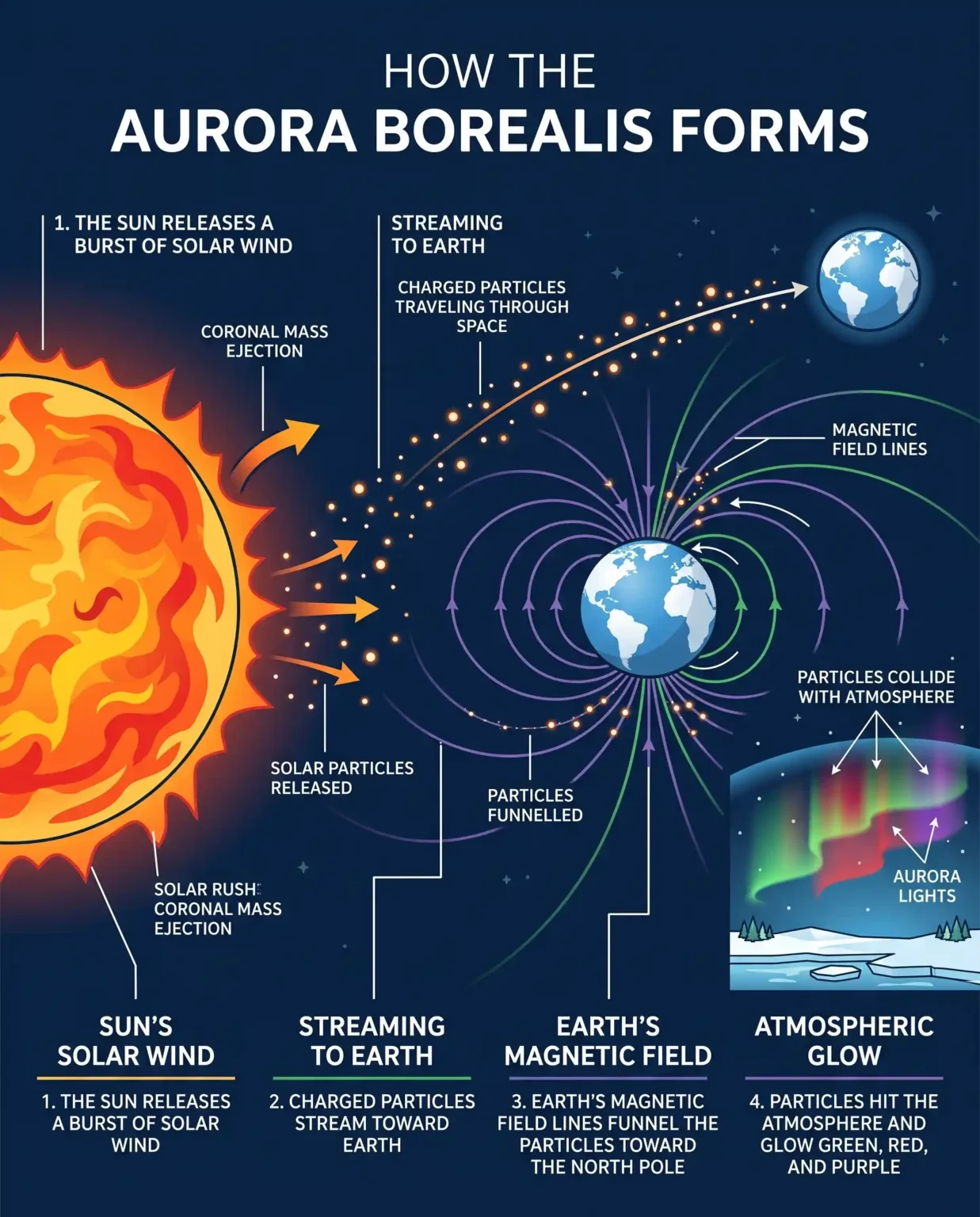
The aurora borealis, or northern lights, is light produced when charged particles from the Sun collide with gases high in Earth’s atmosphere. The Sun constantly streams out a flow of electrons and protons called the solar wind. When that wind carries a strong burst, often after a solar flare or a coronal mass ejection, Earth’s magnetic field funnels the particles toward the two magnetic poles. There they strike oxygen and nitrogen atoms roughly 100 to 300 kilometres up, and those atoms release the energy as visible light.
The colour depends on the gas and the altitude. Oxygen at around 100 kilometres glows the familiar green, the most common aurora colour. Oxygen much higher up produces deep red, while nitrogen adds blue and purple fringes along the lower edges of a display. The whole show happens inside a ring around each magnetic pole known as the auroral oval, which is why the lights are a polar phenomenon rather than something you can see from the tropics.
The same process happens at the South Pole, where it is called the aurora australis, or southern lights. Auroras are not unique to Earth either: spacecraft have photographed them on Jupiter, Saturn, and other planets with magnetic fields, though the term aurora borealis refers specifically to Earth’s northern display.
Best places to see the aurora borealis
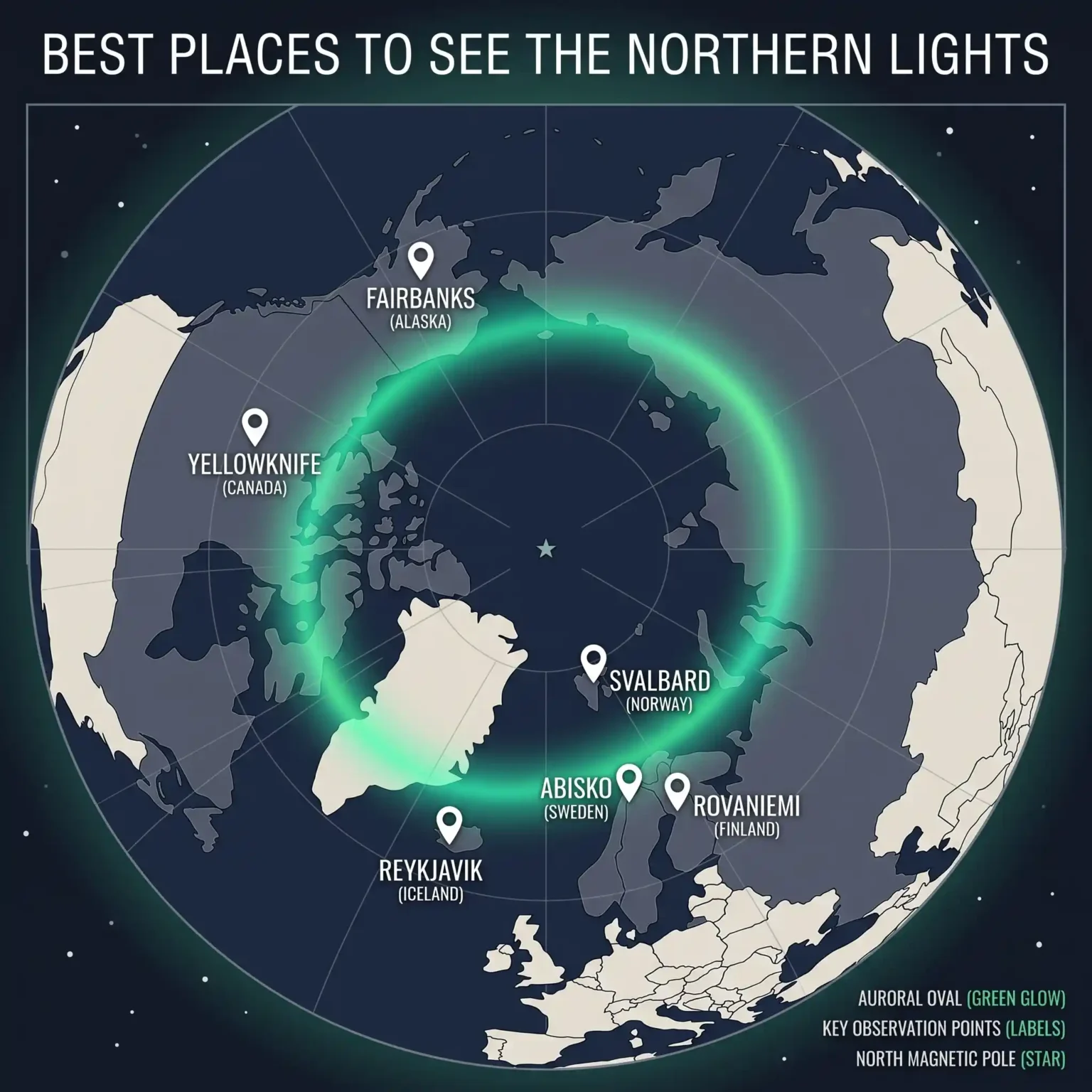
The single most important factor is latitude. The auroral oval typically sits between about 65 and 72 degrees north, so the best place to see the northern lights is somewhere inside or just below that band, with dark skies and a decent chance of clear weather. These destinations consistently deliver:
- Tromso, Norway: At 69 degrees north, Tromso is the most accessible aurora city in the world, with direct flights, a large choice of tours, and the oval often overhead. Weather off the coast is changeable, but chasing tours drive inland to find clear sky.
- Abisko, Sweden: A small national park that is statistically the clearest place in Europe to see the aurora. A gap in the mountains, the local “blue hole”, keeps skies clear on nights when everywhere nearby is clouded over, giving roughly a three-in-four chance of clear conditions in season.
- Finnish Lapland (Rovaniemi and beyond): Pairs strong aurora odds with glass igloos, husky sledding, and easy family logistics. A popular choice for a first northern lights holiday.
- Iceland: The whole country sits under the oval, and you can combine aurora hunting with waterfalls, geysers, and the Ring Road. Cloud cover is the main variable, so mobility matters.
- Yellowknife, Canada: Far from any coast, the dry continental air delivers more clear nights than almost anywhere in Scandinavia, and the flat horizon gives an uninterrupted view. One of the most reliable spots on Earth.
- Fairbanks, Alaska: Sitting under the oval in interior Alaska, Fairbanks offers frequent displays and easy add-ons like hot springs where you can watch the sky from warm water.
- Greenland and Svalbard: For a wilder trip. Svalbard is the only place with a polar night aurora season, when the lights can appear even in the middle of the day during the sunless weeks of winter.
The Lofoten Islands in northern Norway deserve a mention of their own: the aurora reflected over jagged peaks and fishing villages is one of the most photographed scenes in the aurora world, which is why the Lofoten northern lights are a trip in their own right.
Southern hemisphere: If you are below the equator, look for the aurora australis instead. Tasmania and the south of New Zealand, including Stewart Island and coastal Otago, are the most practical places to try, though displays are rarer and fainter because there is far less accessible land at high southern latitudes.
Best time to see the northern lights
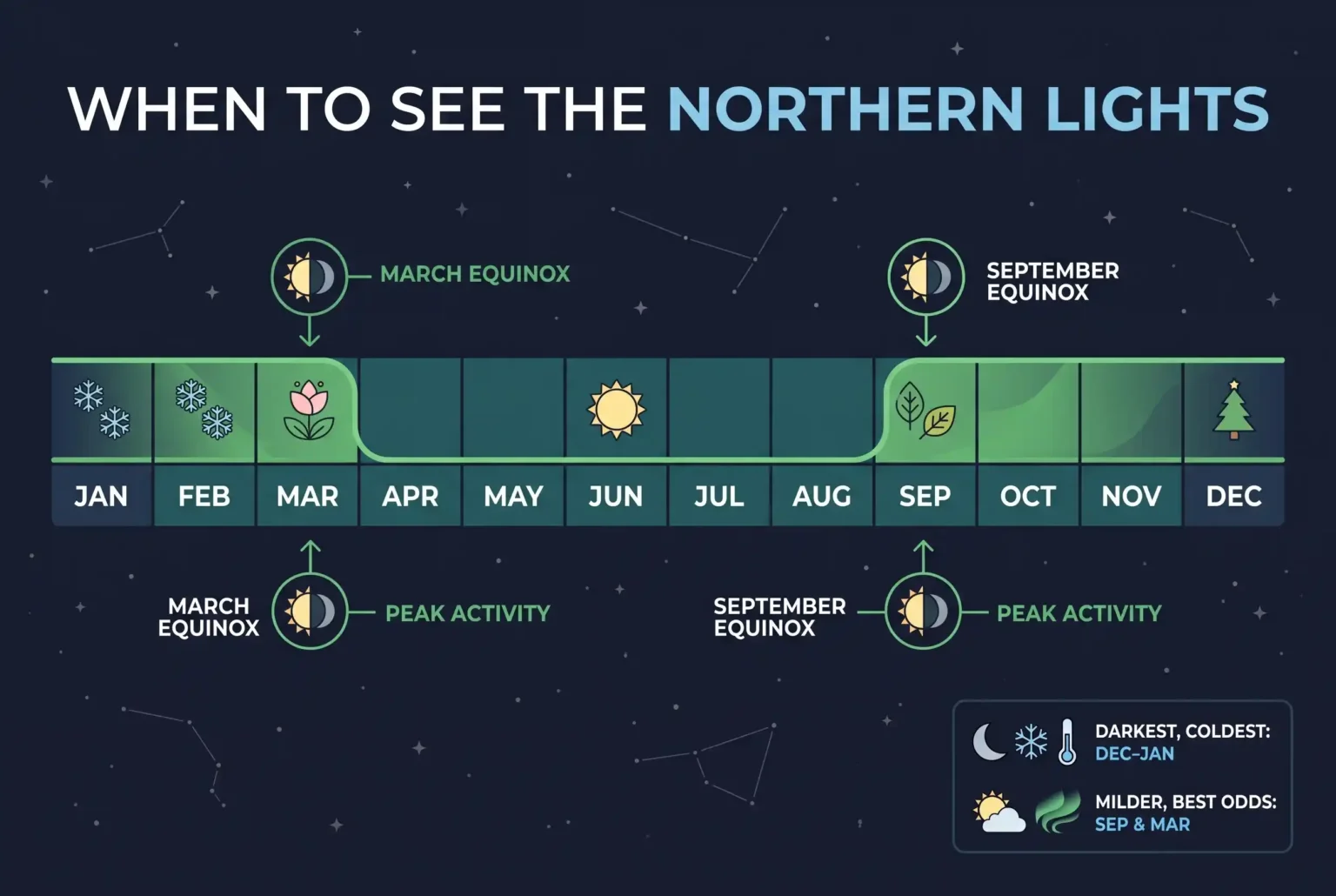
You need three things to line up: darkness, clear skies, and solar activity. The season runs from roughly late September to late March, when nights in the far north are long and dark enough. Summer is a write-off inside the Arctic Circle because the sky never fully darkens.
Within that window, two periods stand out. Statistically, the strongest activity clusters around the equinoxes in late March and late September, an effect known to scientists as the Russell-McPherron effect that can roughly double the chance of a display compared with midwinter. In 2026 the equinoxes fall on 20 March and 23 September. The trade-off is temperature and daylight: deep winter, from November to February, is colder and darker with more viewing hours per night, while the equinox months are milder and often clearer but with shorter nights.
On any given night, aim for the hours around local magnetic midnight, usually between about 9pm and 2am. A new moon helps, since bright moonlight washes out fainter auroras. And wherever you base yourself, be ready to travel away from town, because light pollution is the enemy and twenty minutes down a dark road can transform a display.
How to know if the aurora is out tonight
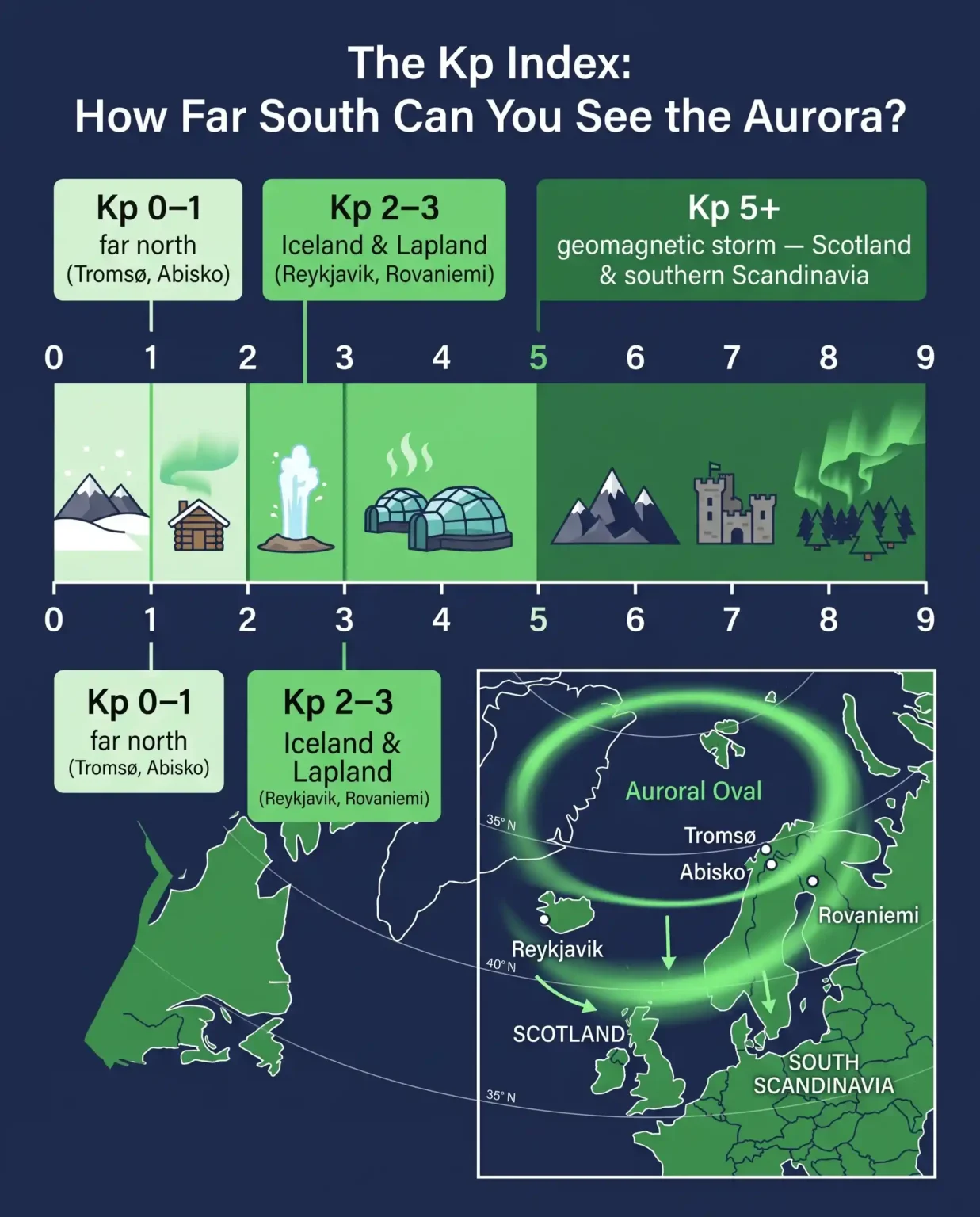
Checking the aurora borealis forecast before you commit to a cold night outdoors is worth the two minutes. The key number is the Kp index, a 0-to-9 scale of global geomagnetic activity. The higher the Kp, the further south the aurora pushes.
- Kp 0 to 1: enough to see the aurora from far-north bases like Tromso or Abisko.
- Kp 2 to 3: brings it into view from Reykjavik, Rovaniemi, and much of Iceland and Lapland.
- Kp 5 and above: a geomagnetic storm, when the lights can reach Scotland, southern Scandinavia, and occasionally much further south.
For live data, the US NOAA Space Weather Prediction Center publishes a 30-minute aurora forecast, and free apps such as My Aurora Forecast, Hello Aurora, and Space Weather Live push alerts when activity spikes and overlay cloud cover so you can judge both the aurora and the sky at once. Treat any forecast as a probability, not a promise.
How to actually see it: practical tips
- Give it time. Auroras come in waves. A quiet, faint arc can erupt into a full display within minutes, so plan to stay out for a few hours rather than glancing up once.
- Get away from lights. Even a small town glow reduces contrast. Head to a lakeshore, a hilltop, or open countryside with a clear view to the north.
- Let your eyes adjust. Give your eyes 15 to 20 minutes in the dark and avoid looking at your phone screen. Faint auroras appear grey to the naked eye and only show colour to a camera.
- Dress for standing still. You will be stationary in sub-zero cold for hours. Layer properly, and cover hands, feet, and face. Our packing list generator can build a cold-weather kit for you.
- For photos, use a tripod, manual mode, a wide aperture around f/2.8, ISO 1600 to 3200, a shutter of 5 to 15 seconds, and focus manually on a distant light or the stars. Modern phones with a night or long-exposure mode can capture the aurora surprisingly well.
Northern lights holidays and tours
You can chase the aurora independently by renting a car and watching the forecast, which gives you flexibility and costs less. A guided tour buys local knowledge: guides track the weather in real time, drive you to the clearest sky, and often provide warm suits, hot drinks, and cameras set up for the conditions. For a first trip, a tour meaningfully raises your odds.
One honest caveat: no one can promise the lights, so be wary of any guaranteed northern lights marketing. The aurora depends on solar activity and clear skies, both outside anyone’s control. What good operators offer instead is a second or third attempt free of charge if the first night fails, which is a far more realistic guarantee. Build several nights into any aurora holiday rather than pinning everything on one.
Conclusion
Seeing the aurora borealis comes down to putting yourself in the right place, at the right time of year, on a clear and dark night, during a strong stretch of solar activity. With Solar Cycle 25 still elevated through 2026, the right stretch is happening now. Pick a base inside the auroral zone such as Tromso, Abisko, Iceland, or Yellowknife, travel between late September and March, watch the Kp index, and give yourself several nights. Do that, and your odds of witnessing the northern lights are as good as they have been in more than a decade.
Frequently asked questions
What causes the different aurora borealis colours?
The colour depends on which gas the solar particles strike and how high up. Oxygen at about 100 kilometres produces the common green, oxygen much higher up glows red, and nitrogen creates blue and purple edges. Green is by far the most frequently seen.
What is the best month to see the aurora borealis?
Any month from late September to late March can work. Statistically, activity peaks around the March and September equinoxes, so those months offer the best odds combined with milder weather, while December and January give the longest, darkest nights.
Can you see the aurora borealis from the southern hemisphere?
Not the borealis itself, but its mirror image, the aurora australis or southern lights, appears around the South Pole. Tasmania, southern New Zealand, and Antarctica are the main viewing areas, though displays are less accessible than in the north.
Does the aurora happen on other planets?
Yes. Any planet with a magnetic field and an atmosphere can produce auroras, and they have been photographed on Jupiter, Saturn, and others. The name aurora borealis applies only to Earth’s northern display.
Can I see the northern lights tonight where I live?
Check the Kp index for your latitude. From the far north, Kp 0 to 2 is often enough; from mid-latitudes you usually need a strong geomagnetic storm of Kp 5 or higher. A live aurora forecast app will tell you the current probability for your location.
Do I need a tour to see the aurora borealis?
No, but it helps. Independent travel is cheaper and more flexible, while a guided tour improves your chances by moving you to clear skies and providing gear. Either way, base yourself inside the auroral zone and allow several nights.