Introduction
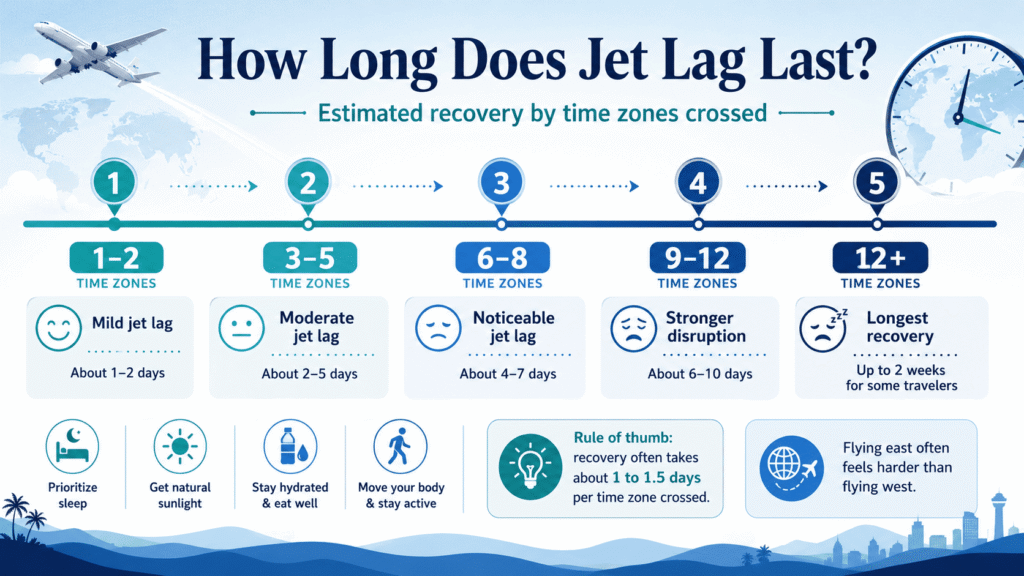
If you have just crossed several time zones, your first question is probably simple: how long does jetlag last? Most jet lag improves within a few days, but a useful rule is about 1 to 1.5 days for each time zone crossed. Some feel normal sooner; others need close to a week. Direction matters too. Flying east often feels harder because your body has to sleep earlier than it wants to. In this 2026 guide, you will learn the jetlag definition, the main symptoms, eastbound recovery tips, return-home advice, and how to use a free jet lag app to plan sleep, sunlight, caffeine, and naps.

Table of Contents
- How Long Does Jetlag Last?
- Jetlag Definition: What Is Jet Lag?
- What Are 5 Symptoms of Jet Lag?
- How to Beat Jet Lag Going East
- How to Get Over Jet Lag When Returning Home
- How to Beat Jet Lag Coming Back From Europe
- Best Flight Times to Avoid Jet Lag
- Best Jet Lag Supplements
- Free Jet Lag App: Plan Before You Fly
- Conclusion
- Frequently Asked Questions
How Long Does Jetlag Last?
Jet lag usually lasts from two days to about one week. The exact answer depends on the number of time zones crossed, travel direction, sleep before flying, and how quickly you follow local light and sleep cues after landing.
Sleep Foundation says symptoms often last about 1 to 1.5 days per time zone crossed. Cleveland Clinic also notes that many people feel better after a few days, while some need up to one week. So, for a three-time-zone trip, you may feel off for one to three days. For a six-time-zone trip, it may take several days to feel normal again.
How long does jetlag last after a long-haul flight?
Count the time zones, then adjust for direction. Eastbound travel can take longer because your body must move earlier. Westbound travel is often easier because staying awake later feels more natural. If you cross eight or more time zones, recovery can feel slower because morning and evening light cues may become confusing.
Jetlag Definition: What Is Jet Lag?
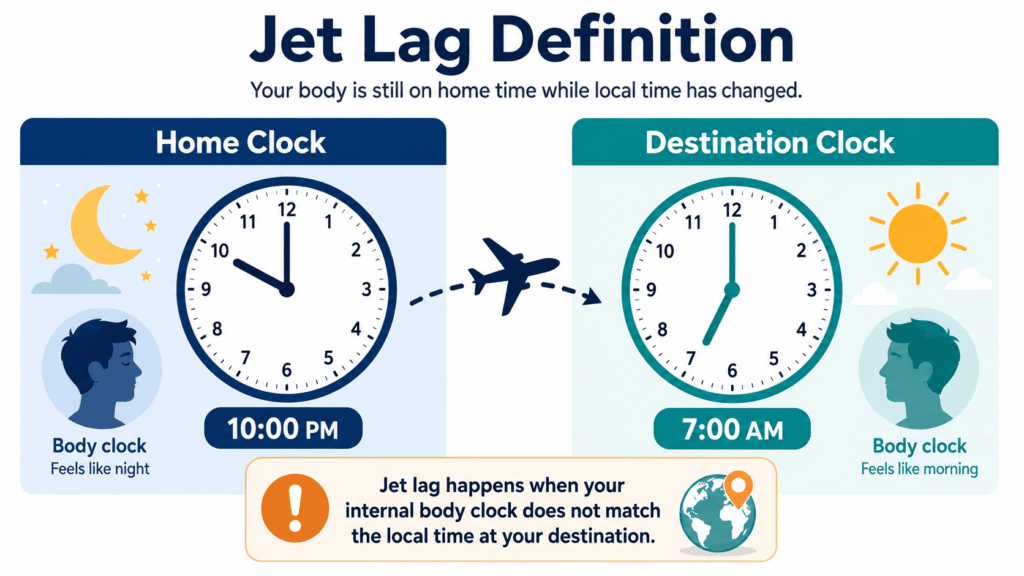
Here is the simple jetlag definition: jet lag is a temporary sleep problem caused by rapid travel across time zones. Your internal body clock still follows your departure city, while the local clock at your destination says something else.
The CDC describes jet lag as temporary desynchronization between the internal biological clock and local time after rapid travel across time zones. Jet lag is not only “being tired after a flight.” Travel fatigue may improve after one good sleep. Jet lag can last longer because your circadian rhythm needs time, light, meals, and sleep timing to reset.
What Are 5 Symptoms of Jet Lag?
If you are asking what are 5 symptoms of jet lag, start with these common signs:
- Insomnia, including trouble falling asleep or waking too early
- Daytime sleepiness or heavy fatigue
- Poor focus, slower thinking, or brain fog
- Irritability or low mood
- Digestive discomfort, appetite changes, or general malaise
These symptoms often appear within one or two days after crossing time zones. CDC diagnostic criteria include insomnia or daytime sleepiness with reduced sleep time after travel across at least two time zones, plus daytime impairment or physical symptoms.
How to Beat Jet Lag Going East
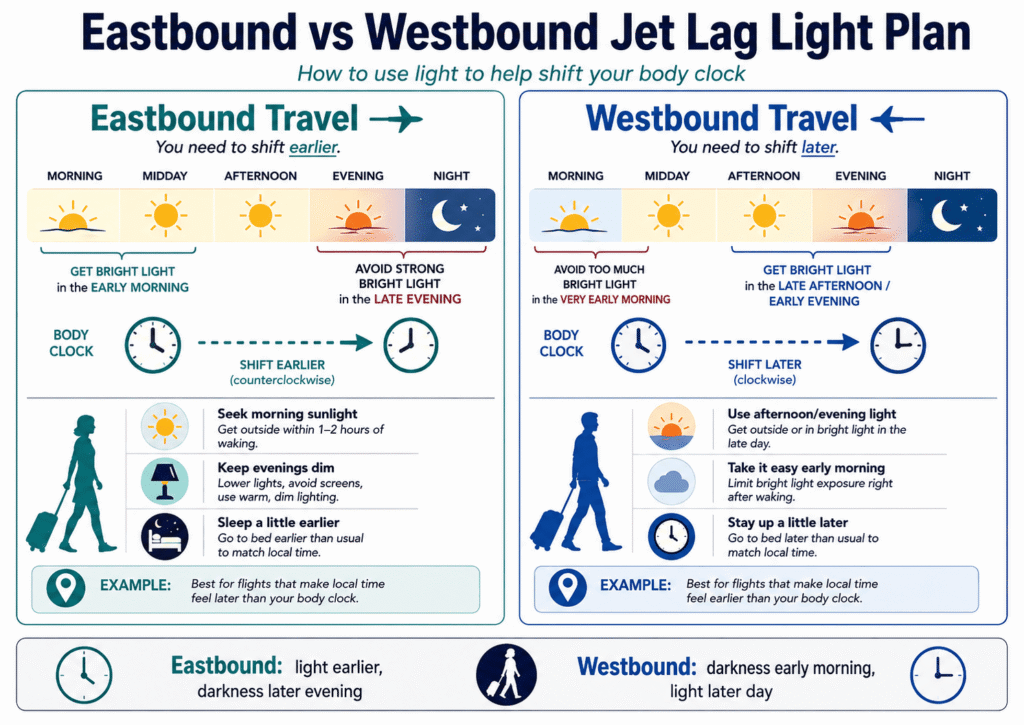
Many travelers ask how long does jetlag last after an eastbound flight because the first nights can feel hard. Going east requires your body clock to move earlier. You need to fall asleep before your body feels ready.
To beat jet lag going east, start two or three days before departure. Move bedtime and wake-up time earlier by 30 to 60 minutes. Mayo Clinic recommends going to bed one hour earlier for a few nights before eastbound travel.
After boarding, set your phone to destination time. Sleep when it is night at your destination, not when it is night at home. Use an eye mask and earplugs. Avoid alcohol as a sleep shortcut because it can fragment sleep and worsen dehydration.
After arrival, use light carefully. Morning light often helps eastbound adjustment, but timing can be tricky on very large time-zone jumps. A route-based jet lag planner is safer than guessing.
How to Get Over Jet Lag When Returning Home
How to get over jet lag when returning home depends on whether home is east or west of your trip destination. Start by shifting back to your home clock during the flight. Eat meals close to home time. Sleep only when it helps you land ready for local daytime.
Once home, avoid a long daytime nap. If you must nap, keep it around 20 to 25 minutes. Then go outside during the day, keep your first evening calm, and sleep at your normal local bedtime. CDC recommends timing activities around the destination time zone during travel and maximizing natural light after arrival.
How to Beat Jet Lag Coming Back From Europe
How to beat jet lag coming back from Europe depends on where home is. If you are returning from Europe to North America, you are usually flying west. Try to choose a flight that lands in the afternoon or early evening. Get daylight after landing, eat dinner at local time, and go to bed near your normal bedtime.
If you are returning from Europe to the UAE, India, or Southeast Asia, you are moving east or southeast. In that case, the harder part may be sleeping earlier. Start shifting bedtime earlier before the return flight. Then use morning light at home and avoid bright light late at night. The CDC notes westward travel is often easier to adapt to than eastward travel because delaying the body clock is usually easier than advancing it.
Best Flight Times to Avoid Jet Lag
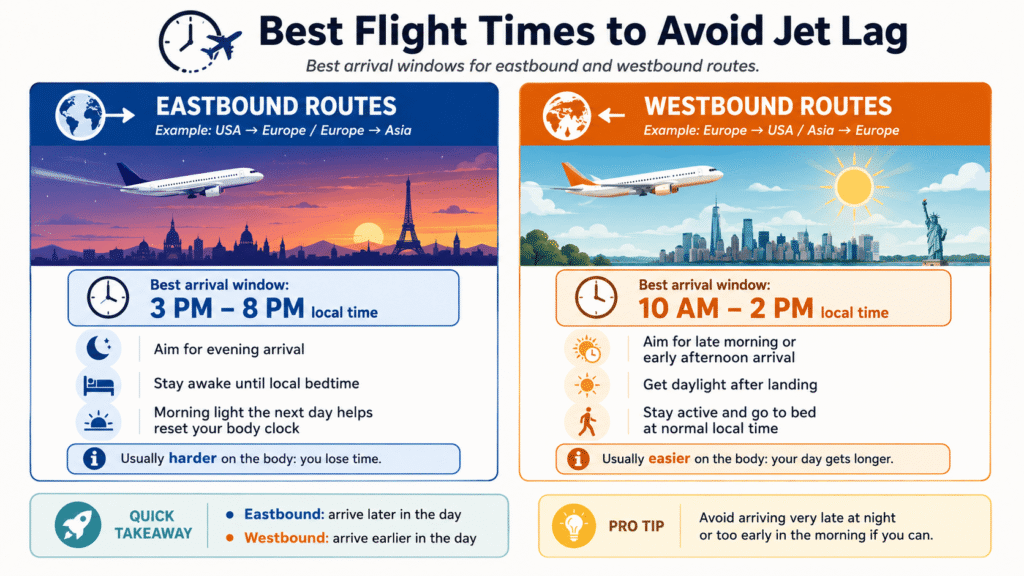
The best flight times to avoid jet lag are flights that make local sleep and light easier after landing. CDC suggests choosing a flight that arrives at a time that gives the traveler the best chance for timed light exposure.
For eastbound trips, overnight flights can work well if you can sleep on the plane and arrive in the morning. For westbound trips, daytime flights or afternoon arrivals can help you stay awake until local evening. Avoid arrival times that force a long nap, because that can delay your first proper night of sleep.
Best Jet Lag Supplements
The best jet lag supplements list should be short. Melatonin has the strongest practical role because it can signal sleep timing and help shift the body clock when used correctly. CDC says 0.5 to 1 mg is often enough for a circadian shift and does not recommend high-dose melatonin over 5 mg. Mayo Clinic says a dose as small as 0.5 mg may work as well as 5 mg or higher for many people.
How to take melatonin for jet lag
Take melatonin near your target bedtime at the destination or home time zone, often about 30 minutes before planned sleep. Do not mix it with alcohol. Ask a healthcare professional first if you are pregnant, giving it to a child, taking sleep medicine, using blood thinners, or managing a medical condition.
Other supplements, such as magnesium or herbal sleep blends, may help some people relax. However, they do not have the same route-timing role as melatonin. Melatonin plus correctly timed light is more useful than a random supplement stack.
Melatonin disclaimer: This information is for general travel-planning purposes only and is not medical advice. Melatonin may not be suitable for everyone, including children, pregnant or breastfeeding travelers, people with medical conditions, or those taking prescription medicines. Always speak with a qualified doctor or pharmacist before using melatonin or any sleep supplement, especially if you are unsure about the right dose or timing.
Free Jet Lag App: Plan Before You Fly
A free jet lag app is helpful because timing is the hardest part. You may know you need sunlight, sleep, caffeine, and short naps, but not know when to use each one.
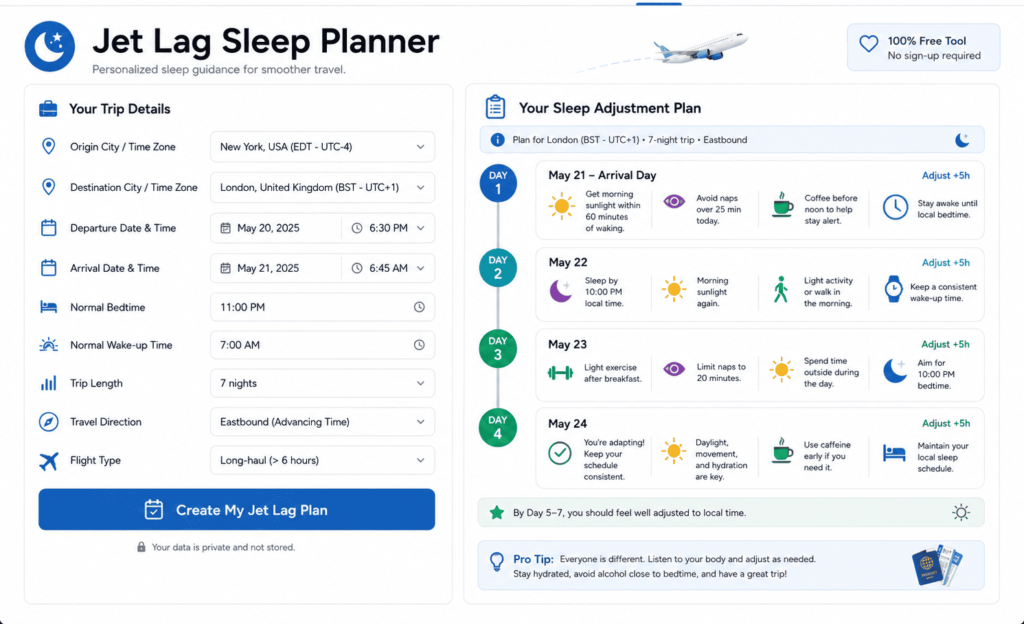
Use our free Jet Lag Sleep Planner before booking or flying. It asks for your origin, destination, departure and arrival times, normal bedtime, normal wake-up time, trip length, travel direction, and flight type. Then it creates a simple sleep adjustment plan.
The tool is useful because it can suggest when to sleep, nap, get sunlight, limit caffeine, and align with destination time. It also considers short trips, where staying partly on your home schedule may be better than adjusting twice. This is helpful if you want to know how long does jetlag last for your exact route, not just in general.
Conclusion
Jet lag is temporary, but it can still ruin the first days of a trip if you leave recovery to chance. The main takeaway is that how long does jetlag last depends mostly on time zones crossed, direction of travel, and how well you time light, sleep, naps, caffeine, and melatonin. A few smart steps can make a real difference. Shift your sleep before departure, follow destination time on the plane, use sunlight carefully, keep naps short, and avoid alcohol as a sleep aid. Before your next long-haul flight, build a route-based plan with the Boarding Gate Jet Lag Sleep Planner so your first day feels less like recovery and more like travel.
Frequently Asked Questions
Can jet lag last two weeks?
Jet lag usually improves before two weeks. If sleep problems, severe fatigue, or illness-like symptoms last that long, speak with a healthcare professional. Cleveland Clinic recommends contacting a provider if symptoms do not go away or get worse more than one week after travel.
Is insomnia a symptom of jet lag?
Yes. Insomnia is one of the main symptoms of jet lag. It may show up as trouble falling asleep, waking during the night, or waking too early in the morning.
How do you beat jet lag going east?
Shift bedtime earlier before travel, sleep on the plane when it is destination night, seek correctly timed morning light after arrival, and avoid late-night bright light. Melatonin may help, but timing matters.
What is the best flight time to avoid jet lag?
The best flight time is one that helps you sleep and get light at the right local time. For many eastbound trips, an overnight flight with a morning arrival works well. For westbound trips, afternoon or early evening arrival can make it easier to stay awake until bedtime.
Is there a free jet lag app for planning sleep?
Yes. Boarding Gate’s free Jet Lag Sleep Planner with absolutely free PDF export helps you plan sleep, naps, sunlight, caffeine, and arrival-day timing based on your route and flight details.