Introduction
The european power plug type is usually Type C or Type F across mainland Europe, but not everywhere. For most phones, laptops, tablets, and camera chargers, you need a plug adapter, not a voltage converter, as long as your charger says Input: 100–240V. Europe commonly uses 230 volts and 50 hertz, while North America uses about 120 volts and 60 hertz, so checking your device label matters before you pack. Electrical Safety First also advises travelers to check the socket type, voltage, and frequency before using appliances abroad.
In this 2026 guide, you will learn which European adapter to buy, when a converter is needed, and which countries need special attention.
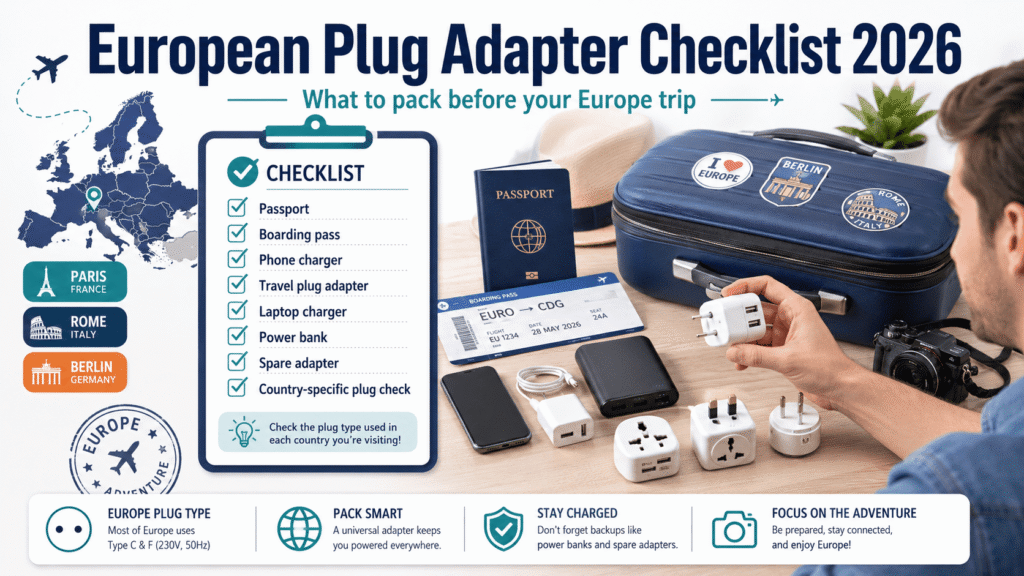
Table of Contents
- European Power Plug Type Explained
- Europe Voltage and Device Safety
- Common European Plug Types by Country
- Type C vs Type F: Which Adapter Should You Buy?
- Countries That Need Extra Attention
- Device-by-Device Travel Advice
- Best Adapter Setup for Europe
- Final Packing Checklist
- Conclusion
- Frequently Asked Questions
European Power Plug Type Explained
European power plug type for most travelers
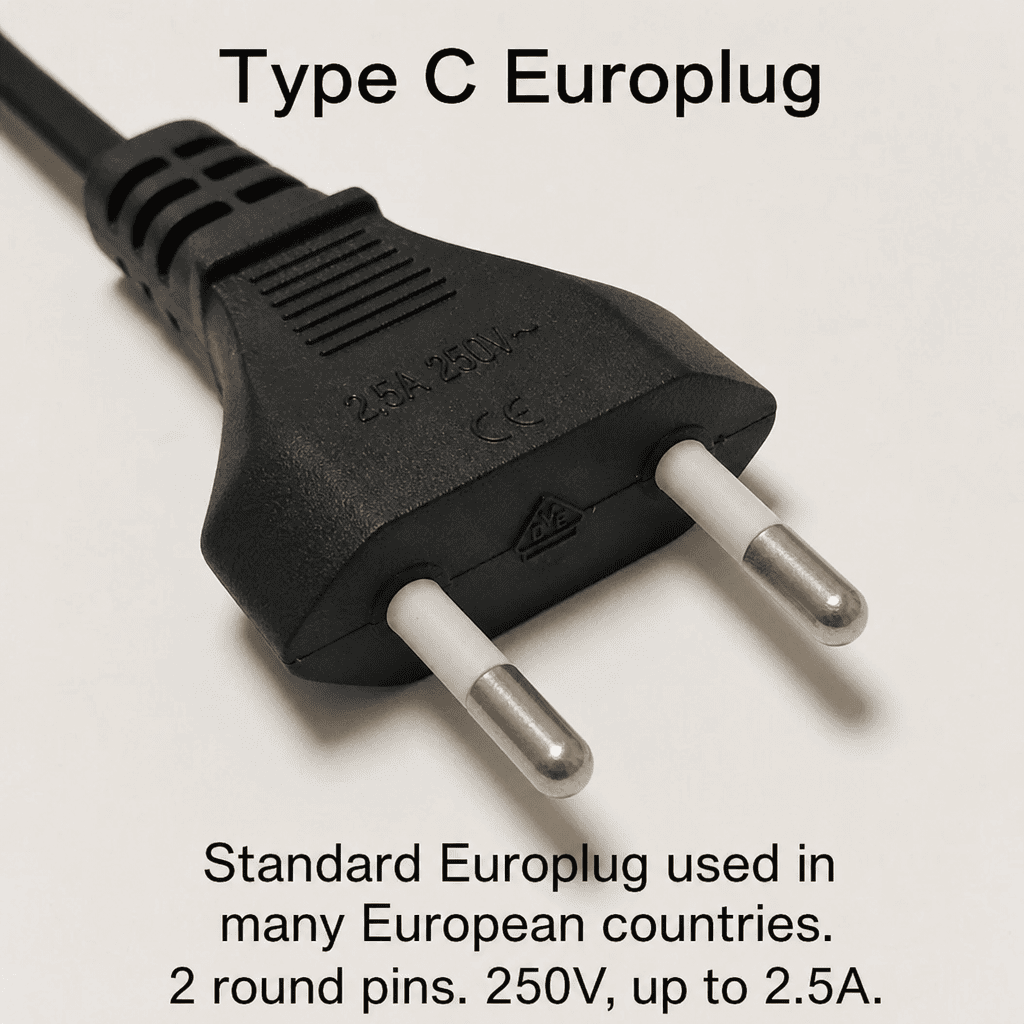
For most mainland Europe trips, the european power plug type you will use is Type C or Type F. Type C is the slim two-round-pin “Europlug.” Type F, also called Schuko, is a larger grounded plug used in countries such as Germany, Spain, the Netherlands, Austria, and many others.
The International Electrotechnical Commission describes Type C as a two-wire plug with two round pins that fits sockets accepting 4.0–4.8 mm round contacts spaced 19 mm apart.
That means a small Type C adapter is enough for many low-power chargers. However, grounded devices need more care.
Adapter vs Converter
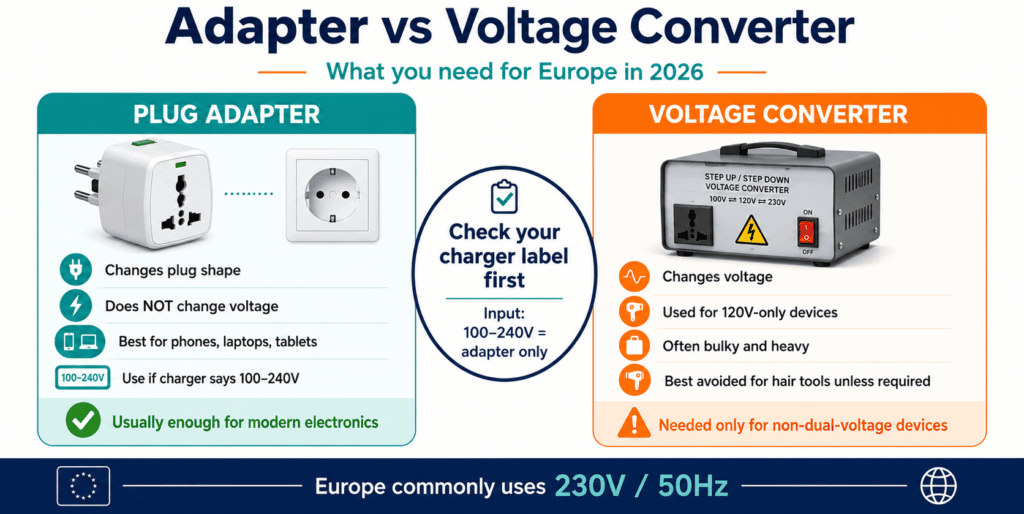
A plug adapter only changes the shape of your plug. It does not change electricity.
A voltage converter changes the voltage. This matters because Europe commonly uses 230V at 50Hz. Electrical Safety First says dual-voltage appliances can work across a range such as 110–240V, but non-dual-voltage devices may need a voltage converter or transformer.
So, before buying anything, check your device label.
Look for:
- Input: 100–240V — you usually need only an adapter.
- Input: 110–120V only — you may need a converter, or you should leave the device at home.
- High-watt heat device — avoid using it abroad unless it is clearly dual voltage.
Europe Voltage and Device Safety
The european power plug type solves only one part of the problem. Voltage is the second part.
Germany and most European countries use 230 volts at 50 hertz, according to VDE’s consumer travel safety guidance. VDE also notes that a plug fitting into a socket does not always mean the device is compatible.
This is why phone chargers usually work, but hair dryers often fail.
Most modern phone, laptop, tablet, and camera chargers are dual voltage. You can confirm this by reading the power brick. If the label says 100–240V, it is designed for international use.
However, many North American hair dryers, curling irons, electric kettles, and heated brushes are 120V only. If you use one in Europe with only a basic adapter, it can overheat, burn out, or trip the room circuit.
Common European Plug Types by Country
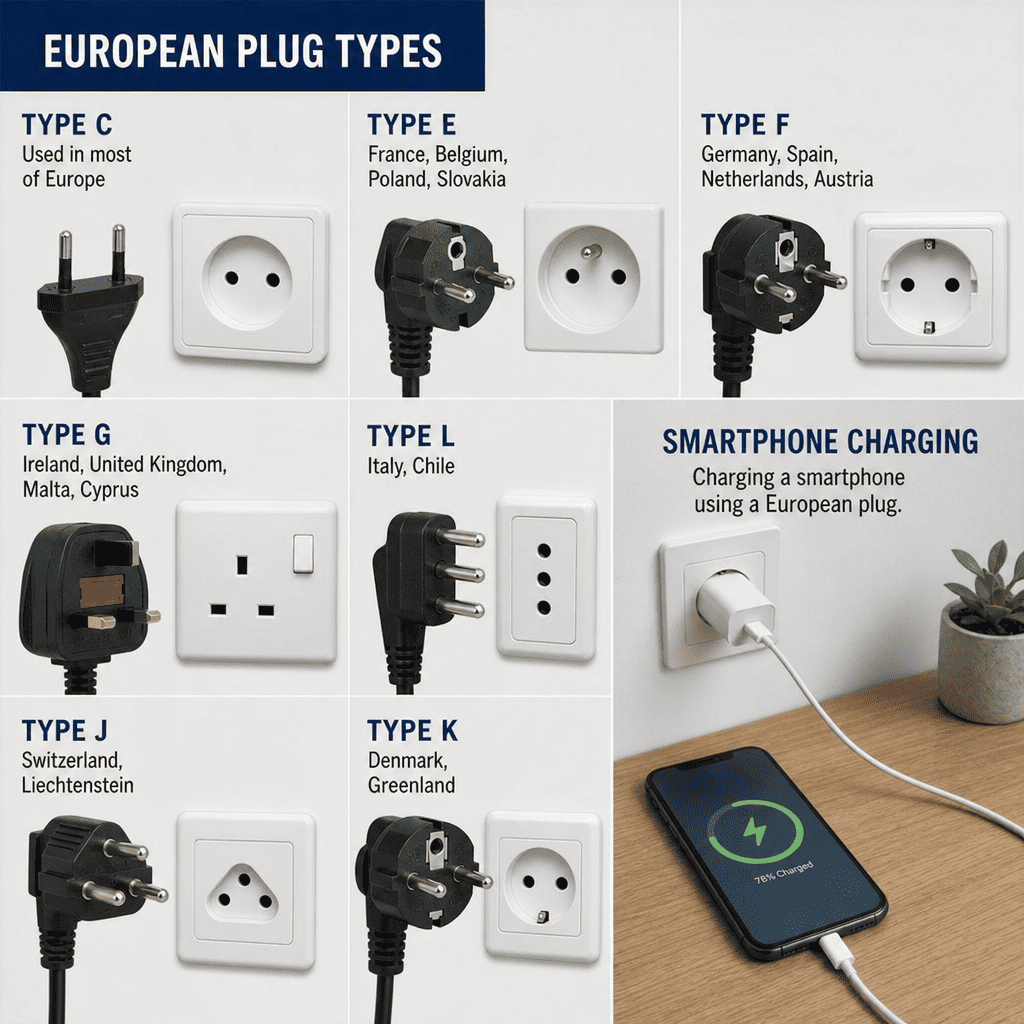
The easiest way to choose your adapter is to match your itinerary to the local socket type.
| Destination | Common plug type | What most travelers need |
|---|---|---|
| France | Type C / Type E | Type C for small chargers, Type E/F for grounded devices |
| Germany | Type C / Type F | Type C or grounded Type F |
| Spain | Type C / Type F | Type C or grounded Type F |
| Netherlands | Type C / Type F | Type C or grounded Type F |
| Greece | Type C / Type F | Type C or grounded Type F |
| Italy | Type C / Type F / Type L | Type C for small chargers, Type L if needed |
| Switzerland | Type C / Type J | Type C for small chargers, Type J for grounded devices |
| United Kingdom | Type G | UK Type G adapter |
| Ireland | Type G | UK/Ireland Type G adapter |
This table is a practical travel summary. Still, hotels, old apartments, trains, and rural stays can vary. Therefore, check your exact destination before leaving.
Type C vs Type F: Which Adapter Should You Buy?
Type C: simple and small
Type C is the slim Europlug. It has two round pins and is ungrounded. It is common for phone chargers, small camera chargers, and other low-power devices.
The european power plug type many travelers picture is Type C because it is small, cheap, and widely used. WorldStandards describes Type C as an ungrounded, unpolarised two-pin plug with 4 mm round pins.
However, Type C is not ideal for heavy or grounded devices.
Type F: better for grounded devices
Type F is the Schuko plug. It has two round pins and side grounding clips. WorldStandards notes that Type F plugs use two 4.8 mm round pins and are used for applications up to 16 amps.
A grounded Type F adapter is better if your laptop power cable has a three-prong plug, or if your device needs an earth connection.
Electrical Safety First warns that some travel adapters are not suitable for appliances that require an earth connection. It also advises travelers to check the adapter’s maximum power rating.
Countries That Need Extra Attention
Italy
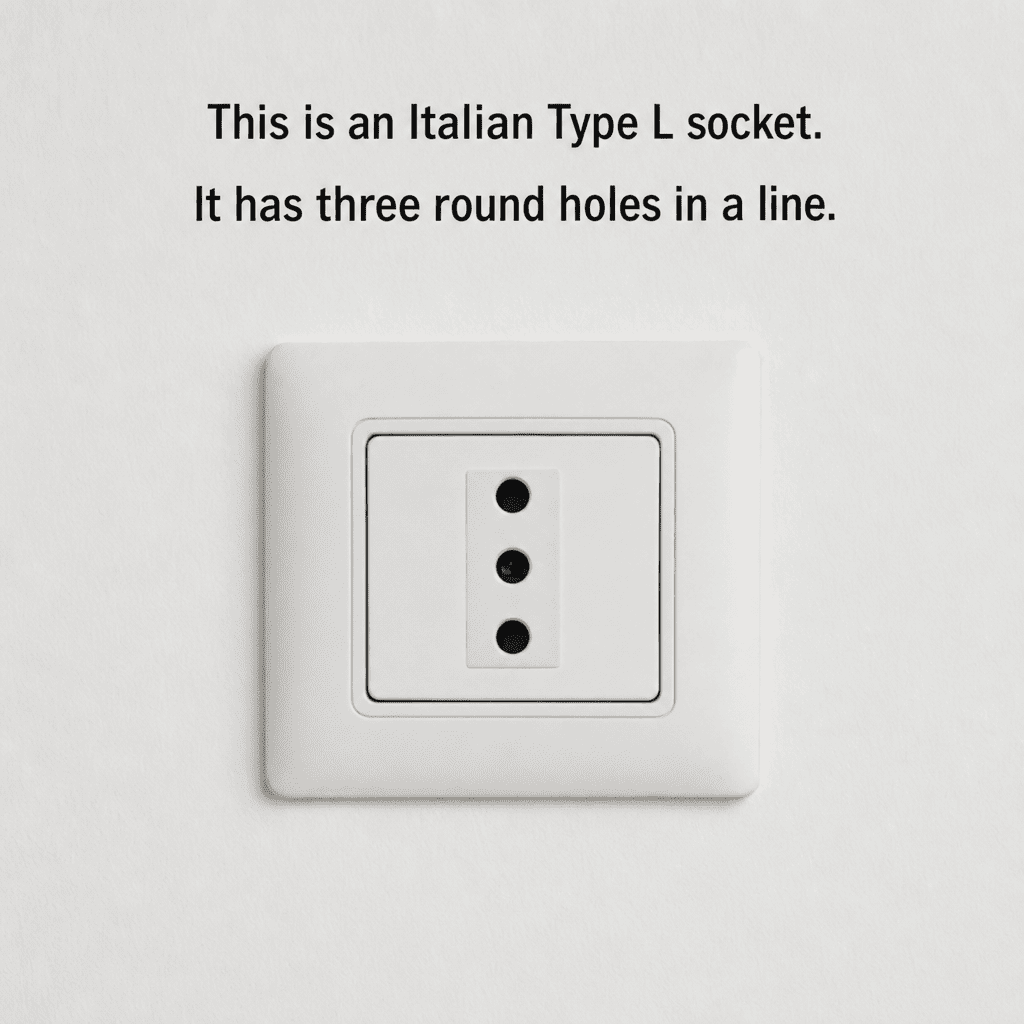
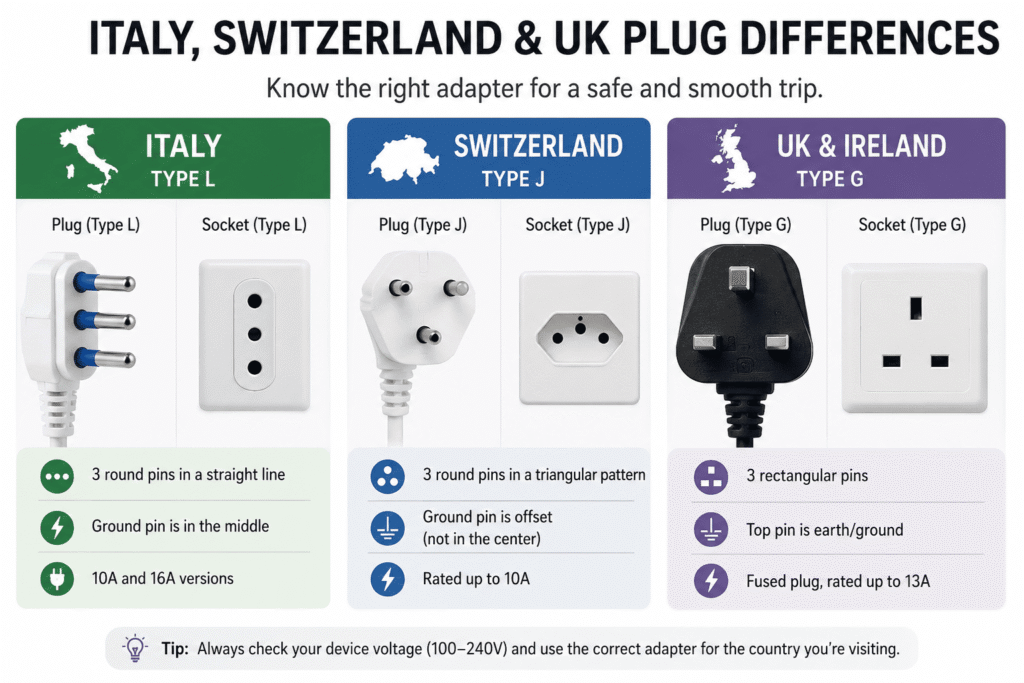
Italy can be confusing because you may see Type C, Type F, and Type L. Type L has three round pins in a straight line. Some modern hotels accept several plug types, but older apartments may not.
WorldStandards lists Type L as used almost exclusively in Italy and Chile, with 10A and 16A versions.
If your trip includes Rome, Florence, Venice, or rural villas, pack at least one Italy-friendly adapter.
Switzerland
Switzerland uses Type J. A slim Type C plug often fits Swiss sockets, but a large round Type F plug may not. That makes Switzerland different from many nearby countries.
WorldStandards lists Type J as used in Switzerland and Liechtenstein, grounded, rated 10A, and compatible with Type C and Type J plugs.
So, if you are carrying grounded equipment, buy a Swiss Type J adapter.
France and Belgium
France and Belgium commonly use Type E. Type E is grounded through a pin in the wall socket. Many modern European grounded adapters are E/F compatible, meaning they work in both French Type E and German Type F sockets.
If your adapter says “Type E/F,” it is usually a safer choice for multi-country mainland Europe trips.
United Kingdom and Ireland
The UK and Ireland use Type G, not Type C or Type F. Type G has three rectangular pins and is much larger than mainland European plugs.
If your trip includes London, Dublin, Edinburgh, or Manchester, pack a separate Type G adapter. Electrical Safety First says Europe uses the same voltage and frequency as the UK, but UK travelers still need a travel adapter when the socket shape differs.
Device-by-Device Travel Advice
Phones, tablets, cameras, and laptops
For most portable tech, the european power plug type is the main issue. Your charger likely supports 100–240V. So, you need a plug adapter that fits the socket.
A useful setup is a compact USB-C wall charger with several ports. Pair it with a Type C or Type E/F adapter, and you can charge your phone, watch, tablet, and power bank from one wall socket.
Hair dryers and straighteners
Hair tools are risky because they draw high power and create heat. A 120V-only hair dryer from North America should not be used in a 230V European outlet with only an adapter.
A heavy-duty voltage converter may work in theory, but it is bulky and can still be unsuitable for some heat appliances. A better option is to use the hotel dryer or buy a dual-voltage travel hair dryer.
If your styling tool has a voltage switch, set it correctly before plugging it in.
CPAP machines and medical devices
Many modern CPAP machines are dual voltage, but you should not guess. Check the power brick and manufacturer guidance before traveling.
For medical equipment, pack:
- The correct plug adapter.
- A backup adapter.
- The device power supply.
- Any airline or medical documentation.
- A power bank only if the device supports it.
Best Adapter Setup for Europe
Option 1: Universal travel adapter
A universal adapter is useful if your route includes Europe, the UK, Asia, and other regions. Many include USB-A and USB-C ports.
However, universal adapters can be bulky. They may fall out of loose sockets, especially on trains, older hotels, or small wall outlets.
Option 2: Individual plug adapters
For a Europe-only trip, individual adapters are often better. They are smaller, lighter, and usually sit more firmly in the socket.
A practical kit for Europe:
- Two Type C adapters for phone chargers.
- One grounded Type E/F adapter for laptops.
- One Type G adapter if visiting the UK or Ireland.
- One Type J adapter if visiting Switzerland.
- One Type L adapter if staying in older Italian properties.
Option 3: USB charging hub
A USB charging hub is useful for families or content creators. It reduces the number of wall outlets you need.
Still, check the input label. It should say 100–240V. Also, avoid overloading one socket with too many devices.
Final Packing Checklist
Before you leave, use this checklist:
- Check every charger for “Input: 100–240V.”
- Buy adapters before going to the airport.
- Pack at least one adapter in your carry-on.
- Bring a grounded adapter if your device needs grounding.
- Do not force a plug into a socket.
- Avoid using high-power appliances in bathroom outlets.
- Carry a power bank for long sightseeing days.
- Pack a Type G adapter for the UK or Ireland.
- Pack Type J for Switzerland if using grounded devices.
- Pack Type L for older Italian stays.
You can also go through our Plug Type & Voltage Checker tool to get the details about plug and voltages.
Conclusion
The european power plug type is simple once you split the problem into two questions: plug shape and voltage. For most travelers, a Type C or Type E/F adapter plus dual-voltage chargers will cover mainland Europe, while the UK, Ireland, Switzerland, and some Italian stays may need extra adapters. Do not assume that a plug fitting means the device is safe. Check the input label first, especially for hair tools and other heat appliances. Before your 2026 Europe trip, match your countries to the socket type, pack one spare adapter, and keep your main charger in your carry-on.
Frequently Asked Questions
What is the main european power plug type?
The main european power plug type is Type C for small two-pin devices and Type F for many grounded sockets in mainland Europe. France often uses Type E, while Italy, Switzerland, the UK, and Ireland may need different adapters.
Do I need a voltage converter for Europe?
You only need a voltage converter if your device is not dual voltage. If the label says Input: 100–240V, you usually need only a plug adapter. If it says 110–120V only, do not use it in Europe without proper voltage conversion.
Will my phone charger work in Europe?
Yes, most modern phone chargers work in Europe because they support 100–240V. You still need a plug adapter so the charger physically fits the wall socket.
Is Type C enough for Europe?
Type C is enough for many small chargers. However, it is ungrounded. If your device needs grounding, use a grounded Type E/F, Type J, Type L, or Type G adapter depending on the country.
What adapter do I need for Italy?
Italy commonly uses Type C, Type F, and Type L. A Type C adapter may work for small chargers, but a Type L adapter is useful for older buildings or sockets that do not accept Schuko-style plugs.
What adapter do I need for Switzerland?
Switzerland uses Type J. A slim Type C plug often works for small chargers, but grounded devices usually need a Type J adapter.
Are UK and European plugs the same?
No. The UK and Ireland use Type G plugs with three rectangular pins. Mainland Europe usually uses round-pin plugs such as Type C, E, or F.
Can I use a US power strip in Europe?
Only use a power strip if it is rated for 230V and has no incompatible surge protection. Many North American surge protectors are not designed for European voltage. When unsure, use a local or travel-rated USB charger instead.