Nail clippers are allowed on a plane — in both your carry-on and checked bag — despite one of travel’s most stubborn myths. Scissors and other grooming tools are allowed too, within a size limit. These are US TSA rules, which most travelers are searching for. Other authorities — the UK, EU and the UAE’s GCAA — follow similar but not identical limits, and the final call always rests with the security officer and your airline. Check before you fly.
Table of Contents
Nail Clippers, Tweezers and Nail Files: All Fine
Nail clippers are permitted in carry-on. They have no exposed blade long enough to concern TSA, and the tiny folding file attached to them is fine as well. Tweezers, nail files, emery boards and cuticle pushers are all allowed in carry-on too. None of these need to go in checked baggage.
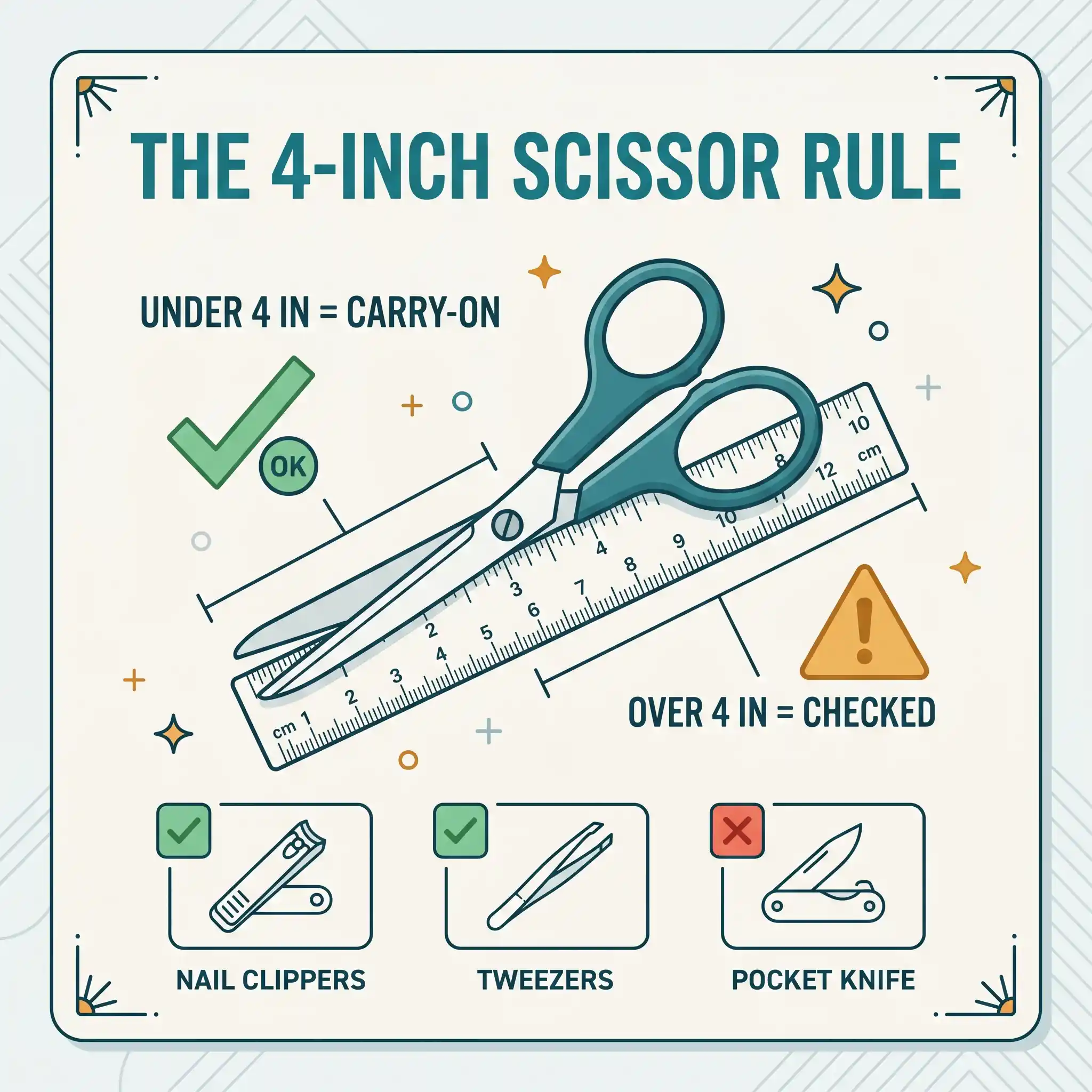
Scissors: The 4-Inch Blade Rule
Scissors are allowed in carry-on if the blades are shorter than 4 inches (10 cm) measured from the pivot. That covers most nail scissors, cuticle scissors, small craft and sewing scissors. Anything with longer blades — kitchen or fabric shears — must go in checked baggage.
What Has to Be Checked
Keep these out of your carry-on: full-size scissors over 4 inches, box cutters and utility knives, pocket knives and multi-tools with a blade (a Swiss Army knife or Leatherman), and straight razors. All are allowed in checked baggage, where a blade poses no cabin risk. A razor guide covers shaving blades specifically.
Why the Nail-Clipper Myth Persists
The confusion dates to the tightened rules just after 2001, when many small metal items were pulled from cabins. Clippers were quietly allowed back years ago, but the myth stuck. If an officer ever objects to a specific item, their decision is final — but standard clippers pass every day. The TSA A-Z tool confirms it.
This is one item in our full guide to what you can bring on a plane — the complete carry-on and checked-bag rundown.
How the rules vary — and the safe way to pack
The limits above reflect common security-screening practice, but they are not identical the world over. The United States allows scissors with blades shorter than four inches in carry-on; much of Europe and the United Kingdom permits small scissors with blades up to around six centimetres, and some countries are stricter still. Airlines can also impose their own rules on top of the airport’s. Because the detail shifts between jurisdictions, the figure that matters is the one published by the security authority at your departure airport and your airline, so it is always worth a quick check before you fly on an international route.
When something is borderline, the simplest insurance is to put it in your checked bag, where grooming tools and blades face far fewer restrictions. Remember too that the screening officer has the final say: even an item that is technically allowed can be refused at their discretion, and the usual outcome is confiscation at the checkpoint rather than a fine. For a one-off cheap item like nail scissors that is a minor loss, but for anything you value — a quality manicure set or a cherished pair of scissors — checking it removes the risk of having to surrender it at security.
One last practical tip: keep your grooming kit together in a clear, easily reached pouch. If an officer wants to inspect it, you can produce it quickly rather than unpacking your whole bag at the belt, and you are far less likely to forget a stray pair of scissors loose in a pocket of your carry-on, which is how most travellers end up losing one in the first place.
Watch out for multi-tools. A pocket knife or multi-tool with a blade is not allowed in the cabin even when it also carries scissors, so pack the whole tool in checked baggage. The same applies to a cased sewing or repair kit with embedded scissors over the blade limit. Once these items live in your hold luggage, none of the fine checkpoint distinctions apply and you avoid an awkward decision at the belt.
Frequently Asked Questions
Can you bring nail clippers on a plane?
Yes. Nail clippers are allowed in both carry-on and checked baggage. The attached file is fine too. The old ban is a myth.
Are scissors allowed on airplanes?
Yes, in carry-on if the blades are under 4 inches (10 cm) from the pivot. Larger scissors must go in checked baggage.
Can you bring tweezers on a plane?
Yes. Tweezers are allowed in carry-on and checked baggage with no restriction.
Can you bring a nail file on a plane?
Yes. Emery boards and metal nail files are both allowed in carry-on.
Can you bring a pocket knife or multi-tool in carry-on?
No. Any knife or multi-tool with a blade must go in checked baggage, regardless of blade length.
Can you bring cuticle scissors on a plane?
Yes. Small grooming scissors with blades under 4 inches are allowed in carry-on.
Can you bring cuticle scissors or cuticle nippers on a plane?
Yes. Cuticle scissors, cuticle nippers, manicure scissors and grooming scissors are all allowed in your carry-on because their blades are very short. The same small-blade guideline that applies to nail scissors covers them, so your everyday grooming kit is fine in the cabin.
Can you pack nail clippers and nail scissors in checked luggage?
Yes, and checked baggage is the safest place for anything borderline. Nail clippers, nail scissors, cuticle tools and files all travel without restriction in a checked bag, so if you are unsure whether a larger pair of scissors will be allowed in the cabin, simply pack it in your hold luggage.
Are nail clippers allowed on international flights?
Generally yes. Nail clippers, also called nail cutters, are allowed in carry-on worldwide, and most countries also permit small nail and cuticle scissors. What varies is the scissors blade-length limit: the United States allows blades under four inches, while the UK and EU typically allow blades up to about six centimetres. A few airlines are stricter, so check your carrier on an international route, or pack scissors in your checked bag to be safe.