On a low hill just outside Heraklion sits the oldest city in Europe, and the ruins of its royal centre still draw more visitors than anywhere else on Crete. The Palace of Knossos was the heart of the Minoan civilisation more than 3,500 years ago, a sprawling complex of courtyards, storerooms, and brightly painted halls that later Greeks remembered as the labyrinth of King Minos and the Minotaur. This guide covers the history, the myth, what survives on the ground today, and everything you need to plan a visit to Knossos Palace in Crete.
What is the Palace of Knossos
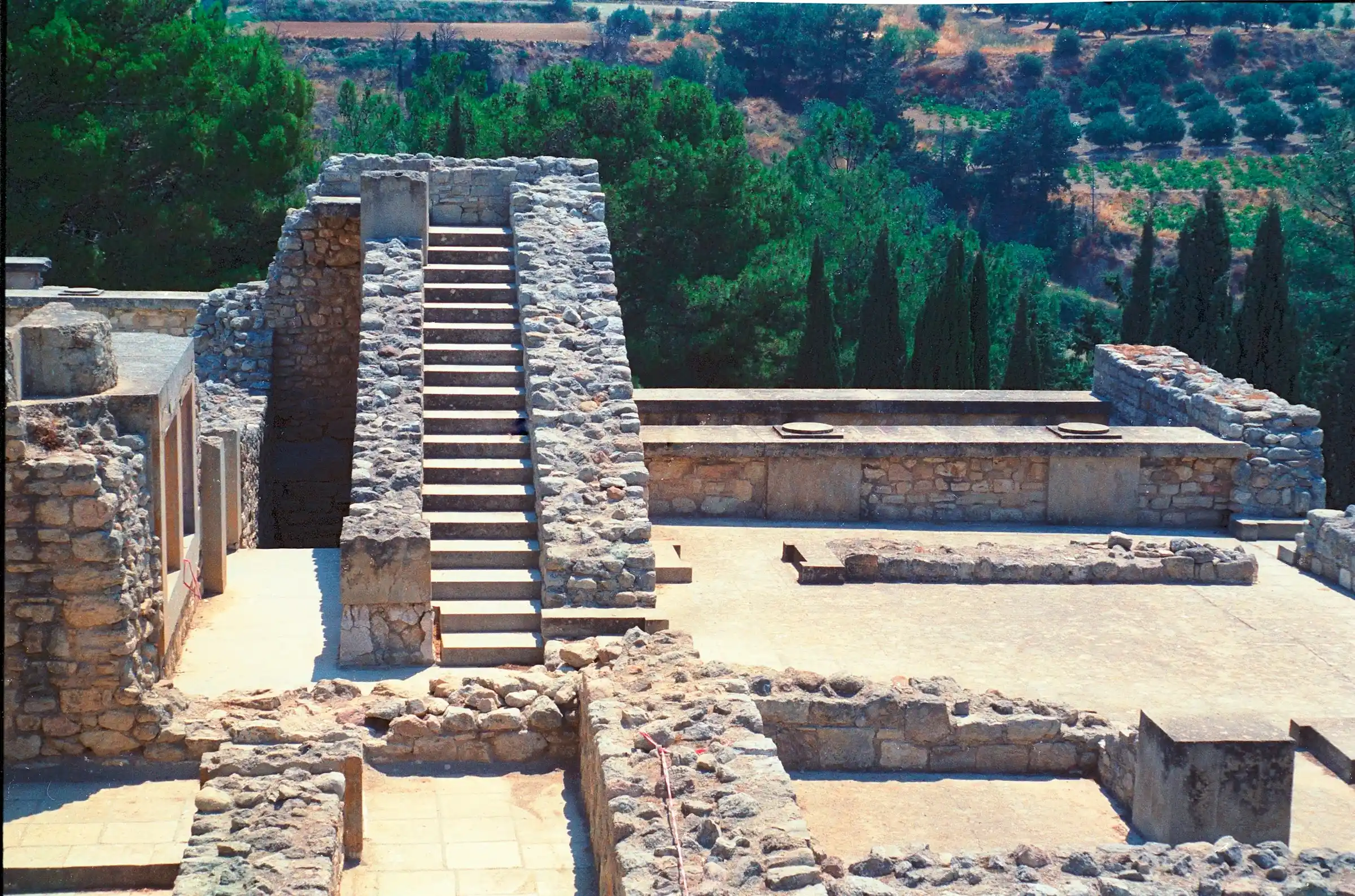
Knossos was the largest Bronze Age site on Crete and the political and ceremonial capital of the Minoans, Europe’s first advanced civilisation. The complex covered around 20,000 square metres and once rose several storeys high, with hundreds of interconnected rooms arranged around a large central court. People lived on the hill from the Neolithic period, and the great palace was built, destroyed, and rebuilt between roughly 1900 and 1350 BC. Its scale and tangle of corridors are almost certainly the source of the labyrinth legend.
The Minoans and King Minos
The Minoans take their name from the legendary King Minos, though we do not know what they called themselves. They were skilled traders and seafarers who spread across the Aegean, built fine pottery and jewellery, and wrote in scripts we still only partly understand. Knossos controlled a wide region and stored vast quantities of grain, oil, and wine in its rows of giant clay jars. A series of earthquakes and fires, and later the arrival of Mycenaean Greeks from the mainland, brought the palace era to an end, but the memory of its power lived on in Greek myth.
The Minotaur and the labyrinth
The most famous story tied to Knossos is the myth of the Minotaur, a creature half man and half bull kept in a maze beneath the palace of King Minos. The hero Theseus sailed from Athens to kill it and found his way out using a thread given to him by Minos’s daughter Ariadne. Scholars think the maze of the myth reflects the real complexity of the building, while the bull appears everywhere in Minoan art, from the horns that crown the walls to the famous fresco of young athletes leaping over a charging bull.
What to see at Knossos
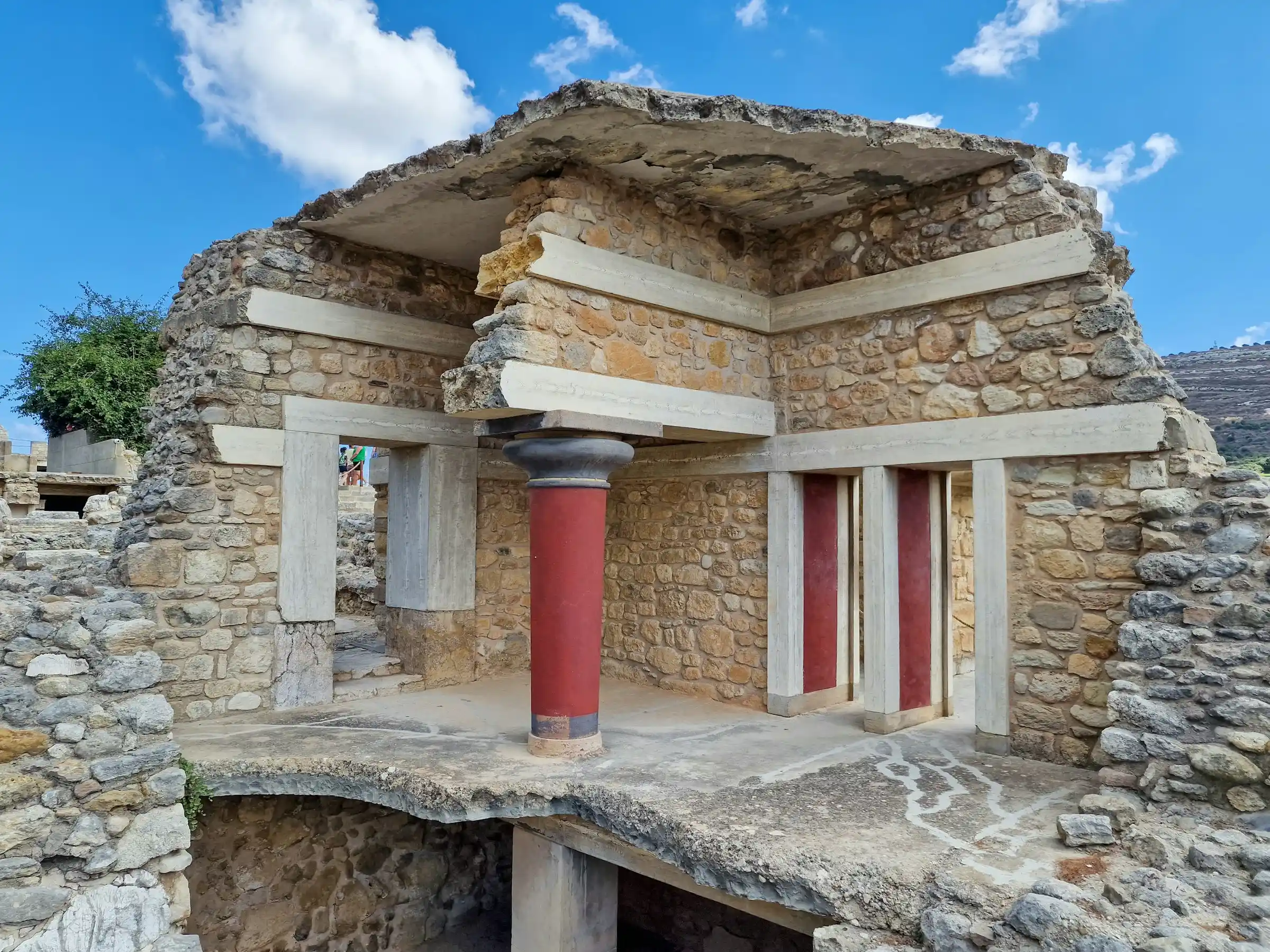
Much of what you see was partly rebuilt in the early 1900s by the British archaeologist Arthur Evans, who excavated the site and reconstructed sections in concrete and colour to show how they may have looked. His work is debated, but it makes the ruins far easier to picture. The highlights are:
- The Throne Room, with its alabaster seat and painted griffins, one of the oldest throne rooms in Europe.
- The Grand Staircase and the restored royal apartments on the east side.
- The North Entrance with its charging bull fresco and tall red columns.
- The Central Court, the open heart of the palace where ceremonies took place.
- The rows of storage jars, or pithoi, that held the wealth of the kingdom.
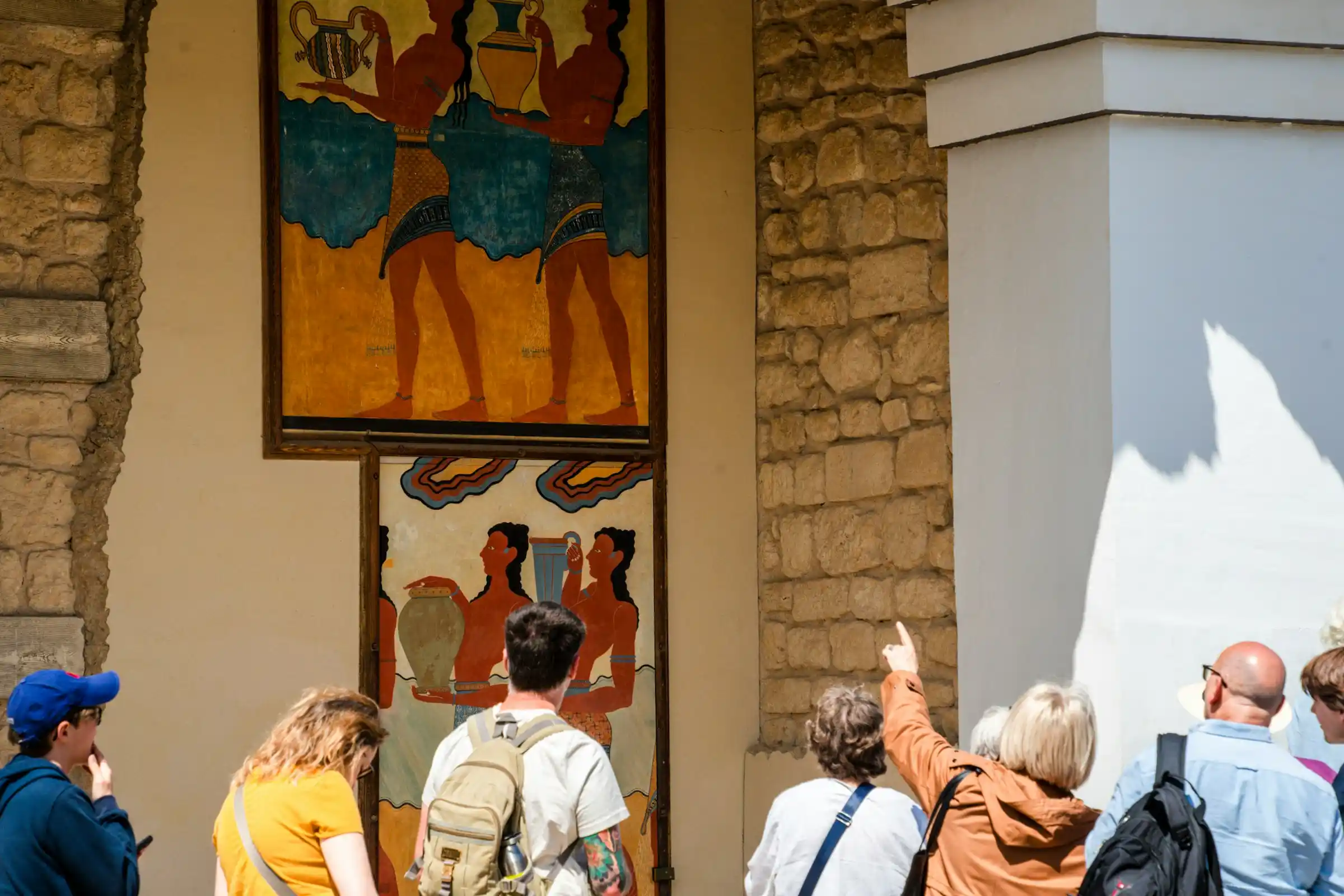
Many of the original frescoes and finds, including the Bull-Leaping fresco and the snake goddess figurines, are kept in the Heraklion Archaeological Museum in town. Seeing both together gives the fullest picture, so many visitors pair the two in one day.
Visiting Knossos: tickets and how to get there
Knossos sits about 5 kilometres south of Heraklion, the capital of Crete. City bus number 2 runs straight to the site from the centre and the port, and taxis are quick and cheap. By car there is paid parking nearby. A standard ticket covers the archaeological site, and a combined ticket with the Heraklion Archaeological Museum is better value if you plan to see both. Opening hours are longer in summer and shorter in winter, so check the current times before you go.
Tips for your visit
Go early or late in the day to avoid both the crowds and the midday heat, as there is very little shade on the hill. Bring water, a hat, and sturdy shoes for the uneven ground. A guide or an audio tour helps a great deal, because the signage is limited and the layout is confusing without context. Allow about two hours for the site, plus time for the museum. If you are island hopping in the Aegean, Crete pairs well with the quieter Cyclades covered in our guide to Milos, and history lovers will also enjoy the medieval towers of San Gimignano in Tuscany.
Frequently asked questions
Is Knossos worth visiting?
Yes. Knossos is the most important archaeological site on Crete and the centre of Europe’s first civilisation. The partial reconstructions make the ancient palace easy to picture, and paired with the Heraklion Archaeological Museum it is one of the best history visits in Greece.
How much time do you need at Knossos?
Plan on about two hours to walk the site at a comfortable pace, more with a guide. Adding the Heraklion Archaeological Museum, where the original frescoes and finds are kept, makes for a half-day or full-day outing.
Is Knossos the home of the Minotaur?
In legend, yes. Greek myth places the labyrinth of the Minotaur beneath the palace of King Minos at Knossos. The real building’s maze of rooms and corridors is thought to be the origin of that story, though no actual labyrinth has been found.
How do you get to Knossos from Heraklion?
Knossos is about 5 kilometres south of Heraklion. City bus number 2 runs there from the centre and the port, taxis are inexpensive, and there is paid parking for those driving. The trip takes around 20 minutes.
How old is the Palace of Knossos?
The great palace was built, destroyed, and rebuilt between roughly 1900 and 1350 BC, and the hill was settled even earlier in the Neolithic period. That makes Knossos more than 3,500 years old and the oldest city in Europe.
Can you visit Knossos and the Heraklion museum in one day?
Yes, and it is the best way to see both. The site shows the architecture, while the museum holds the original frescoes and artefacts. A combined ticket covers the two, and they are only a short bus ride apart.