Dorset is one of the best counties in England for walking, and its coastline is the headline act: the Jurassic Coast, England’s only natural World Heritage Site, where 185 million years of Earth history are laid bare in cliffs, coves and fossil beaches. Behind the coast rise the chalk ridges and rolling green hills of inland Dorset, laced with footpaths and crowned with hillforts and castle ruins. This guide picks the best walks in Dorset, from the famous coastal icons to quieter inland routes, with the practical details to plan your day.
| Walk | Distance | Difficulty | Highlight |
|---|---|---|---|
| Lulworth Cove to Durdle Door | About 3 km return | Short but steep | The Jurassic Coast’s famous arch |
| Studland to Old Harry Rocks | About 5 km | Easy, mostly flat | White chalk stacks; family-friendly |
| Golden Cap from Seatown or Charmouth | About 7–8 km | Good climb | Highest point on England’s south coast (191 m) |
| Corfe Castle circulars | Varies | Moderate ridge climbs | Castle ruins and Purbeck views |
Dorset walks in short
- Top walks: Lulworth Cove to Durdle Door, Studland to Old Harry Rocks, Golden Cap and the Corfe Castle circulars lead the list.
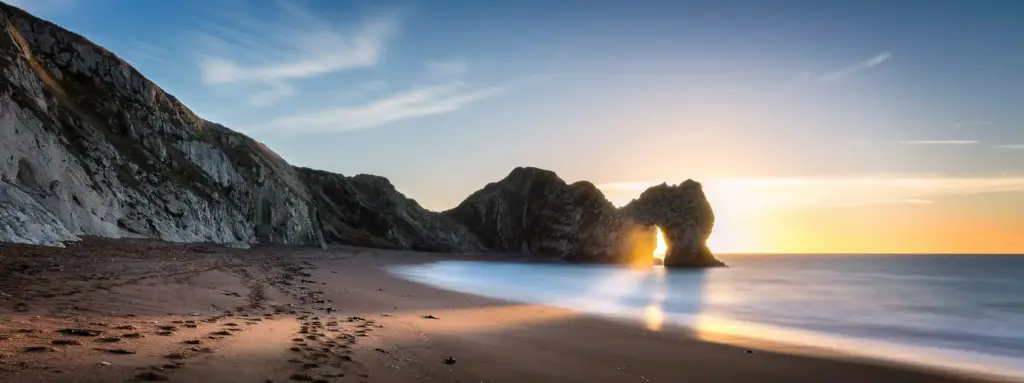
- Durdle Door: The round trip from Lulworth Cove is around 3 km, short but with a sharp climb and plenty of steps.
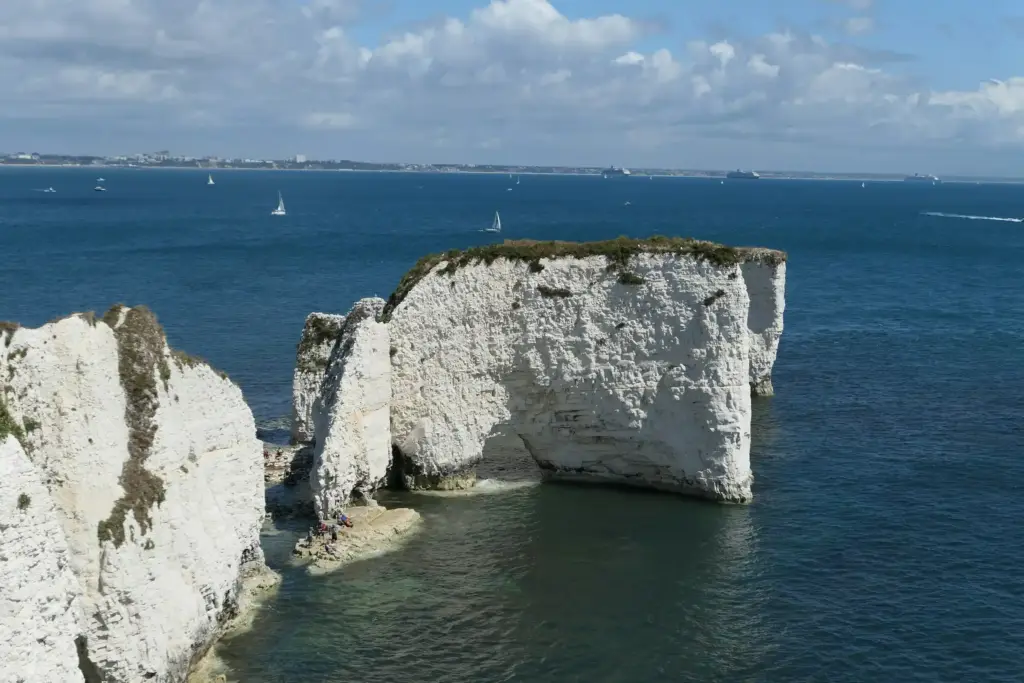
- Easy walk: Studland to Old Harry Rocks is around 5 km and mostly flat, making it one of Dorset’s best family-friendly coastal walks.
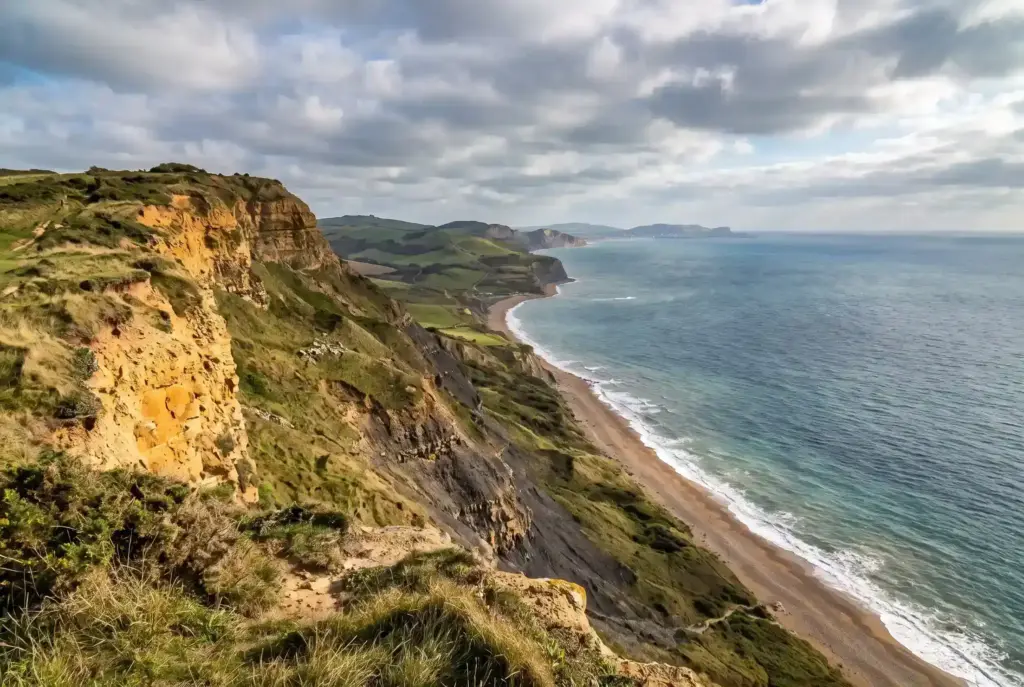
- Golden Cap: The 7 to 8 km circular from Seatown or Charmouth climbs to 191 m, the highest point on England’s south coast.
- Safety: Stay on marked paths, keep away from eroding cliffs, check tide times and arrive early, because summer parking fills fast.
Durdle Door and Lulworth Cove
The most famous walk in Dorset links two of the coast’s natural wonders. From Lulworth Cove, an almost perfectly circular bay carved by the sea, a steep path climbs the cliff to the celebrated limestone arch of Durdle Door — a round trip of around 3 km that is short but involves a sharp climb and plenty of steps. It is the postcard image of the Jurassic Coast and, inevitably, busy; walk it early or out of season for the best of it, and extend along the coast path toward Bat’s Head and Swyre Head for far fewer people.
Old Harry Rocks and Studland
At the eastern end of the Jurassic Coast, an easy, mostly flat walk of around 5 km from Studland leads to Old Harry Rocks, a line of brilliant white chalk stacks and a sea arch marking the point where the chalk ridge dives into the sea. The gentle gradient and huge views make it one of the best family-friendly coastal walks in Dorset, and it can be combined with the sweeping sands of Studland Bay.
Golden Cap and the west Dorset coast
For a bigger coastal day, Golden Cap near Charmouth is the highest point on the entire south coast of England at 191 m, with a glorious panorama along the Jurassic Coast from its flat, golden-sandstone top. The circular from Seatown or Charmouth is around 7–8 km with a good climb. The fossil beaches of Lyme Regis and Charmouth below are among the best places in Britain to find ammonites — collect only from the beach and loose rock, never the cliffs, which are unstable.
Corfe Castle and the Isle of Purbeck
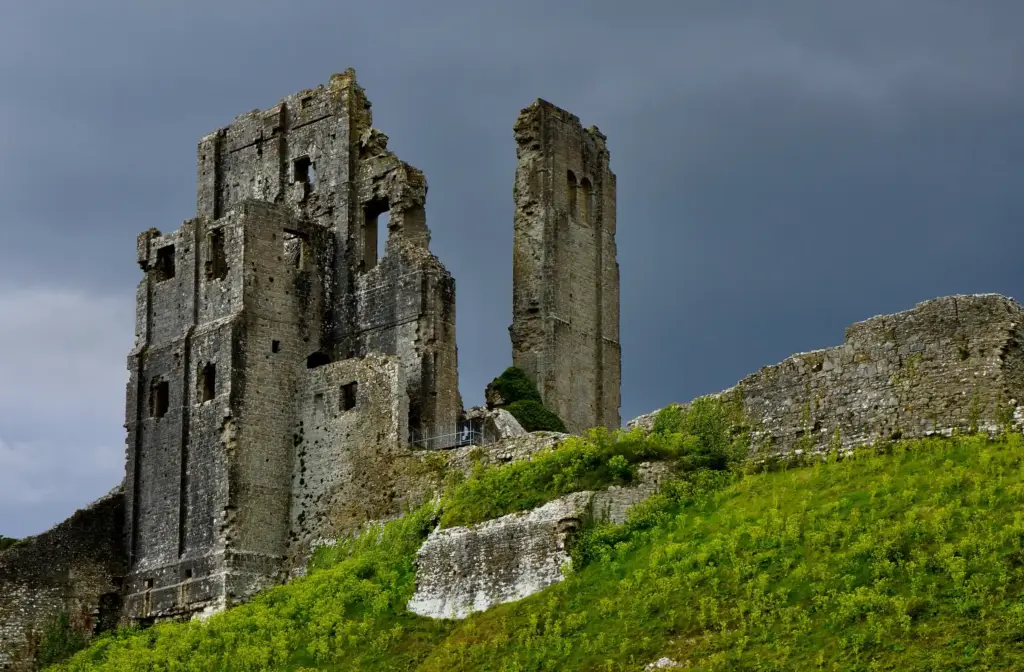
Inland from the coast, the dramatic ruins of Corfe Castle rising from a gap in the Purbeck Hills are the centrepiece of some of Dorset’s finest walking. Circular routes from Corfe village climb the ridge for superb views over the castle and across Purbeck, and longer walks link to Swanage, Kimmeridge Bay and the switchback cliffs of St Aldhelm’s Head. The Dorset Ridgeway and the ancient hillfort of Maiden Castle near Dorchester offer rolling chalk-downland walking away from the coast.
Planning your Dorset walk: tides, fossils and safety
Stay on marked paths, keep away from eroding cliffs, check tide times, and arrive early because parking at Lulworth, Durdle Door and Studland fills fast in summer.
A few practicals keep you safe and spare the queues. The Jurassic Coast cliffs are actively eroding, so stay on marked paths, keep well back from cliff edges and bases, and never dig into the cliffs when fossil hunting — the best finds wash out onto the beach, especially after winter storms, and you should check tide times so you are not cut off beneath the cliffs. Parking at Lulworth, Durdle Door and Studland fills fast in summer and on fine weekends, so arrive early or use park-and-ride and bus links where they exist. The coast path is undulating and can be slippery, so wear proper footwear and carry waterproofs and water. Spring to autumn gives the best conditions, and — as ever on this coast — the simplest way to escape the crowds is to walk a little further along the path. If you prefer fells to cliffs, our guide to the best Yorkshire Dales walks covers waterfalls and classic trails. Prefer lakes and mountains to cliffs? Our guide to the best Lake District walks starts with easy routes and big views.
Lulworth Ranges walks and Tyneham access
The Lulworth Ranges walks are open to the public only when the Ministry of Defence is not firing, which is mostly at weekends. Gates normally open as close to 4.30pm on Friday as range clearance and weather allow, and stay open until 8am on Monday.
The ranges cover the coast between Lulworth Cove and Kimmeridge Bay. They hold Tyneham, the village evacuated in 1943, and Worbarrow Bay, a quiet beach with few of the crowds at Durdle Door. Public access is along the South West Coast Path and several waymarked circular routes. Parking is at Tyneham and Whiteway. The Tyneham village gate opens at 9am when no military activity is under way and closes at dusk, and the school and church exhibitions open from 10am to 4pm on non-firing days.
Check these points before you set out:
- Closed weekends in 2026: 17 to 18 January, 14 to 15 March, 13 to 14 June, 12 to 13 September, 10 to 11 October and 14 to 15 November.
- Open every day: Easter (28 March to 12 April), 2 to 4 May, 23 to 31 May, 25 July to 31 August, and 21 December 2026 to 3 January 2027.
- Red flags by day and red lamps at night mean live firing, so access is prohibited whatever the published times.
- Stay inside the red and white poles that mark the range boundary, and never touch military debris. Note where you saw it and tell the police or a Training Safety Officer.
- Firing times change at short notice. Check the monthly Lulworth firing notice on GOV.UK, or phone 0800 085 6628 or 01929 404712 on weekdays from 8am to 5pm.
Last checked: November 2026.
Walking the Jurassic Coast: how far it runs
The Jurassic Coast is a 95-mile World Heritage Site that runs from Exmouth in Devon to Studland in Dorset, so the walks above sit near its eastern end. Old Harry Rocks marks the eastern limit, and Lulworth Cove, Golden Cap and Lyme Regis all fall inside it.
Most of these routes use the South West Coast Path, which is waymarked with an acorn sign. That makes it easy to join two of the walks above into a longer day, for example Lulworth Cove towards Worbarrow Bay when the ranges are open, or Seatown to Charmouth along the cliffs of west Dorset. Plan any one-way stretch around bus or taxi returns, because coast paths seldom loop back on themselves. For a longer coastal walk in west Wales, our Pembrokeshire Coast Path guide breaks the route into sections.
Frequently asked questions
What is the best walk in Dorset?
The Lulworth Cove to Durdle Door walk is the most famous — a short but steep clifftop route linking two natural wonders of the Jurassic Coast. For a gentler classic, the Studland to Old Harry Rocks walk is hard to beat, and Golden Cap offers the best big-view coastal day.
How far is the walk from Lulworth Cove to Durdle Door?
It is about 3 km (under 2 miles) return from Lulworth Cove to Durdle Door, but it involves a steep climb and many steps up and over the cliff, so it feels tougher than the distance suggests. Allow around an hour or so plus time at the arch.
Where is the best fossil hunting in Dorset?
The beaches at Lyme Regis and Charmouth on the west Dorset coast are among the best places in Britain to find fossils such as ammonites. Collect only from the beach and loose rock — never dig into the cliffs, which are unstable — and check the tides so you are not cut off.
Is the Old Harry Rocks walk easy?
Yes. The walk from Studland to Old Harry Rocks is about 5 km, mostly flat and on good paths, with gentle gradients and big sea views, which makes it one of the best family-friendly coastal walks in Dorset.
Where can I walk near Corfe Castle?
Circular walks from Corfe Castle village climb the Purbeck ridge for superb views over the castle ruins, and longer routes link to Swanage, Kimmeridge Bay and St Aldhelm’s Head. The area is one of the finest walking bases in Dorset, combining coast and downland.