Borobudur is the largest Buddhist monument in the world, a vast stone pyramid rising out of the jungle and rice fields of central Java. It was built more than a thousand years ago, lost for centuries under volcanic ash and plant growth, and recovered only in the 19th century. This guide covers what Borobudur is, who built it and why, the meaning hidden in its design, how it was rediscovered, and how to visit it today.
What Borobudur is
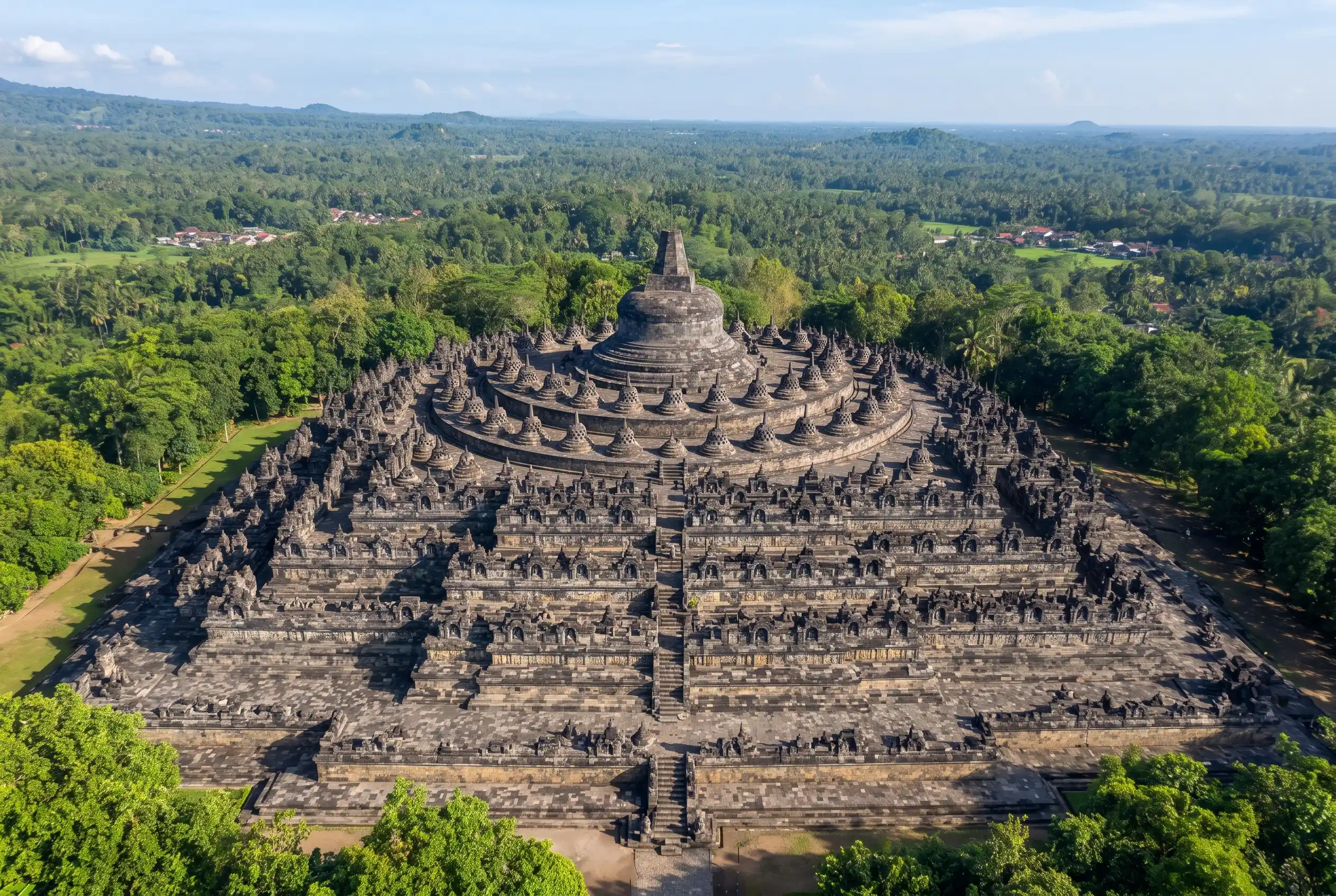
Borobudur sits near Magelang, about an hour and a half from the city of Yogyakarta in Central Java, Indonesia. It is a single massive structure built from around two million blocks of volcanic andesite stone, laid without mortar over a natural hill. Rather than a temple you enter, it is a monument you climb, a stepped pyramid of nine stacked platforms crowned by a central dome, decorated with more relief panels and Buddha statues than any comparable site on earth. UNESCO added it to the World Heritage list in 1991.
Who built it and when
Borobudur was built in the 8th and 9th centuries, roughly between 780 and 840 AD, under the Sailendra dynasty, which ruled central Java at the time. It is a Mahayana Buddhist monument, raised during a period when Buddhism and Hinduism both flourished on the island, which is why the great Hindu temple of Prambanan stands not far away and from a similar era. The exact purpose is still debated, but it was clearly a place of pilgrimage, designed to be walked and read rather than simply admired.
The design and its meaning
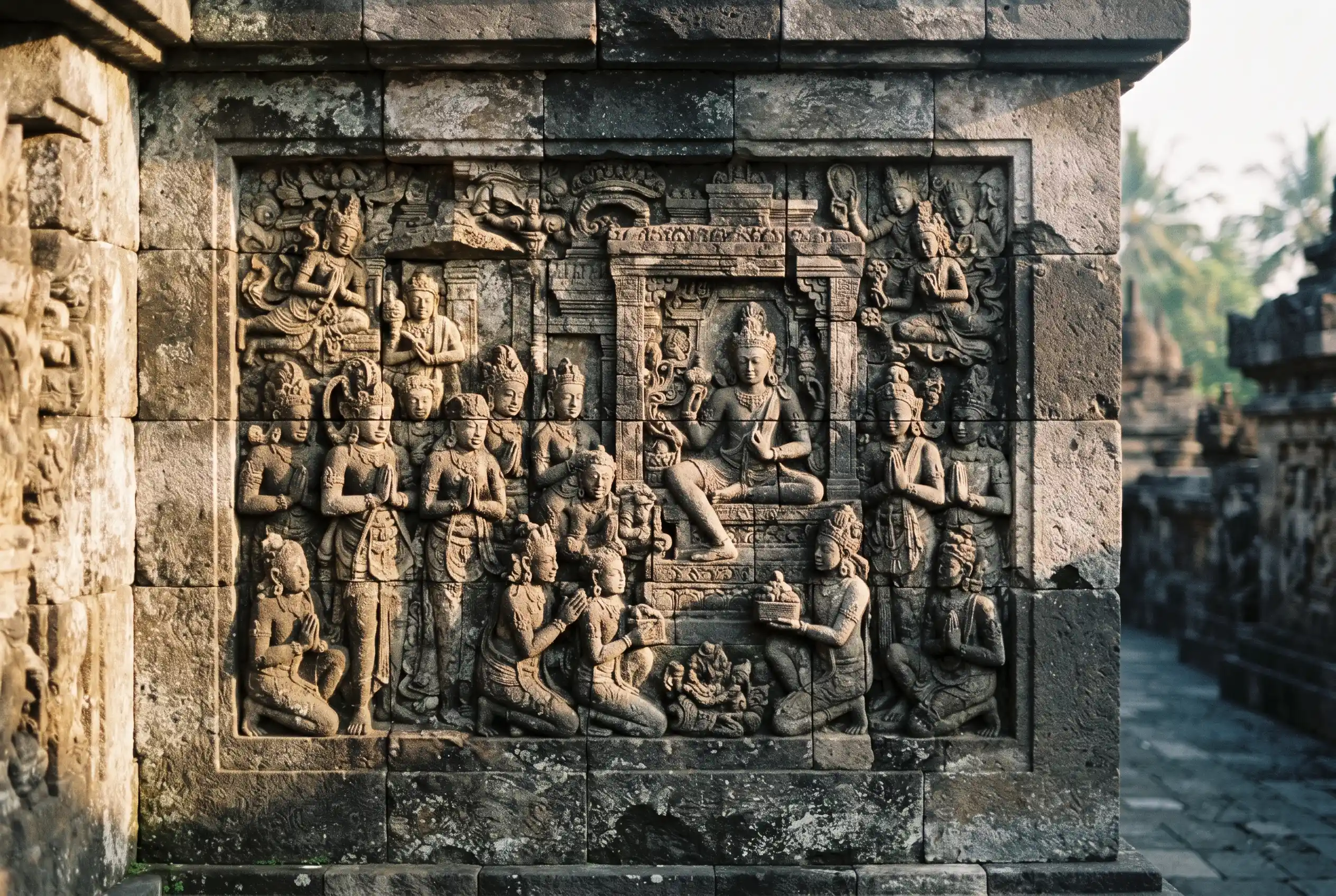
The structure is a three dimensional map of the Buddhist path. It has three levels that represent the three realms of existence. The hidden base and lower galleries stand for Kamadhatu, the world of desire. The five square terraces above represent Rupadhatu, the world of forms, their walls lined with carved stories. The three circular terraces near the top represent Arupadhatu, the formless world, open and plain by contrast. Pilgrims walk clockwise around each level, climbing gradually, so that the journey up the monument mirrors the spiritual journey towards enlightenment.
The numbers are staggering: 2,672 relief panels that together form the longest and most complete set of Buddhist reliefs in the world, and 504 Buddha statues. On the upper circular terraces stand 72 bell shaped perforated stupas, each with a seated Buddha inside, visible through the stone latticework. The whole thing is best understood slowly, which is why a guide or a good read beforehand adds a lot.
Lost and rediscovered
Borobudur was abandoned around the 14th century, as power shifted east on Java and the island gradually converted to Islam, helped along by volcanic eruptions that may have driven people away. It sat buried under ash and jungle for centuries. In 1814, during the brief British rule of Java, Sir Thomas Stamford Raffles heard of a great monument in the interior and sent a surveyor to uncover it. Major restorations followed, first by the Dutch engineer Theodoor van Erp in the early 1900s, and then a huge UNESCO backed project between 1975 and 1982 that dismantled and rebuilt the lower terraces to save them. That the monument stands so complete today is the result of that work.
Visiting Borobudur today
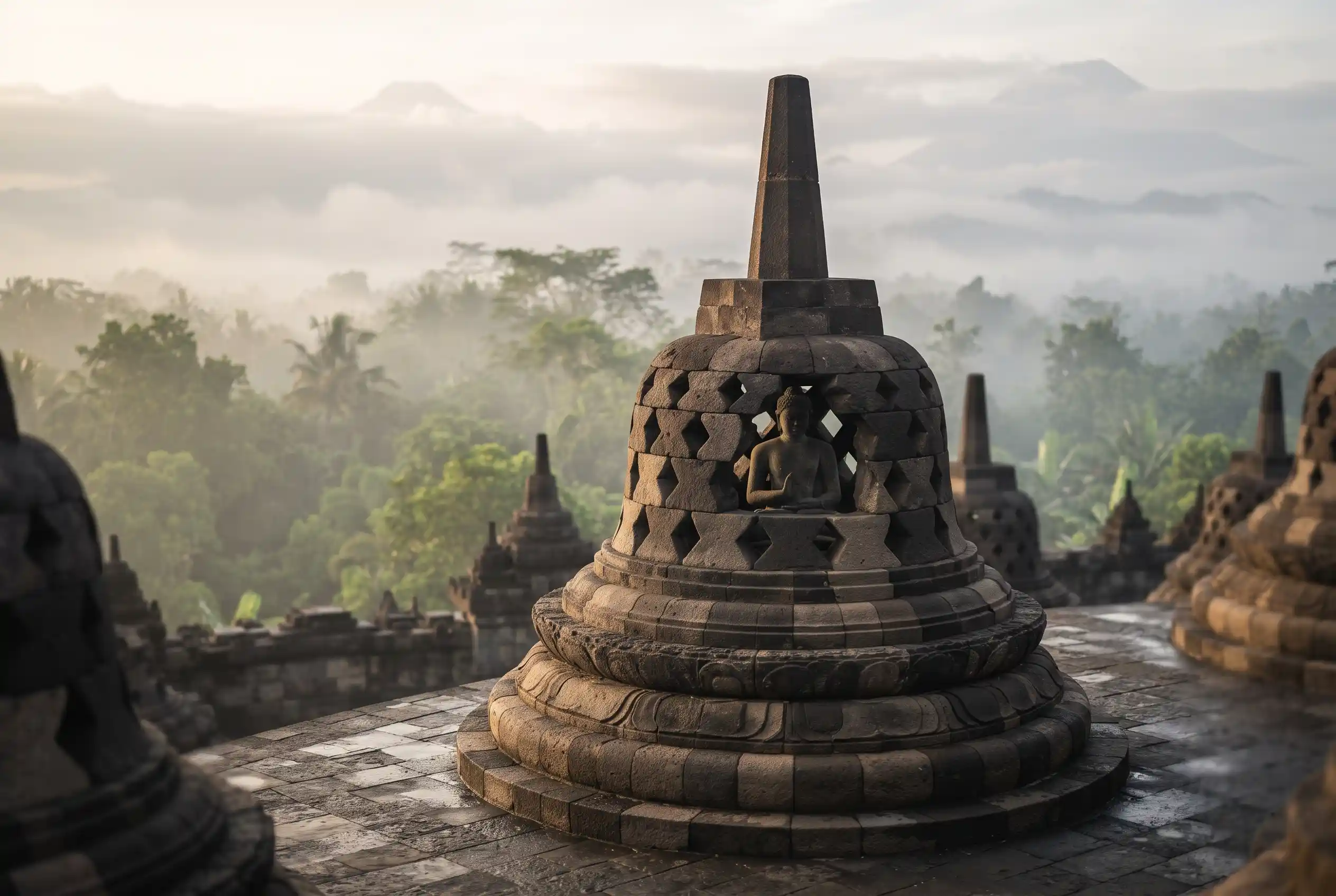
Most visitors base themselves in Yogyakarta and come for sunrise, when mist lies over the surrounding jungle and the volcano Merapi often shows on the horizon. In recent years, to protect the ancient stone, the number of people allowed to climb the monument itself has been limited, and climbing requires a timed ticket, a guide, and special sandals that are provided at the gate. You can still visit the grounds on a cheaper courtyard ticket without climbing. Because the rules and prices change, check the current options when you book. Borobudur pairs naturally with the nearby Hindu temple of Prambanan, and the two make a classic day out from Yogyakarta.
If you are combining Java with the rest of Indonesia, our guides to Bali’s temples and Kuta Beach cover the next island over. For another of Asia’s great temple complexes from the same broad era, see our guide to Angkor Wat. Before you fly, our packing list tool helps with the early start and the sun. For official information, see the UNESCO listing for the Borobudur Temple Compounds and Wonderful Indonesia.
Best time to visit
The dry season from April to October is the most reliable time, with clearer skies for sunrise. Whatever the season, the first slot of the morning gives the softest light, the coolest stone, and the smallest crowds. Allow a couple of hours at the monument, more if you add Prambanan the same day.
Frequently asked questions
Where is Borobudur?
Borobudur is in Central Java, Indonesia, near the town of Magelang and about an hour and a half from Yogyakarta, which is the usual base for visiting. It is the largest Buddhist monument in the world.
Who built Borobudur and when?
It was built in the 8th and 9th centuries, around 780 to 840 AD, by the Sailendra dynasty of central Java. It is a Mahayana Buddhist monument designed as a place of pilgrimage.
Can you still climb Borobudur?
Yes, but access is limited to protect the stone. Climbing the monument now needs a timed ticket, a guide, and special sandals provided at the gate. A cheaper courtyard ticket lets you visit the grounds without climbing. Check current rules when booking.
How many Buddha statues are at Borobudur?
There are 504 Buddha statues and 2,672 relief panels. The upper circular terraces hold 72 bell shaped perforated stupas, each containing a seated Buddha visible through the stone latticework.
How was Borobudur rediscovered?
After being abandoned around the 14th century and buried under ash and jungle, it was uncovered from 1814 during the brief British rule of Java under Sir Thomas Stamford Raffles. Major restorations followed, including a large UNESCO backed project from 1975 to 1982.