Great Smoky Mountains National Park sits on the Tennessee–North Carolina border, covers 522,427 acres of old-growth forest, and draws more than 12 million visitors a year. It is the most visited national park in the United States by a wide margin, and yet large sections of it stay empty even on peak weekends.
The park charges no entrance fee. That fact alone changes how you plan a trip here compared to Yellowstone, Zion, or the Grand Canyon. What does cost money — and what most first-time visitors miss — is the parking tag, the campsite reservation, and the backcountry permit. This guide covers the logistics that the official NPS pages scatter across dozens of subpages, and the practical timing and routing that government sites never publish.
Why the Smokies pull 12 million people a year
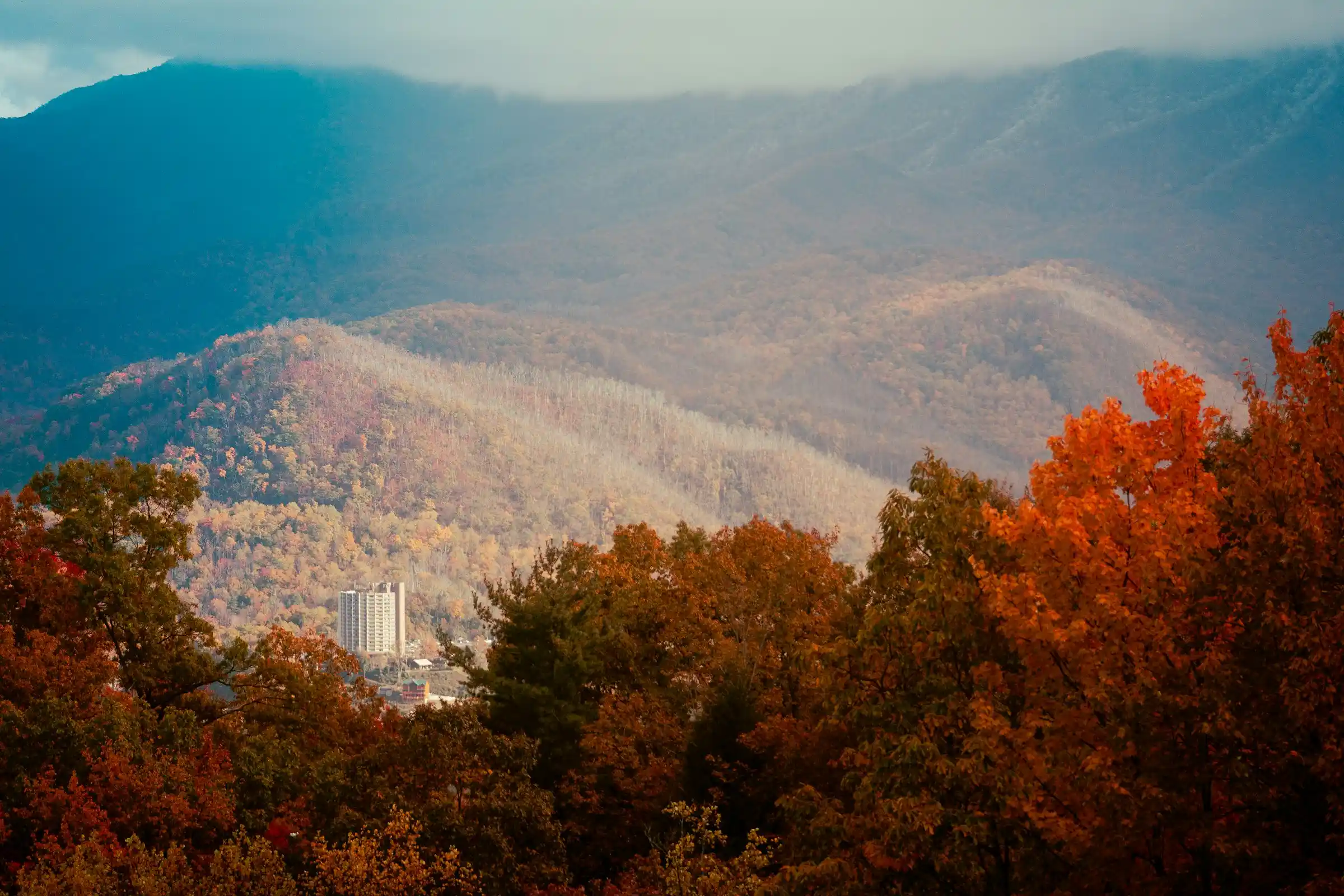
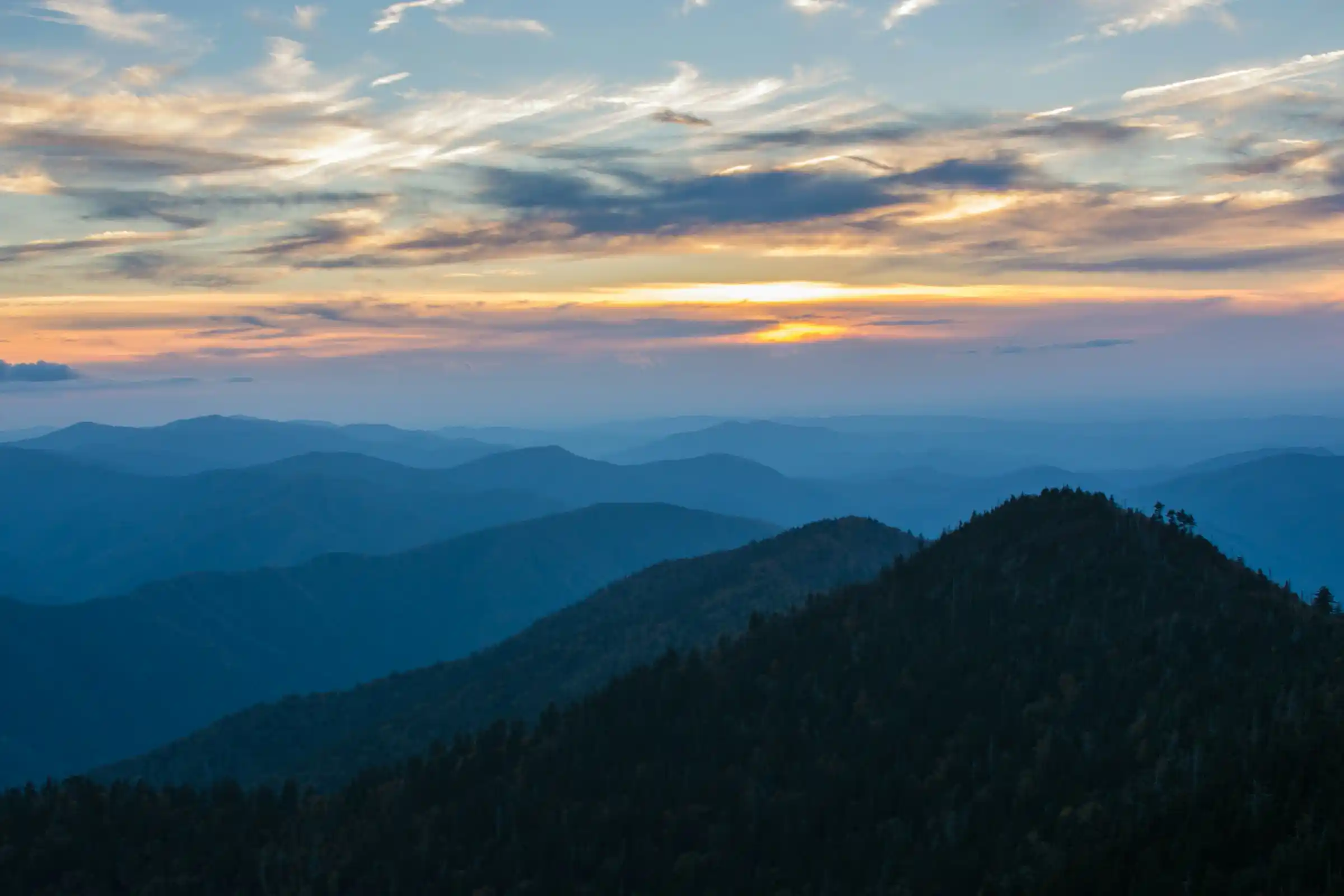
The Great Smoky Mountains hold more tree species than all of northern Europe. They contain the largest block of old-growth temperate forest in eastern North America. The “smoke” is real — a natural hydrocarbon haze released by the vegetation that gives the ridges their blue, layered look at distance.
More than 1,600 species of flowering plants grow here, along with 200 species of birds, 66 species of mammals (including roughly 1,500 black bears), and more salamander species than anywhere else on the planet. The park is a UNESCO World Heritage site and an International Biosphere Reserve.
But the real reason people come is access. The park is within a day’s drive of roughly one-third of the US population. No entrance fee. Over 800 miles of trails. Campgrounds that cost $25 to $36 a night. And two gateway towns — Gatlinburg on the Tennessee side and Cherokee on the North Carolina side — that offer lodging, food, and supplies within minutes of major trailheads.
What it actually costs
Great Smoky Mountains National Park has no entrance fee, but it is not free to visit. Since 2023, all vehicles stopping at trailheads, picnic areas, and other park facilities need a parking tag. Here is what you will pay.
- Daily parking tag. $5 per vehicle, valid for one calendar day.
- Weekly parking tag. $15 per vehicle, valid for seven consecutive days.
- Annual parking tag. $40 per vehicle, valid 12 months from purchase.
- America the Beautiful Annual Pass. $80, covers the parking tag here and entrance fees at every other national park. If you plan to visit two or more fee-charging parks in a year, the annual pass saves money — use our national parks pass planner to check whether it is worth it for your specific itinerary.
- Frontcountry camping. $25 to $36 per night depending on the campground. Reserve at recreation.gov up to six months ahead.
- Backcountry camping. Free with a permit, self-registered online at the NPS site or at a ranger station.
- LeConte Lodge. The only non-camping lodging inside the park. Rates start around $170 per adult per night, meals included. It books out months in advance — often a year for peak fall dates. You hike in; there is no road.
For a realistic three-day visit, budget $15 for the parking tag, $25 to $36 per night for a campsite, and your fuel and food. If you stay in Gatlinburg or Cherokee instead of camping, hotel rooms typically run $120 to $300 per night depending on season and how early you book.
The best hikes
The park has 849 miles of maintained trails, from flat riverside strolls to steep ridge climbs. These are the ones worth prioritising.
Alum Cave Trail to Mount LeConte
The signature hike. The trail climbs 2,763 feet over 5.5 miles to the summit of Mount LeConte, the third-highest peak in the park. The first two miles pass Arch Rock and Alum Cave Bluffs, a massive overhanging cliff face. Most day hikers turn around at the bluffs (4.4 miles round trip). The full summit push is strenuous but rewards with views from Cliff Top and Myrtle Point.
Charlies Bunion via the Appalachian Trail
Start at Newfound Gap and hike 4 miles along the Appalachian Trail to Charlies Bunion, a rocky outcrop with unobstructed views of the main ridge. The trail follows the Tennessee–North Carolina state line at roughly 5,000 feet. Elevation changes are moderate. This is one of the best ridge walks in the eastern United States.
Ramsey Cascades
Eight miles round trip to the tallest waterfall in the park, a 100-foot cascade dropping over a moss-covered rock face. The trail follows the Middle Prong of the Little Pigeon River through old-growth forest. The final two miles are rocky and steep. Start early — the parking area fills by mid-morning from June through October.
Laurel Falls
The most accessible waterfall in the park: 2.6 miles round trip on a paved trail. The 80-foot waterfall is worth seeing, but the trail is heavily crowded, especially on weekends. Go before 8 a.m. or after 4 p.m.
Andrews Bald
A 3.6-mile round trip from the Kuwohi (Clingmans Dome) parking area to a high-elevation grassy bald with sweeping views. One of only two maintained balds in the park. Less crowded than the Kuwohi observation tower itself.
Scenic drives worth the time
Not every highlight requires a hike. Three drives give you the park’s range without leaving your car.
Newfound Gap Road (US 441)
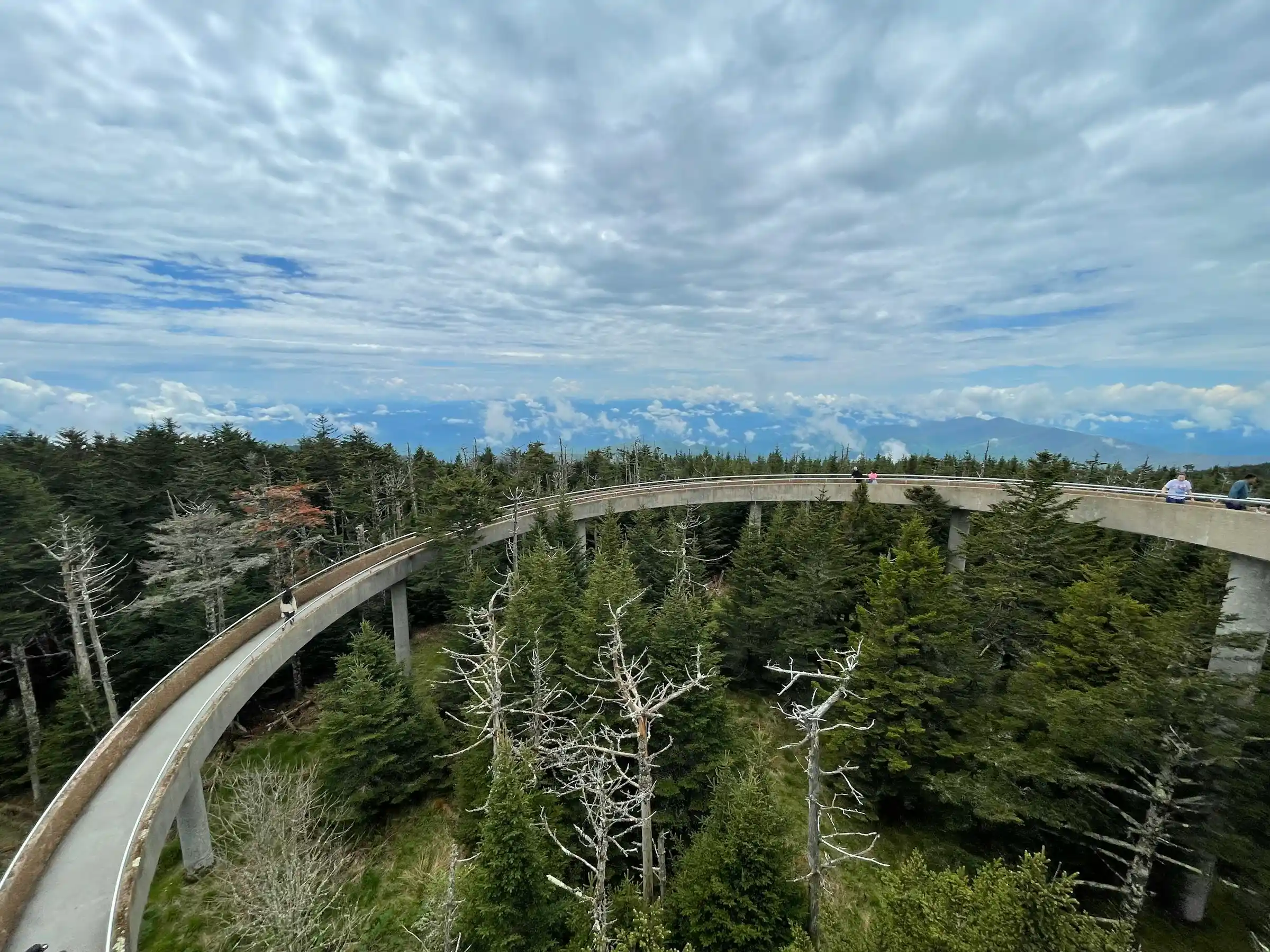
The only road that crosses the park, running 31 miles from Gatlinburg to Cherokee. It climbs to 5,046 feet at Newfound Gap, where you can stand on the state line and look into both Tennessee and North Carolina. From Newfound Gap, a seven-mile spur road leads to the Kuwohi observation tower at 6,643 feet — the highest point in the park accessible by car. Allow 90 minutes for the full crossing without stops.
Cades Cove Loop Road
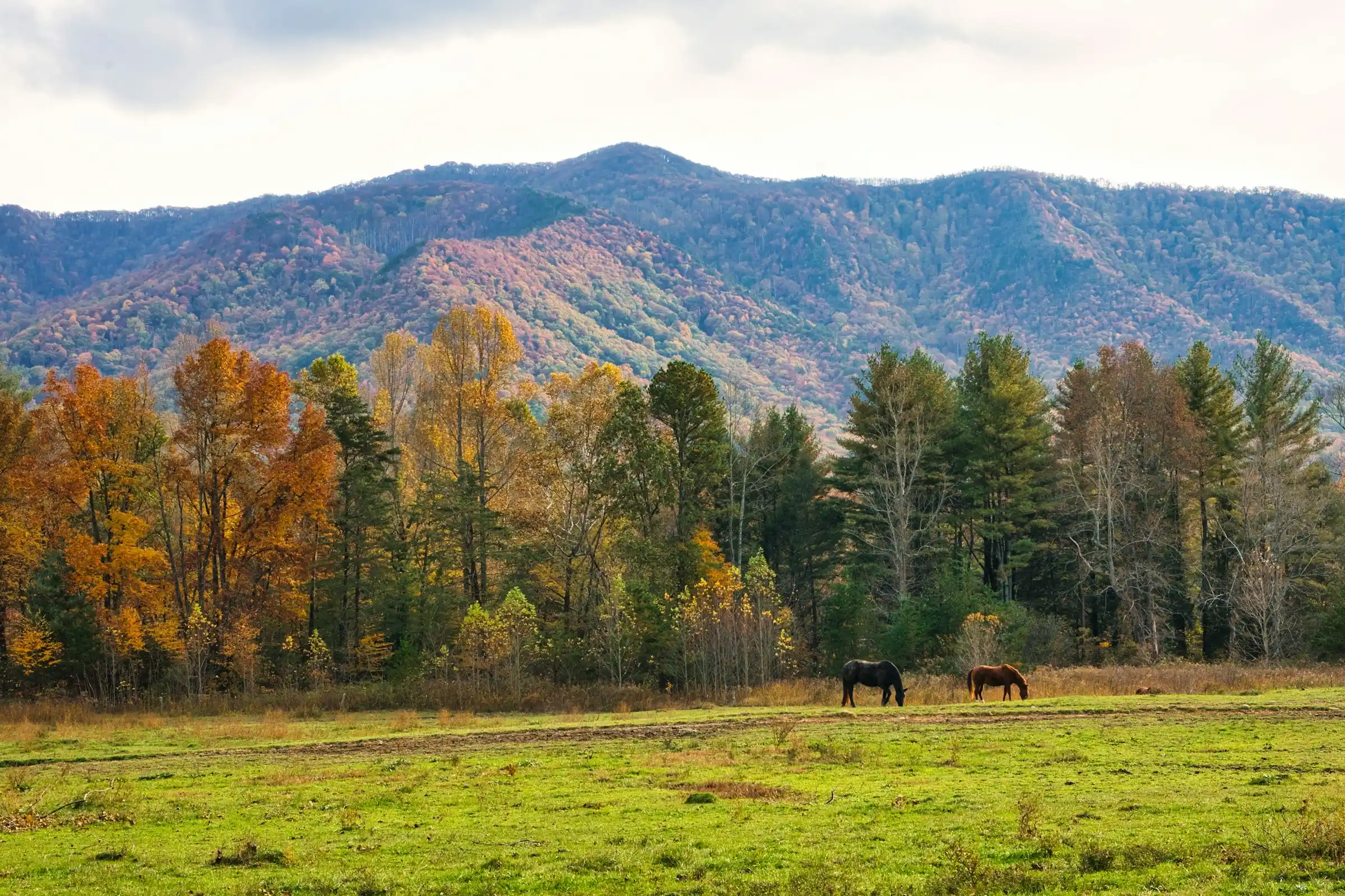
An 11-mile one-way loop through a broad valley on the Tennessee side. Historic cabins, churches, and a working gristmill line the road. White-tailed deer are everywhere; black bears are common in spring and fall. The loop regularly takes two to three hours because of traffic. Visit early on a weekday morning, or go on a Wednesday or Saturday before May 6 when the loop is closed to motor vehicles and open to cyclists and walkers only.
Roaring Fork Motor Nature Trail
A narrow, one-way loop off Historic Nature Trail Road near Gatlinburg. Old-growth hemlocks, rushing streams, and trailheads for Grotto Falls and Rainbow Falls. Closed in winter.
Wildlife and where to find it
The park is home to roughly 1,500 black bears, which means an average density of about two bears per square mile. You are most likely to see them in Cades Cove at dawn or dusk, along Roaring Fork Motor Nature Trail, and in the Cataloochee Valley on the North Carolina side.
Cataloochee also has a reintroduced elk herd, now numbering over 200 animals. The elk are most active at dawn and dusk in the open fields around the valley. Fall rutting season (September through October) is the best time — bulls bugle and spar in full view of the road.
The synchronous fireflies in Elkmont are the park’s most famous wildlife event. For two weeks in late May to early June, thousands of Photinus carolinus fireflies flash in unison. Access is by lottery only through recreation.gov, and demand far exceeds capacity. Enter the lottery in late April.
Two rules apply everywhere: stay at least 50 yards from bears and elk, and never feed or approach wildlife. The park issues fines starting at $150 for violations.
The North Carolina side most people miss
Most visitors enter from Gatlinburg on the Tennessee side. The North Carolina entrances are quieter, less developed, and worth the detour.
Cataloochee Valley
A remote, largely unpaved-road valley in the park’s eastern corner. It has the elk herd, several well-preserved historic buildings, excellent trout fishing, and a fraction of the crowd that Cades Cove draws. The drive in is long and winding — roughly 40 minutes from I-40 on a narrow gravel road — which is exactly why it stays uncrowded.
Deep Creek
Near Bryson City, North Carolina. Three waterfalls within two miles of the trailhead, plus a stretch of calm water popular for tubing in summer. Deep Creek Campground is one of the park’s most pleasant, and the nearby town of Bryson City is a good base that is far cheaper than Gatlinburg.
Oconaluftee Visitor Center and Mountain Farm Museum
The main North Carolina entrance, just outside Cherokee. The open-air farm museum is a collection of original 19th-century log buildings moved here from various locations in the park. Free to visit. The adjacent Mingus Mill, a working water-powered gristmill, runs demonstrations from spring through fall.
Best time to visit
The Great Smoky Mountains are open year-round, but access, crowds, and conditions change dramatically by season.
Spring (April through mid-June) brings wildflowers — the park’s biodiversity peaks with over 1,500 species blooming in sequence from the valleys upward. Crowds are moderate. The synchronous firefly event falls in late May to early June. Some higher-elevation roads (Clingmans Dome Road, Balsam Mountain Road) stay closed until late May or early June depending on weather.
Summer (mid-June through August) is peak season. Expect full parking lots by 9 a.m. at popular trailheads, heavy traffic on Cades Cove loop, and afternoon thunderstorms most days. Temperatures in the valleys hit 85 to 90°F, but ridgeline trails at 5,000+ feet stay 10 to 15 degrees cooler.
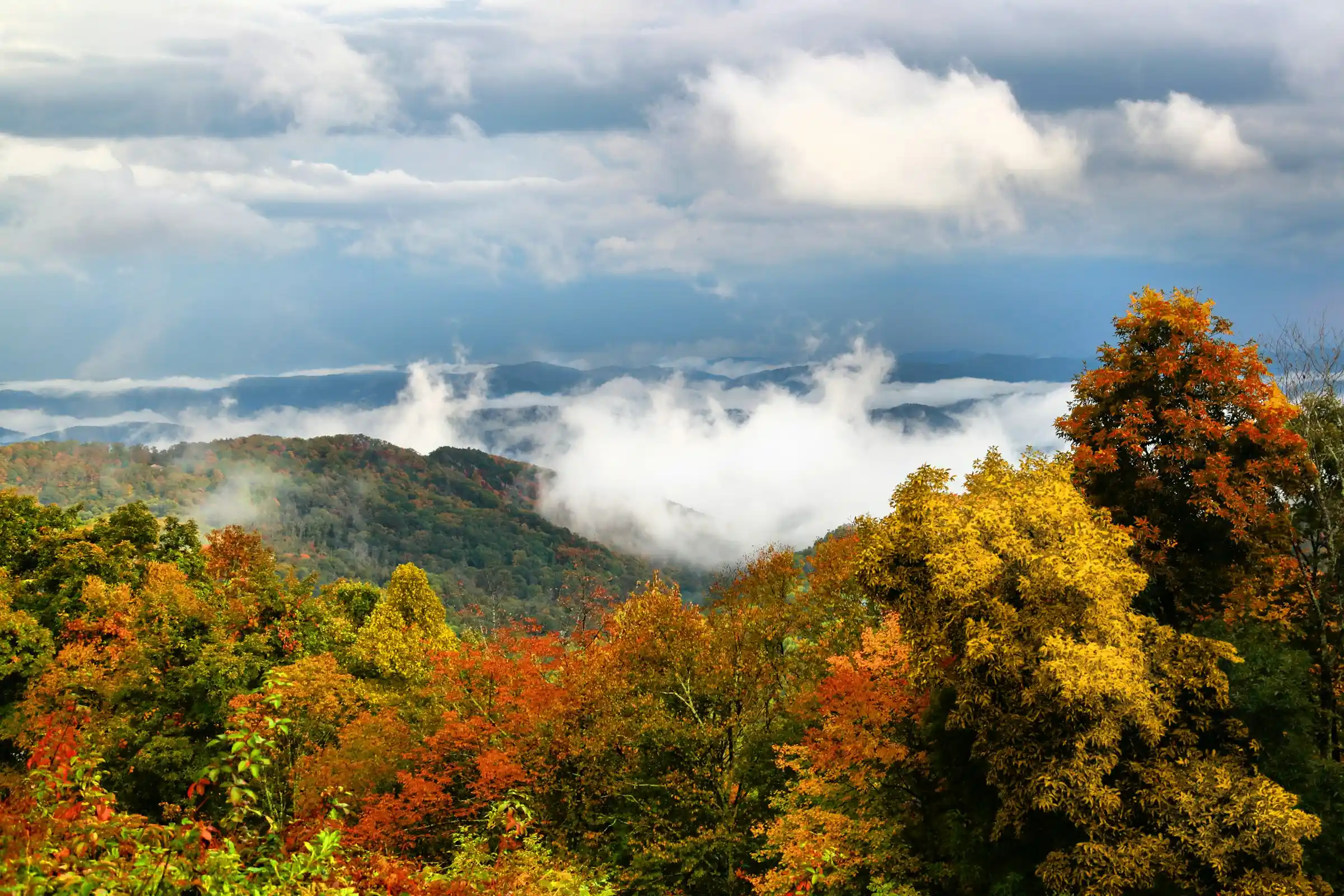
Fall (September through early November) is the best time for most visitors. Crowds thin after Labor Day, then spike again for fall foliage in mid-October through early November. Color starts at the highest elevations in late September and works its way down. The elk rut in Cataloochee peaks in late September through October.
Winter (December through March) is the quietest season. Many secondary roads and campgrounds close. Newfound Gap Road stays open but may close temporarily for snow and ice. Trails above 4,000 feet can be icy or snow-covered. If you are prepared for cold weather, winter offers solitude that the park never provides in other seasons.
How to get there
The park has no public transit, no shuttle system (except the Elkmont firefly trolley during the lottery event), and no rail service. You need a car.
From Knoxville, Tennessee (McGhee Tyson Airport, TYS)
The closest major airport. Drive time to the Sugarlands Visitor Center (Tennessee entrance) is about 45 minutes. This is the most convenient option for most visitors.
From Asheville, North Carolina (Asheville Regional Airport, AVL)
About 1.5 hours to the Oconaluftee Visitor Center (North Carolina entrance) via I-40 and US-19. A good option if you want to combine the Smokies with the Blue Ridge Parkway or Asheville itself.
From Atlanta, Charlotte, or Nashville
All three are roughly three to four hours by car. Nashville and Charlotte have direct flights from most US cities. Atlanta’s Hartsfield-Jackson is the busiest US airport and often the cheapest option for international travellers.
Cell coverage inside the park is patchy at best. Download offline maps before you arrive. Google Maps and AllTrails both allow offline downloads of the park area.
Where to stay
You have three broad options: camp inside the park, stay in a gateway town, or book a cabin in the surrounding mountains.
Camping inside the park
The park operates nine frontcountry campgrounds. Elkmont, Cades Cove, and Smokemont are the largest and most popular — reserve these as early as possible at recreation.gov, especially for summer and fall weekends. Rates are $25 to $36 per night. All sites have picnic tables and fire rings. None have showers or electrical hookups.
Gateway towns
Gatlinburg and Pigeon Forge (Tennessee) offer the widest range of hotels, restaurants, and attractions — see our guide to the best things to do in Gatlinburg for recommendations. Cherokee (North Carolina) is smaller and less commercial, with the Museum of the Cherokee Indian and the Qualla Arts and Crafts Mutual nearby. Bryson City (North Carolina) is the quietest option and puts you close to Deep Creek and the Nantahala River.
Cabin rentals
Mountain cabins are the classic Smokies accommodation. Thousands are available in the hills around Gatlinburg, Pigeon Forge, and Townsend. Expect to pay $150 to $400+ per night depending on size, season, and how far in advance you book. Many have hot tubs, decks with mountain views, and full kitchens.
Practical tips and safety
- Parking fills early. Popular lots (Alum Cave, Laurel Falls, Cades Cove, Chimney Tops) fill by 8 to 9 a.m. on summer and fall weekends. Arrive before 8 a.m. or after 3 p.m.
- Bear safety. Carry bear spray if you are hiking backcountry. Store all food in bear-proof containers or hang it at least 10 feet off the ground. Never leave food in your car with the windows down.
- Weather changes fast. Temperatures at ridgeline can be 10 to 15°F cooler than in the valleys. Afternoon thunderstorms are routine in summer. Pack layers and rain gear even for a day hike.
- Water crossings. Several trails involve crossing streams. After rain, these can become dangerous. Check conditions at the visitor center before starting a hike that involves ford crossings.
- Cell coverage. Spotty to nonexistent inside the park. Tell someone your itinerary. Download maps offline.
- Pack your gear right. Use our packing list generator to build a list matched to the season and your planned activities.
Sample itineraries
One day from Gatlinburg
Drive Newfound Gap Road to the summit of Kuwohi (Clingmans Dome) in the morning. Hike the short paved trail to the observation tower. On the way back, stop at Newfound Gap for photos at the state line, then take Alum Cave Trail as far as the bluffs (4.4 miles round trip). End the day with sunset at Cades Cove or dinner in Gatlinburg.
Three days
Day 1: Sugarlands Visitor Center for maps and conditions. Drive Roaring Fork Motor Nature Trail. Hike Grotto Falls (2.6 miles round trip, walk behind the waterfall). Afternoon in Gatlinburg.
Day 2: Early start for Alum Cave Trail, either to the bluffs or the full LeConte summit. Afternoon on Newfound Gap Road, with stops at overlooks and a side trip to Kuwohi if the road is open.
Day 3: Cades Cove loop — arrive by 7 a.m. to avoid traffic. Walk to Abrams Falls (5 miles round trip) from the loop road. Drive to Cataloochee Valley for elk viewing at dusk if time allows (add 1.5 hours each way).
Five days (both sides of the park)
Add the North Carolina side. Day 4: Cross to Cherokee via Newfound Gap Road. Visit the Mountain Farm Museum and Mingus Mill. Hike Deep Creek to the three waterfalls. Stay in Bryson City. Day 5: Drive to Cataloochee Valley early for elk. Hike Boogerman Trail through old-growth forest. Return via I-40.
Conclusion
Great Smoky Mountains National Park asks very little of you — no entrance fee, no timed entry, no lottery for most trails — and gives back an unreasonable amount. The challenge is not getting in; it is knowing where to go and when to go there. Start early, stay on the ridge, and the park that 12 million people visit will feel like it belongs to you alone.
Frequently asked questions
Is Great Smoky Mountains National Park free?
There is no entrance fee. However, a parking tag is required for vehicles stopping at park facilities: $5 for a day, $15 for a week, or $40 for a year. The America the Beautiful Annual Pass ($80) also covers it.
What is the best month to visit the Smoky Mountains?
October for fall color and moderate crowds after Labor Day. April and May for wildflowers and lower prices. Summer is warmest but most crowded. Winter offers solitude but some roads and campgrounds close.
How many days do you need in the Smoky Mountains?
Three days is a solid minimum to cover the Tennessee-side highlights. Five days lets you explore both sides of the park, including the quieter North Carolina entrances and Cataloochee Valley.
What is the most popular hike in the Smokies?
Laurel Falls (2.6 miles round trip, paved) is the most walked trail. Alum Cave Trail to Mount LeConte is the most iconic longer hike. Both fill early on weekends — arrive before 8 a.m.
Can you see bears in the Great Smoky Mountains?
Yes. The park has roughly 1,500 black bears. Cades Cove, Cataloochee Valley, and Roaring Fork Motor Nature Trail are the most reliable viewing areas. Keep at least 50 yards of distance at all times.
Where should I stay near Great Smoky Mountains?
Gatlinburg for convenience and nightlife, Townsend for a quieter Tennessee-side base, Cherokee or Bryson City for the North Carolina side. Cabin rentals in the hills around Gatlinburg and Pigeon Forge are the most popular option for families and groups.