Of all the temples at Angkor, Ta Prohm is the one that stops people in their tracks. While the others were cleared and restored, this one was deliberately left in the grip of the jungle, its galleries cracked open by the roots of giant trees that have grown over and through the stone for centuries. It is also the temple most people know from the film Tomb Raider. This guide covers what Ta Prohm is, who built it, the trees that made it famous, the truth behind the dinosaur carving, and how to visit.
What Ta Prohm is
Ta Prohm sits within the Angkor Archaeological Park near Siem Reap in Cambodia, about a kilometre east of the walled city of Angkor Thom and a short drive from Angkor Wat. It is a sprawling, low lying complex of courtyards, corridors, and towers rather than a tall mountain temple, which is part of why the trees have been able to colonise it so completely. Visiting it feels less like touring a monument and more like exploring a ruin that nature is slowly reclaiming.
Who built it and why
Ta Prohm was begun in 1186 by King Jayavarman VII, the great builder king of the Khmer Empire, who also raised the Bayon and much of Angkor Thom. Its original name was Rajavihara, the monastery of the king, and it was built as a Mahayana Buddhist monastery and place of learning, dedicated to his mother. Its sister temple, Preah Khan, was dedicated to his father. Stone inscriptions found at the site record that it was no quiet retreat: in its prime it housed and was supported by tens of thousands of people, from priests and dancers to the villagers of the surrounding estates, along with a treasury of gold and precious stones.
The trees that took over
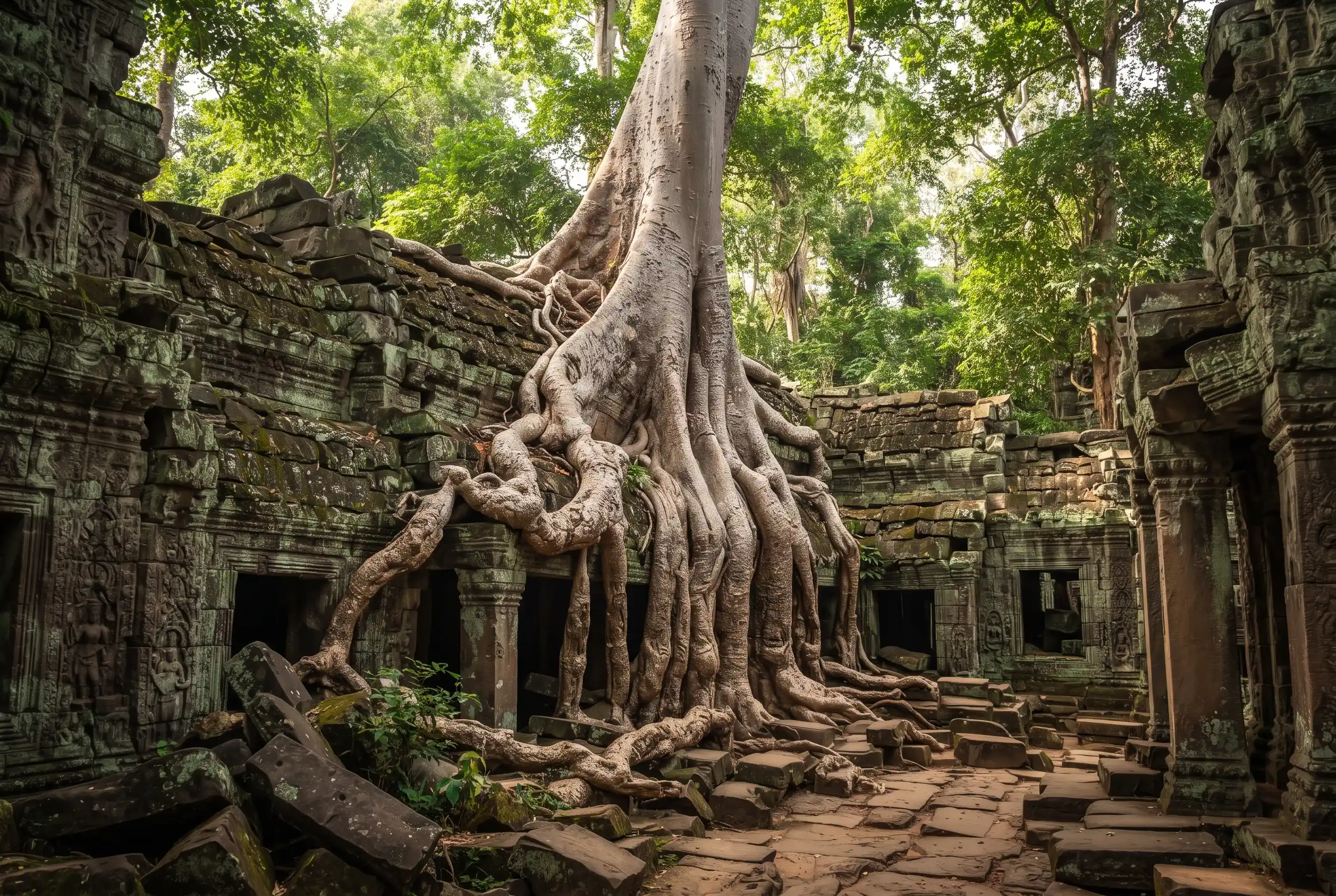
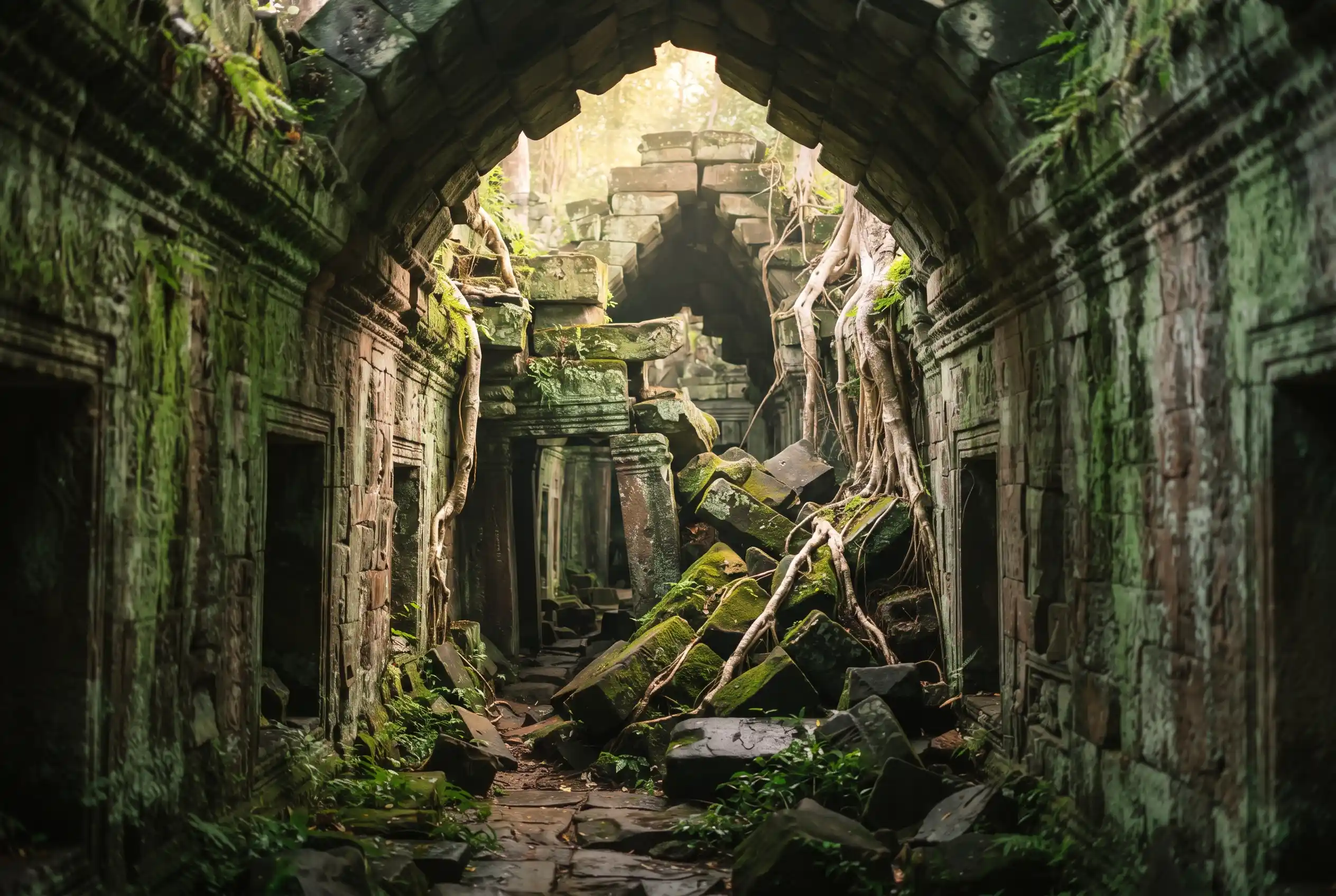
The reason Ta Prohm looks the way it does is a conservation decision. When French teams began clearing and restoring the Angkor temples a century ago, they chose to leave Ta Prohm largely as they found it, as an example of how the jungle had reclaimed the whole site. Two kinds of tree dominate: the tall, pale silk cotton trees and the strangler figs, whose roots pour over walls and prise apart the sandstone like melted wax. The most photographed spots are the huge root formations draped over the galleries and gopuras. The balance is delicate, and in recent years conservation teams have had to stabilise both the stone and the trees, adding walkways and props, so some corners change between visits.
The Tomb Raider connection
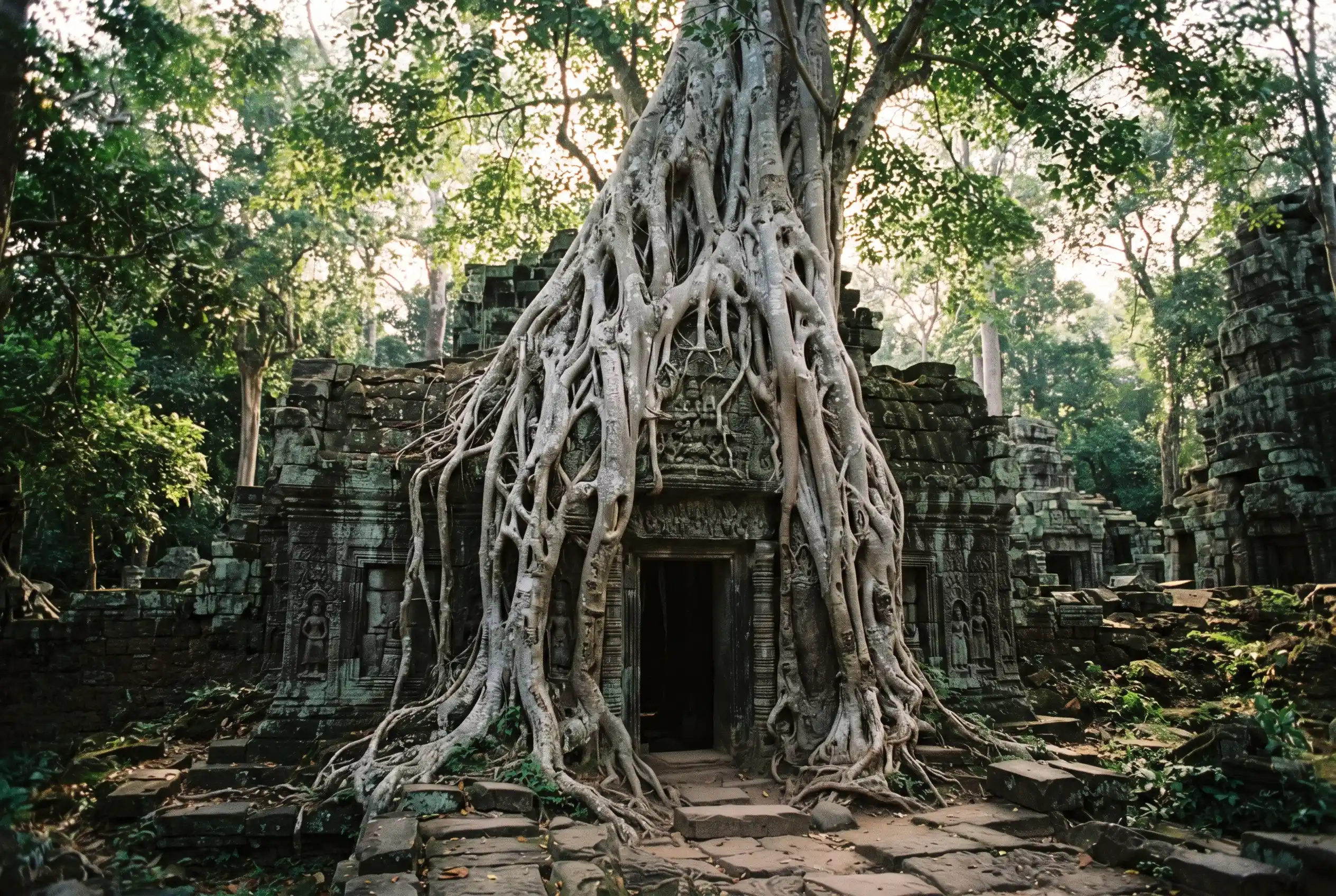
Ta Prohm became famous worldwide when it was used as a location in the 2001 film Lara Croft: Tomb Raider, starring Angelina Jolie. The scene where she picks a jasmine flower and falls into the earth was shot among these ruins, and the temple has been nicknamed the Tomb Raider temple ever since. One particular tree, its roots cascading over a doorway, is still pointed out as the Tomb Raider tree and draws a steady queue of photographers.
The dinosaur carving
One small carving at Ta Prohm gets far more attention than its size deserves. Among the decorative reliefs on a wall is a little animal that, to some eyes, resembles a stegosaurus, complete with plates along its back. It has been seized on as proof of all sorts of theories. The sober explanation is that it is almost certainly a stylised version of a known animal, perhaps a rhinoceros, boar, or chameleon, with ordinary leafy background decoration behind it that happens to look like plates. It is a fun thing to hunt for, but it is a carving, not a mystery.
How to visit
Ta Prohm is covered by the standard Angkor Pass, so there is no separate ticket. It lies on the Small Circuit and is usually combined in one day with Angkor Wat and the Bayon. For the best experience, come early in the morning or late in the afternoon, both for softer light through the trees and to avoid the thickest crowds around the famous root formations. There is a one way route through the complex that helps manage the flow, so follow the marked path. As everywhere at Angkor, the dress code applies: cover your shoulders and knees. For the full picture of the park, the pass, and the other temples, see our guide to Angkor Wat, and to understand the faith behind these monuments, read whether Angkor Wat is Hindu or Buddhist.
To plan the cost of a Cambodia trip around the Angkor Pass, use our travel budget calculator, and for temple etiquette elsewhere in the region, our guide to Bali’s temples covers similar ground. For official information, see the UNESCO listing for Angkor and the Cambodia tourism board.
Frequently asked questions
Why is Ta Prohm famous?
Ta Prohm is famous for the giant silk cotton and strangler fig trees whose roots have grown over and through the ancient stone, because it was deliberately left in its jungle state rather than fully restored. It is also the temple used as a location in the film Tomb Raider.
Who built Ta Prohm?
King Jayavarman VII built it from 1186 as a Buddhist monastery and place of learning called Rajavihara, dedicated to his mother. Its sister temple, Preah Khan, was dedicated to his father. Both date from the height of the Khmer Empire.
Do you need a separate ticket for Ta Prohm?
No. Ta Prohm is covered by the standard Angkor Pass, which gives access to the whole park. It sits on the Small Circuit and is usually visited in one day alongside Angkor Wat and the Bayon.
Is there really a dinosaur carving at Ta Prohm?
There is a small carving that looks a little like a stegosaurus, but it is almost certainly a stylised version of a known animal such as a rhinoceros or boar, with ordinary leaf decoration behind it. It is a fun thing to find, not evidence of anything.
When is the best time to visit Ta Prohm?
Early morning or late afternoon, for softer light filtering through the trees and fewer crowds at the famous root formations. Follow the one way route through the complex, and allow around an hour to an hour and a half.