Angkor Wat is the largest religious monument in the world and the heart of a temple city that was once the capital of the Khmer Empire. It is the single reason most travellers come to Cambodia, and it lives up to it. This guide covers what Angkor Wat is and who built it, the main temples worth your time, how the sunrise works, the pass system and current prices, how long to spend, and the practical details of dress code and getting around the park.
What Angkor Wat is
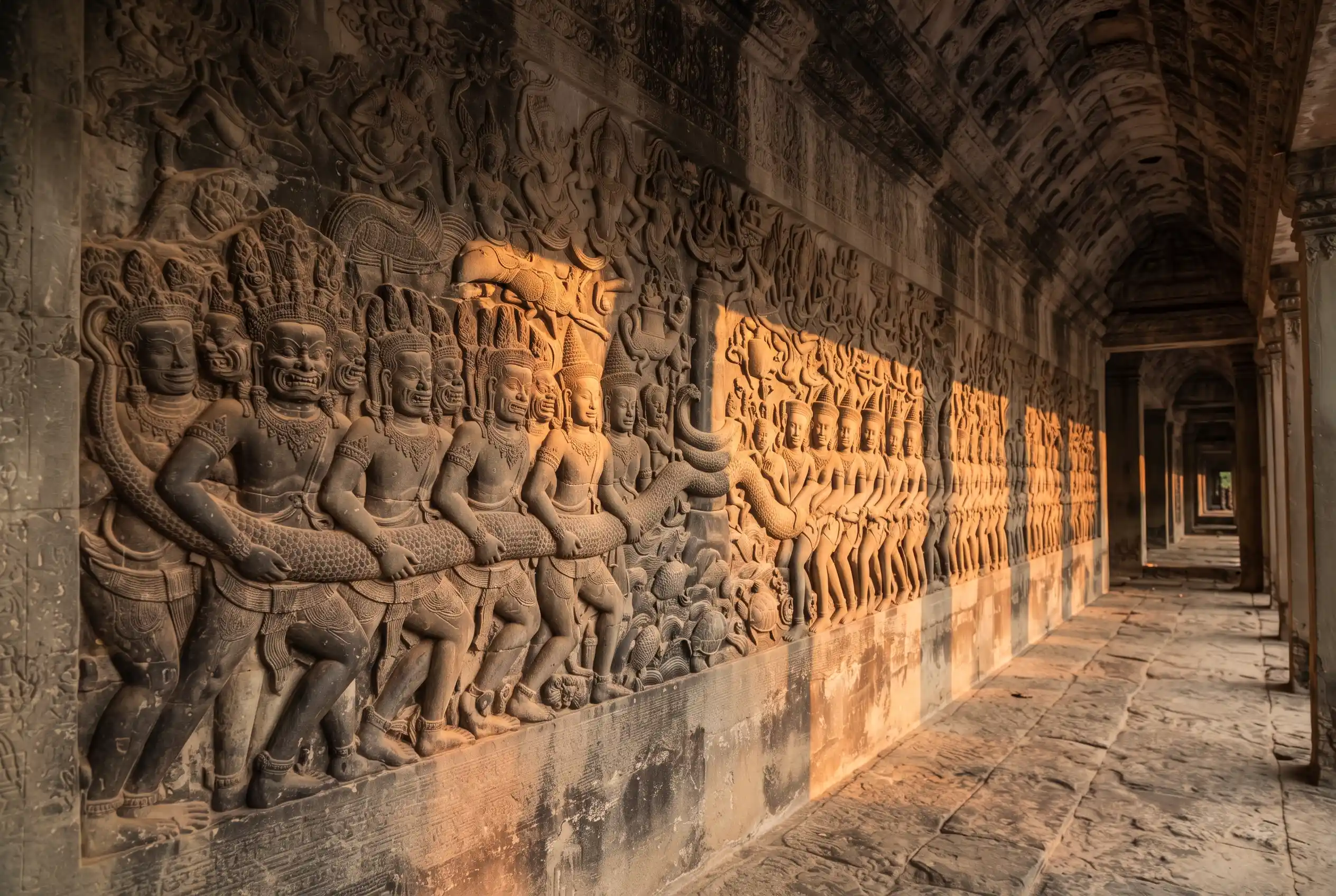
Angkor Wat sits just outside the town of Siem Reap in northern Cambodia. The name means temple city in Khmer. The main temple covers around 160 hectares inside a vast moat, and it is only one of hundreds of temples spread across the 400 square kilometre Angkor Archaeological Park, which UNESCO protects as a World Heritage Site. The temple is famous for its five lotus shaped towers, its kilometres of carved bas relief galleries, and the way the towers mirror in the reflecting pools at dawn.
Who built Angkor Wat, and when
Angkor Wat was built in the early 12th century by King Suryavarman II, who reigned from about 1113 to 1150. He raised it as a Hindu temple dedicated to Vishnu, which is unusual because most Khmer state temples honoured Shiva. It is also one of the few major temples that faces west rather than east, a choice linked to Vishnu and to funerary symbolism. Over the following centuries, as the empire shifted toward Buddhism, Angkor Wat gradually became a Buddhist temple, and it remains an active place of Buddhist worship today. That change of faith is a story in itself, which we cover in our explainer on whether Angkor Wat is Hindu or Buddhist.
The main temples to see
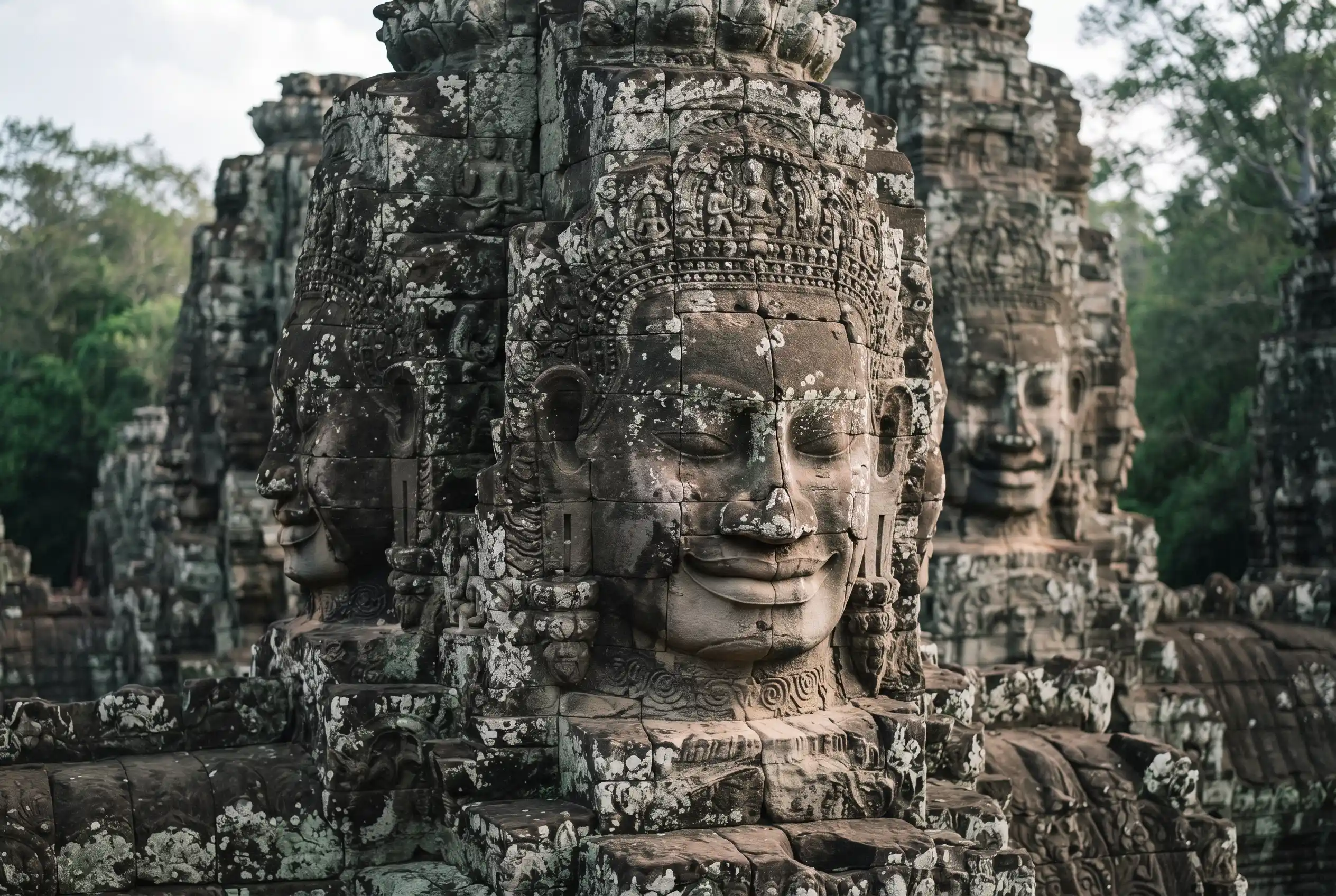
The park is far larger than the single famous temple, and a good visit mixes three or four highlights rather than trying to see everything.
Angkor Wat itself is the obvious first stop. Walk the outer galleries to see the bas reliefs, including the long Churning of the Sea of Milk panel, then climb to the upper level, the Bakan, for the view (this upper tier has its own dress rules and queue).
Angkor Thom is the great walled city just to the north, entered through monumental gates. At its centre is the Bayon, the temple studded with more than 200 giant serene stone faces, built by King Jayavarman VII at the end of the 12th century. Nearby are the Baphuon, the Terrace of the Elephants, and the Terrace of the Leper King.
Ta Prohm is the temple left partly in the grip of the jungle, where huge silk cotton and strangler fig roots pour over the stone. It is the one most people picture from the film Tomb Raider, and it has a completely different mood from the others. We cover it in full in our guide to Ta Prohm.
If you have a third day, Banteay Srei, a small 10th century temple of deep pink sandstone with the finest carving in the park, and Preah Khan, a large and atmospheric monastery, are both worth the extra drive.
The Angkor Wat sunrise
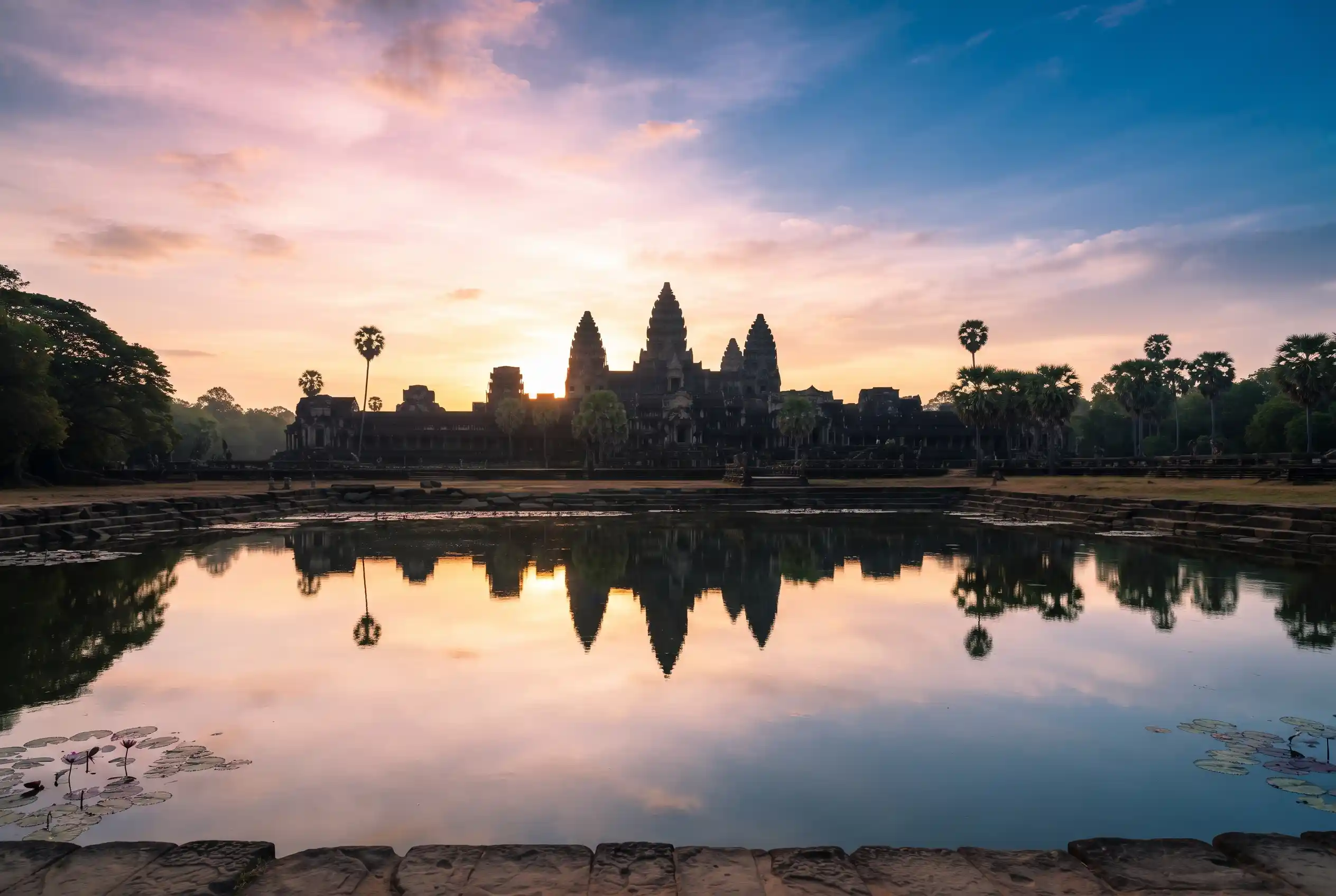
The classic experience is watching the sun rise behind the towers, reflected in the northern pond. Gates open at 5 am, and you want to be at the pool by around 5:15 to claim a spot, as it gets busy. It is popular for good reason, but it is not the only option. Sunset from the hill temple of Phnom Bakheng, or a quieter dawn at the Bayon or at Srah Srang, can be just as rewarding with a fraction of the crowd.
The Angkor Pass and prices
You need an Angkor Pass to enter the park, sold only through the official Angkor Enterprise ticket office (or its website). There are three types: a one day pass for 37 US dollars, a three day pass for 62 US dollars, and a seven day pass for 72 US dollars. The three day pass can be used on any three days within a ten day window, and the seven day pass across any seven days within a month, which suits a slower trip. Your photo is taken and printed on the pass, and it is checked at every temple, so keep it on you. Children under 12 enter free with a passport.
For most people the three day pass is the sweet spot: enough time to see the big three plus a couple of outlying temples without temple fatigue. To plan the wider cost of a Cambodia trip around it, our travel budget calculator is a quick starting point.
How to get around and how long to spend
The temples are spread out, so you need transport between them. A tuk tuk with a driver for the day is the usual choice and costs around 15 to 25 US dollars depending on the circuit. A car with air conditioning costs more and suits hot days or the longer run to Banteay Srei. Cyclists can follow the Small Circuit, which links Angkor Wat, Angkor Thom, and Ta Prohm, while the Grand Circuit loops out to the further temples.
One day is enough to see Angkor Wat, the Bayon, and Ta Prohm at a rush. Three days is the comfortable amount for most visitors. Serious temple lovers and photographers can fill a week.
Dress code and best time to visit
Angkor is a sacred site, and the dress code is enforced, especially to climb to the upper level of Angkor Wat: shoulders and knees must be covered. Carry a light scarf and wear breathable clothes, because the middle of the day is very hot. The same etiquette you would use at temples elsewhere in the region, covered in our guide to Bali’s temples, applies here.
The best months are November to February, when it is dry and relatively cool. March to May is extremely hot, and the wet season from June to October brings green landscapes, fuller moats, and fewer people. For official information, see the UNESCO listing for Angkor and the Cambodia tourism board.
Frequently asked questions
How much does it cost to visit Angkor Wat?
Entry is through the official Angkor Pass: 37 US dollars for one day, 62 for three days, and 72 for seven days. The three and seven day passes can be spread across a longer window. Children under 12 enter free with a passport.
How many days do you need at Angkor Wat?
One day covers Angkor Wat, the Bayon, and Ta Prohm at a fast pace. Three days is the comfortable choice for most visitors and lets you add Banteay Srei and Preah Khan. A week suits dedicated temple and photography trips.
Who built Angkor Wat?
King Suryavarman II built Angkor Wat in the early 12th century as a Hindu temple dedicated to Vishnu. As the Khmer Empire turned to Buddhism in later centuries, the temple became Buddhist, and it is still used for worship today.
What time is sunrise at Angkor Wat?
Gates open at 5 am. Be at the reflecting pool by about 5:15 to claim a spot, as it fills quickly. The actual sunrise is usually around 6 am depending on the season. Quieter alternatives include the Bayon or Srah Srang at dawn.
What is the best time of year to visit Angkor Wat?
November to February is best, with dry, cooler weather. March to May is very hot. The June to October wet season is greener and quieter, with fuller moats, though you should plan around afternoon downpours.