Last checked: 15 July 2026
Saudi visa prices, insurance charges and eligibility are calculated dynamically by the official application platform. Entry restrictions affecting Makkah can also change before and during the Hajj season.
Introduction
A Saudi multiple-entry visa for UAE residents can normally be requested online through the official KSA Visa platform. It is intended for tourism, leisure, events, visiting relatives and performing Umrah outside the Hajj rules.
It cannot be used for employment, paid work, long-term study or Hajj.
An eligible UAE resident may receive a one-year multiple-entry tourist eVisa, commonly permitting stays of up to 90 days under the conditions printed on the approved visa.
Saudi Arabia also allows certain accompanying first-degree relatives of eligible GCC residents to apply, even when those relatives do not hold UAE residency themselves. However, the qualifying UAE resident should accompany them whenever they enter Saudi Arabia using this eligibility route.
Table of Contents
- Who Can Apply for the Saudi eVisa?
- Saudi Multiple-Entry Visa Validity and Stay
- What Can You Do With a Saudi Tourist eVisa?
- First-Degree Relatives of UAE Residents
- Is it must the UAE Resident Travel With the Relative?
- Documents for Accompanying Family Members
- Documents Required for the Main UAE-Resident Applicant
- Passport Requirements
- Photograph Requirements
- How to Apply for a Saudi Multiple-Entry Visa
- What Does “Send to Embassy” Mean?
- What Should You Do After Seeing “Send to Embassy”?
- Saudi Multiple-Entry Visa Fee
- Saudi eVisa Payment Method
- Are Saudi Visa Fees Refundable?
- Saudi Visa on Arrival for US, UK and Schengen Visa Holders
- Documents Required for Saudi Visa on Arrival
- Saudi Visa-on-Arrival Process
- Saudi Visa-on-Arrival Fee and Payment
- No US Entry Stamp? Use the I-94 Record
- Entering Saudi Arabia by Road From the UAE
- Traveller Documents for the Saudi Land Border
- Vehicle Documents for Saudi Road Entry
- Borrowed, Rented or Financed Vehicles
- Travelling to Qatar Through Saudi Arabia
- Saudi Stopover and Transit Visa
- Remaining Airside During a Saudi Connection
- Saudi 96-Hour Stopover Visa
- Saudi Stopover Visa Fee
- Saudi Stopover Visa Payment Method
- Documents for a Saudi Stopover Visa
- Common Mistakes to Avoid
- Conclusion
- Frequently Asked Questions
Who Can Apply for the Saudi eVisa?
Saudi Arabia’s current tourism visa system provides several possible entry routes.
You may qualify through one of the following categories:
- Citizens of countries on Saudi Arabia’s standard tourist-eVisa list
- Legal residents of GCC countries, including the UAE
- Eligible first-degree relatives accompanying a GCC resident
- Certain holders of valid US, UK or Schengen visas
- Certain holders of US, UK or EU residence rights
- Passengers using an approved Saudi airline stopover programme
Holding UAE residence does not guarantee approval. Your residence permit must be genuine and valid, and you must meet the conditions displayed by the official KSA Visa eligibility questionnaire.
Use the official platform at ksavisa.sa to check which application route is currently available for your passport nationality, UAE residence status and intended travel purpose.
You can also compare regional travel options through our guide to visa-free countries for UAE residents.
Travellers planning to visit Oman during the same trip can read our Oman visa for UAE residents guide.

Saudi Multiple-Entry Visa Validity and Stay
A Saudi tourist eVisa is generally:
- Valid for one year from its issue date
- Issued for multiple entries unless the approval states otherwise
- Limited to the maximum stay printed on the visa
- Commonly associated with a maximum tourist stay of up to 90 days
- Non-extendable
- Valid for tourism and other permitted short visits
- Not valid for employment or residence
Do not assume that every new entry automatically provides another 90 days.
The visa record may limit:
- The total number of days allowed during the visa’s validity
- The maximum stay per visit
- The final date by which you must enter
- The final date by which you must leave
Read the approved visa carefully before travelling.
What Can You Do With a Saudi Tourist eVisa?
A Saudi tourist eVisa can normally be used for:
- Tourism
- Leisure trips
- Visiting family and friends
- Attending events
- Short recreational visits
- Performing Umrah outside Hajj restrictions
- Travelling around Saudi Arabia
- Entering by an approved airport or land border
It cannot normally be used for:
- Employment
- Paid or unpaid work
- Long-term study
- Permanent residence
- Hajj
- Activities requiring a professional permit
- Staying beyond the permitted period
Tourist-visa holders must also follow seasonal restrictions affecting entry to Makkah during the Hajj period.
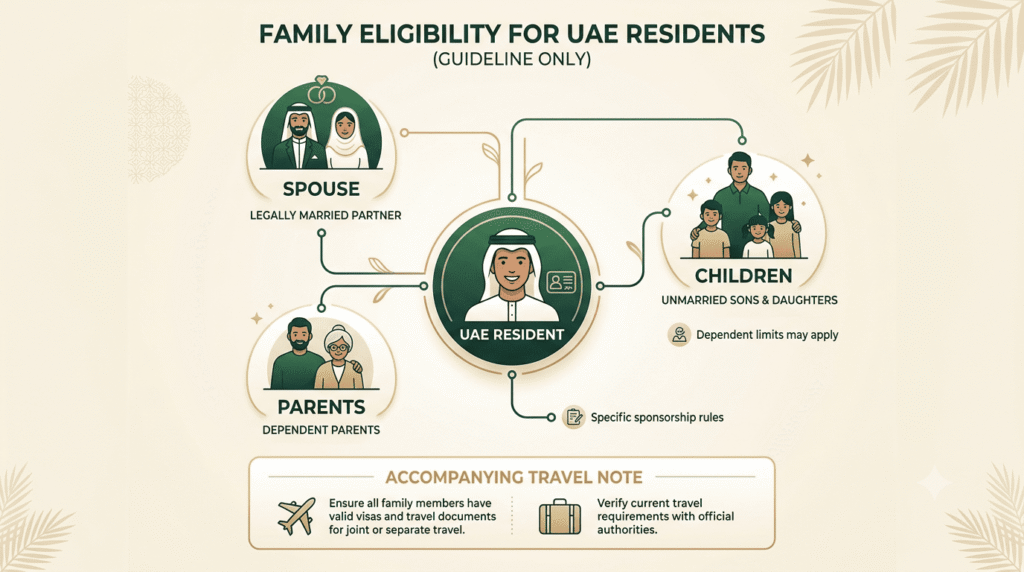
First-Degree Relatives of UAE Residents
Saudi Arabia permits eligible first-degree relatives of qualifying GCC residents to apply as accompanying family members.
This commonly includes:
- Spouse
- Children
- Parents
The family member may qualify even when they do not hold UAE residency.
For example, an eligible UAE resident may be able to apply with a visiting parent, spouse or child who holds residence in another country or does not hold GCC residence.
However, the application must correctly identify the person as an accompanying relative rather than a GCC resident.
Is it must the UAE Resident Travel With the Relative?
The eligibility route is intended for accompanying first-degree relatives.
The qualifying UAE resident should therefore travel with the relative whenever that relative enters Saudi Arabia using this visa basis.
Do not assume that the family member can:
- Enter Saudi Arabia independently
- Travel on different dates
- Use the visa after the UAE resident cancels their trip
- Arrive through a different airport or border
- Continue using the visa after the qualifying resident’s status changes
Where possible, family members should:
- Apply together
- Use matching travel dates
- Use the same flight or road itinerary
- Carry proof of relationship
- Carry copies of the UAE resident’s visa and residence documents
Documents for Accompanying Family Members
Prepare the following documents:
- Passport for each traveller
- UAE resident’s passport copy
- UAE resident’s Emirates ID
- Proof of valid UAE residence
- Marriage certificate for a spouse
- Birth certificate for a child
- Birth certificate or family record proving a parent relationship
- Family book or equivalent document where available
- Matching flight or road bookings
- Matching hotel booking
- Copy of the UAE resident’s approved Saudi visa
- Certified translation where documents are not in Arabic or English
The authorities may request additional relationship documents when names differ or the relationship is not clearly shown.
Documents Required for the Main UAE-Resident Applicant
A UAE resident applying for the Saudi tourist eVisa should normally prepare:
- Passport valid for at least six months from entry
- Clear passport bio-page scan
- Physical Emirates ID
- Proof of valid UAE residence
- Recent digital photograph
- Active email address
- Mobile telephone number
- Occupation details
- Saudi accommodation address
- Expected arrival date
- Payment card
- Travel details
- Mandatory medical-insurance selection
The online platform may not request every document during every application. However, airline staff and Saudi immigration officers can ask for supporting evidence.
Passport Requirements
Your passport should:
- Be valid for at least six months on arrival
- Be in good condition
- Contain accurate personal information
- Match the details entered in the application
- Have enough blank space where required
- Be the same passport used when applying
Do not use a passport that is damaged, cancelled or close to expiry.
If you renew your passport after receiving the visa, check whether the visa must be transferred or whether a new application is required.
Photograph Requirements
Use a recent, front-facing photograph with:
- Plain white background
- Full face clearly visible
- Neutral expression
- No sunglasses
- No heavy shadows
- No filters
- No cropped forehead or chin
- Correct file dimensions
- Acceptable file size
Saudi photo requirements commonly use a square image. Follow the live instructions displayed during the application.
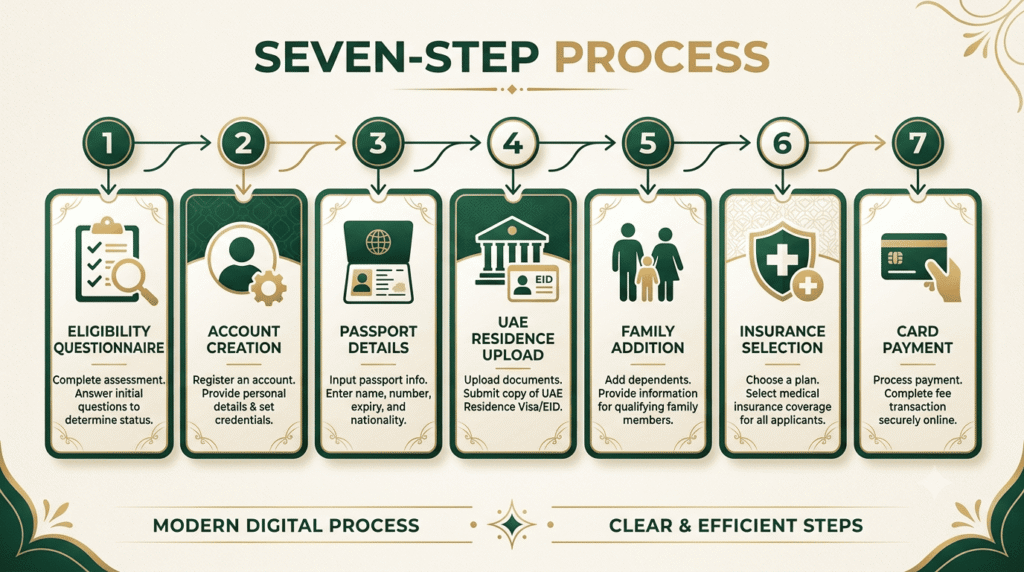
How to Apply for a Saudi Multiple-Entry Visa
Use the official KSA eVisa portal for applications.
Avoid unofficial agents or websites that imitate the government platform.
Step 1: Explore the Available Visa Options
Open the KSA Visa platform and select the option to explore available visas.
Enter or select:
- Passport nationality
- Country of residence
- GCC residence status
- Travel purpose
- Whether you are applying with accompanying family members
The platform should display the visa routes available for your circumstances.
Step 2: Create an Account
Register using an active email address.
Complete the verification process and create a secure password.
Keep access to this email because it may be used for:
- Application verification
- Payment confirmation
- Document requests
- Status notifications
- Visa delivery
Step 3: Select the Tourism Visa
Choose the tourism or visitor category offered to GCC residents.
Do not choose:
- Employment
- Business employment
- Hajj
- Student
- Family residence
unless that is your actual purpose.
Step 4: Enter Personal Details
Provide the information exactly as shown in your passport:
- Full name
- Nationality
- Date of birth
- Place of birth
- Passport number
- Passport issue date
- Passport expiry date
- Gender
- Occupation
- Country of residence
- UAE residence details
- Saudi accommodation address
- Proposed arrival date
Check every number and spelling before continuing.
Step 5: Upload the Photograph and Documents
Upload the requested files.
Make sure:
- The passport scan is clear.
- All passport edges are visible.
- The machine-readable lines are not cropped.
- The photograph meets the background rules.
- The UAE residence document is current.
- The Emirates ID details can be read.
- No document has expired.
Step 6: Add Accompanying Family Members
Use the accompanying-relative option where available.
Enter each family member’s:
- Passport information
- Date of birth
- Relationship
- Nationality
- Travel details
Do not describe a relative as a UAE resident unless they genuinely hold valid UAE residence.
Upload proof of the relationship when requested.
Step 7: Select Medical Insurance
Mandatory Saudi visitor medical insurance is normally generated during the application.
The insurance price may vary depending on:
- Applicant’s age
- Insurance company
- Coverage
- Medical risk assessment
- Number of travellers
Review:
- Insurer name
- Coverage dates
- Policy conditions
- Price
- Total visa amount
before confirming payment.
Step 8: Review the Application
Check:
- Name spelling
- Passport number
- Passport expiry
- UAE residence information
- Relationship information
- Photograph
- Travel dates
- Saudi address
- Email address
A mistake can delay the application or result in refusal.
Step 9: Pay Online
Pay using an accepted debit or credit card.
Cash is not accepted for an online KSA Visa application.
Your bank may add:
- Foreign-currency conversion fees
- International transaction fees
- Card-processing charges
Step 10: Track the Application
Use the “Track Your Application” function on KSA Visa.
Keep:
- Application number
- Payment receipt
- Registered email
- Passport number
- Submitted document copies
The visa may be approved quickly, but some applications require additional review.
What Does “Send to Embassy” Mean?
Some Saudi eVisa applications are approved almost immediately.
Others may display:
Send to Embassy
or a similar referral message.
This normally means that the application has been forwarded for additional review.
It does not automatically mean:
- The visa has been refused
- You must visit the embassy immediately
- You must submit a second application
- You need to pay again
- You must upload documents without being asked
What Should You Do After Seeing “Send to Embassy”?
Follow these steps:
- Do not submit a duplicate application.
- Check the application portal.
- Check your registered email, including the spam folder.
- Wait for the authorities to review the case.
- Respond only when documents or information are requested.
- Use the official KSA Visa contact channel if the case exceeds the platform’s stated processing period.
Submitting a second application can create confusion and may result in two payments.
Do not visit the Saudi embassy unless:
- The platform instructs you to do so.
- The embassy contacts you.
- You receive an appointment request.
- Additional identity verification is required.
Saudi Multiple-Entry Visa Fee
The official KSA Visa platform calculates the final fee dynamically.
The total may include:
- Government visa fee
- Mandatory medical insurance
- Value-added tax
- Platform charges
- Payment-processing charges
A commonly quoted total for a Saudi tourist eVisa is approximately:
SAR 500 to SAR 535
However, this should only be treated as an estimate.
The final amount shown at checkout can differ because insurance premiums vary by:
- Age
- Insurer
- Applicant details
- Coverage period
- Number of travellers
Use the amount displayed by KSA Visa as the final charge for your application.
Saudi eVisa Payment Method
Online applications are normally paid using:
- Debit card
- Credit card
Cash is not accepted for an online application.
Use an internationally enabled card and confirm that:
- Online transactions are active.
- International payments are allowed.
- The card has enough balance or credit.
- Your bank will not block the Saudi transaction.
- You can receive an OTP where required.
Are Saudi Visa Fees Refundable?
Submitted visa and service fees are generally non-refundable once processing begins.
KSA Visa may have separate refund procedures for certain:
- Rejected applications
- Cancelled transactions
- Duplicate payments
- System errors
Refund processing can take several weeks.
Read the terms shown during your specific application before paying.
Saudi Visa on Arrival for US, UK and Schengen Visa Holders
Certain travellers may qualify for a Saudi tourist visa on arrival when they hold a valid:
- United States visa
- United Kingdom visa
- Schengen visa
The supporting visa should normally:
- Be a tourist or business visa
- Remain valid on the date of Saudi arrival
- Have been used to enter the issuing country or region at least once
Holding an unused supporting visa may not meet the arrival conditions.
Documents Required for Saudi Visa on Arrival
Carry:
- Passport valid for at least six months
- Valid US, UK or Schengen visa
- Proof that the visa was used
- Previous entry stamp where available
- Boarding pass from the previous trip where available
- Official travel-history record
- Confirmed return or onward ticket
- Saudi hotel booking
- Payment card
- Proof of funds
- UAE residence evidence
- Travel insurance details
Immigration or airline staff may ask for additional documents.
Saudi Visa-on-Arrival Process
Step 1: Find the Visa Facility
After arriving, follow signs for:
- Visa on arrival
- Tourist visa
- Self-service visa kiosk
- Immigration services
Step 2: Scan Your Passport
Use the kiosk or provide your passport to the officer.
Step 3: Enter Supporting-Visa Information
Provide details of your:
- US visa
- UK visa
- Schengen visa
Step 4: Prove Previous Use
Show evidence that the supporting visa was used to enter the issuing country or region.
This may include:
- Passport entry stamp
- Boarding pass
- Airline itinerary
- Hotel booking
- Official immigration travel history
Step 5: Purchase Mandatory Insurance
The arrival system will calculate the applicable visitor insurance.
Step 6: Pay the Fee
Pay the visa and insurance amount displayed.
Step 7: Complete Biometrics
You may be asked to provide:
- Fingerprints
- Facial photograph
- Other identity verification
Step 8: Proceed to Immigration
Present the visa confirmation and passport at border control.
Saudi Visa-on-Arrival Fee and Payment
The total is calculated at the airport kiosk or visa counter.
It may include:
- Visa fee
- Mandatory insurance
- Tax
- Processing charges
Budget approximately the same general range as an online tourist eVisa, but follow the amount displayed at arrival.
Airport kiosks are primarily designed for electronic payment.
Carry:
- Physical debit or credit card
- Card enabled for international payments
- Backup payment card
Do not rely only on:
- Cash
- Apple Pay
- Google Pay
- A virtual card
- A mobile wallet
Cash may not be accepted at the self-service kiosk.
No US Entry Stamp? Use the I-94 Record
US immigration increasingly records arrivals electronically.
Your passport may not contain a clear US entry stamp even though you legally entered the United States.
In this situation, retrieve your official travel history from the US Customs and Border Protection website.
The I-94 travel-history record can help show that your US visa was used.
Save:
- A PDF copy
- A screenshot
- A printed copy
- Your previous US boarding pass if available
The record should clearly show the traveller’s previous US entry.
Do not wait until reaching the Saudi airport to retrieve it. Download the proof before departure.

Entering Saudi Arabia by Road From the UAE
UAE residents can travel to Saudi Arabia by road when they hold valid entry permission and meet the vehicle requirements.
The main UAE-to-Saudi land route normally crosses through:
- Al Ghuwaifat on the UAE side
- Al Batha on the Saudi side
Traveller documents and vehicle documents are inspected separately.
Traveller Documents for the Saudi Land Border
Carry:
- Passport
- Emirates ID
- UAE residence evidence
- Printed Saudi eVisa
- Hotel booking
- Return or onward itinerary
- Travel insurance
- Proof of relationship for accompanying relatives
- Payment card
- Contact details in Saudi Arabia
Vehicle Documents for Saudi Road Entry
Carry:
- UAE driving licence
- Vehicle registration card
- Saudi-valid motor insurance
- Owner’s NOC when using a borrowed vehicle
- Rental-company approval
- Finance-company or bank approval where applicable
- Roadside-assistance details
- Spare vehicle key
- Vehicle inspection or authorisation documents where required
A normal UAE motor-insurance policy may not automatically cover Saudi Arabia.
Purchase Saudi-valid insurance before entry or at the border facility where available.
Borrowed, Rented or Financed Vehicles
Additional permission may be required when the vehicle is:
- Registered to another person
- Rented
- Leased
- Financed by a bank
- Registered to a company
Carry written authorisation stating that the vehicle can be taken outside the UAE and into Saudi Arabia.
Do not assume that being named as an additional driver is enough.
Travelling to Qatar Through Saudi Arabia
There is no direct UAE–Qatar land border.
A UAE-to-Qatar road trip passes through Saudi Arabia, so every traveller needs valid Saudi entry or transit permission in addition to Qatar entry permission.
Read our Qatar visa for UAE residents guide before planning the journey.
Saudi Stopover and Transit Visa
Saudi Arabia offers a stopover visa that allows eligible passengers to enter the country for up to 96 hours.
It is different from remaining airside during an ordinary airport connection.
Remaining Airside During a Saudi Connection
A traveller may not need a Saudi entry visa when:
- The passenger remains in the international transit area.
- Baggage is checked through to the final destination.
- No airport change is required.
- The onward boarding pass is confirmed.
- The passenger has documents for the final destination.
- The connection complies with airline rules.
Check with the airline when:
- Flights are on separate tickets.
- Baggage must be collected.
- The transit is overnight.
- The terminal changes.
- The passenger must pass immigration.
- A hotel is located outside the airport.
Saudi 96-Hour Stopover Visa
Saudi Arabia’s stopover visa allows eligible passengers to enter for a maximum of 96 hours.
Main conditions commonly include:
- Arranged with a qualifying Saudia or flynas booking
- Single entry
- Visa validity commonly up to 90 days
- Maximum permitted stay of 96 hours
- Non-extendable
- Available for tourism
- Can be used for Umrah outside Hajj restrictions
- Not valid for Hajj
- Not valid for work
The stopover visa should be arranged during or after the qualifying airline booking process.
Saudi Stopover Visa Fee
The government visa component is commonly promoted as free.
However, the passenger may still need to pay for:
- Mandatory medical insurance
- Airline-related charges
- Booking fees
- Processing costs
- Optional stopover services
The airline displays the total payable amount during the application.
Saudi Stopover Visa Payment Method
Payment is normally completed by card during the airline booking or stopover-visa process.
Cash is not used for the online application.
Do not reserve a non-refundable hotel, tour or transport service until the stopover visa is approved.
Documents for a Saudi Stopover Visa
Prepare:
- Valid passport
- Confirmed Saudia or flynas booking
- Onward ticket
- Passport photograph
- Contact details
- Saudi accommodation where required
- Payment card
- Insurance information
- Documents for the final destination
Common Mistakes to Avoid
- Applying through an unofficial agent website
- Using the wrong passport information
- Uploading a poor-quality photograph
- Describing a non-resident relative as a UAE resident
- Letting an accompanying relative travel independently
- Failing to carry relationship documents
- Submitting a duplicate application after seeing “Send to Embassy”
- Visiting the embassy without being instructed
- Using an unused US, UK or Schengen visa for visa on arrival
- Forgetting to download the US I-94 record
- Travelling with less than six months of passport validity
- Treating a tourist visa as a work visa
- Trying to use a tourist visa for Hajj
- Assuming the quoted visa price includes insurance
- Carrying only cash for visa on arrival
- Driving without Saudi-valid motor insurance
- Taking a rented or financed vehicle without approval
- Assuming every new entry provides another 90-day stay
Conclusion
The Saudi multiple-entry visa for UAE residents is usually easiest to request through the official KSA Visa platform.
Eligible applicants may receive a one-year multiple-entry tourist visa, but the permitted stay and conditions are controlled by the approved visa record.
First-degree relatives may qualify even without UAE residence when travelling as accompanying family members. The qualifying UAE resident should travel with them whenever they enter Saudi Arabia through this route.
Travellers holding a valid and previously used US, UK or Schengen visa may also qualify for visa on arrival. Carry clear proof that the supporting visa was used, including an official CBP I-94 record when a US entry stamp is missing.
Check the final visa charge at checkout because mandatory insurance and related fees can cause the amount to vary between applicants.
Frequently Asked Questions
Is the Saudi tourist eVisa multiple entry?
It is commonly issued for one year with multiple entries unless the approved visa states otherwise.
How long can I stay in Saudi Arabia?
The tourist visa commonly permits stays of up to 90 days under the conditions printed on the approval. Do not assume that every entry resets the stay allowance.
Can my parents apply without UAE residence?
They may qualify as accompanying first-degree relatives of an eligible UAE resident. The resident should travel with them whenever they enter Saudi Arabia using that eligibility route.
Can my spouse enter Saudi Arabia without me?
Do not assume so. A non-resident spouse applying as an accompanying relative should travel with the qualifying GCC resident.
What does “Send to Embassy” mean?
It normally means the application has been referred for additional review. Wait for instructions and do not submit a duplicate application.
Do I need to visit the embassy after seeing that status?
Not unless the platform or Saudi authorities specifically ask you to visit.
How much does the Saudi tourist eVisa cost?
A commonly quoted total is approximately SAR 500 to SAR 535, but the final amount varies because mandatory insurance and other charges are calculated during the application.
Can I pay the Saudi eVisa fee in cash?
No. Online applications are paid by debit or credit card.
Can I get a Saudi visa on arrival with a US visa?
You may qualify when the US visa is valid, issued for tourism or business and has been used to enter the United States at least once.
What can I use when my passport has no US entry stamp?
Retrieve your official I-94 travel history from the US Customs and Border Protection website.
Can I pay cash for a Saudi visa on arrival?
Airport kiosks normally use electronic payment. Carry an internationally enabled physical card.
Can I enter Saudi Arabia by road with an eVisa?
An eligible eVisa can normally be used at an approved land border, subject to the visa conditions and border rules.
Is Saudi motor insurance required?
Yes. Your vehicle must have insurance valid in Saudi Arabia.
Is the Saudi transit visa completely free?
The government visa component may be free, but mandatory insurance and other booking-related charges can still apply.
Can I perform Umrah with a tourist eVisa?
A tourist visa can generally be used for Umrah outside the Hajj rules and seasonal restrictions. It cannot be used for Hajj.