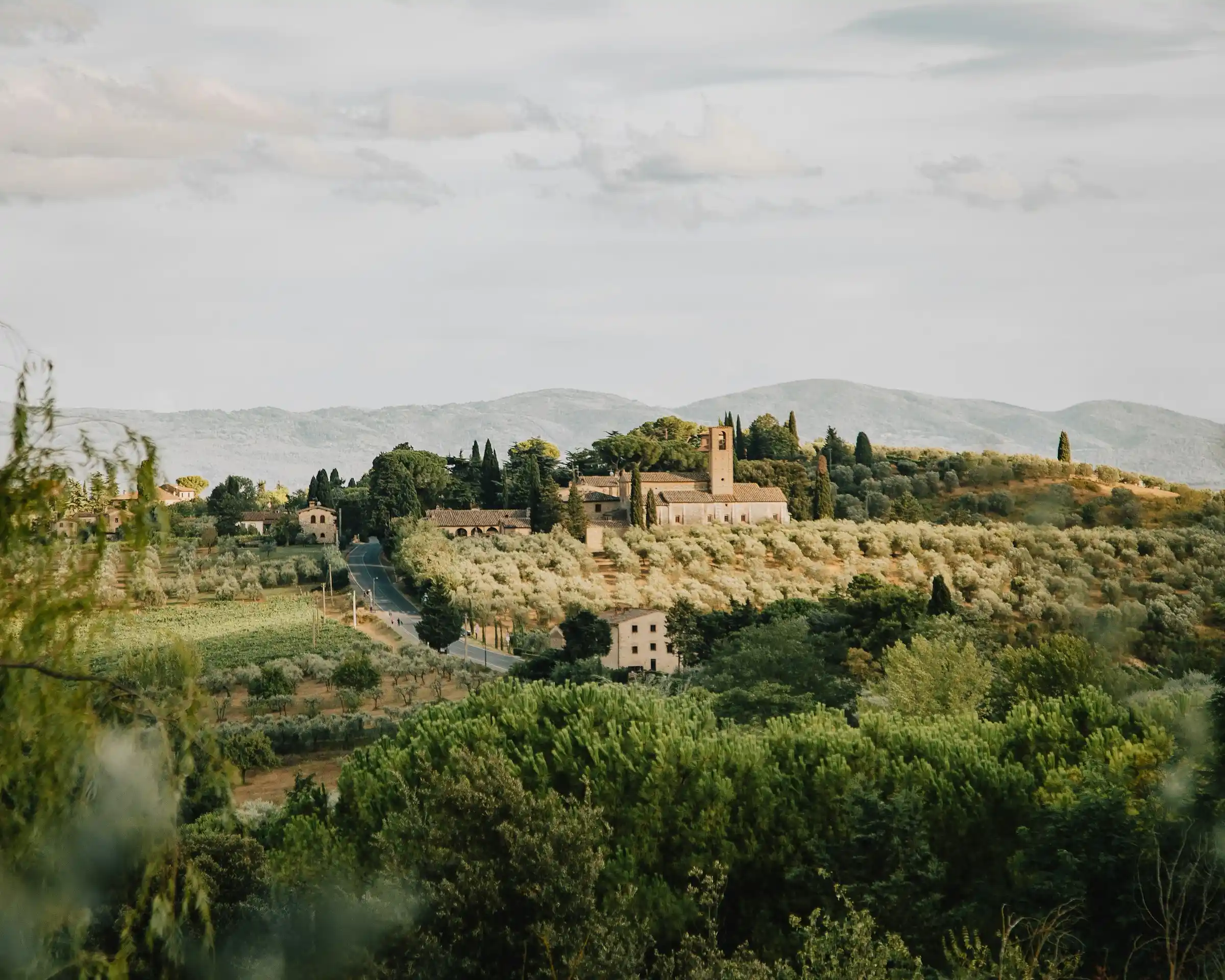
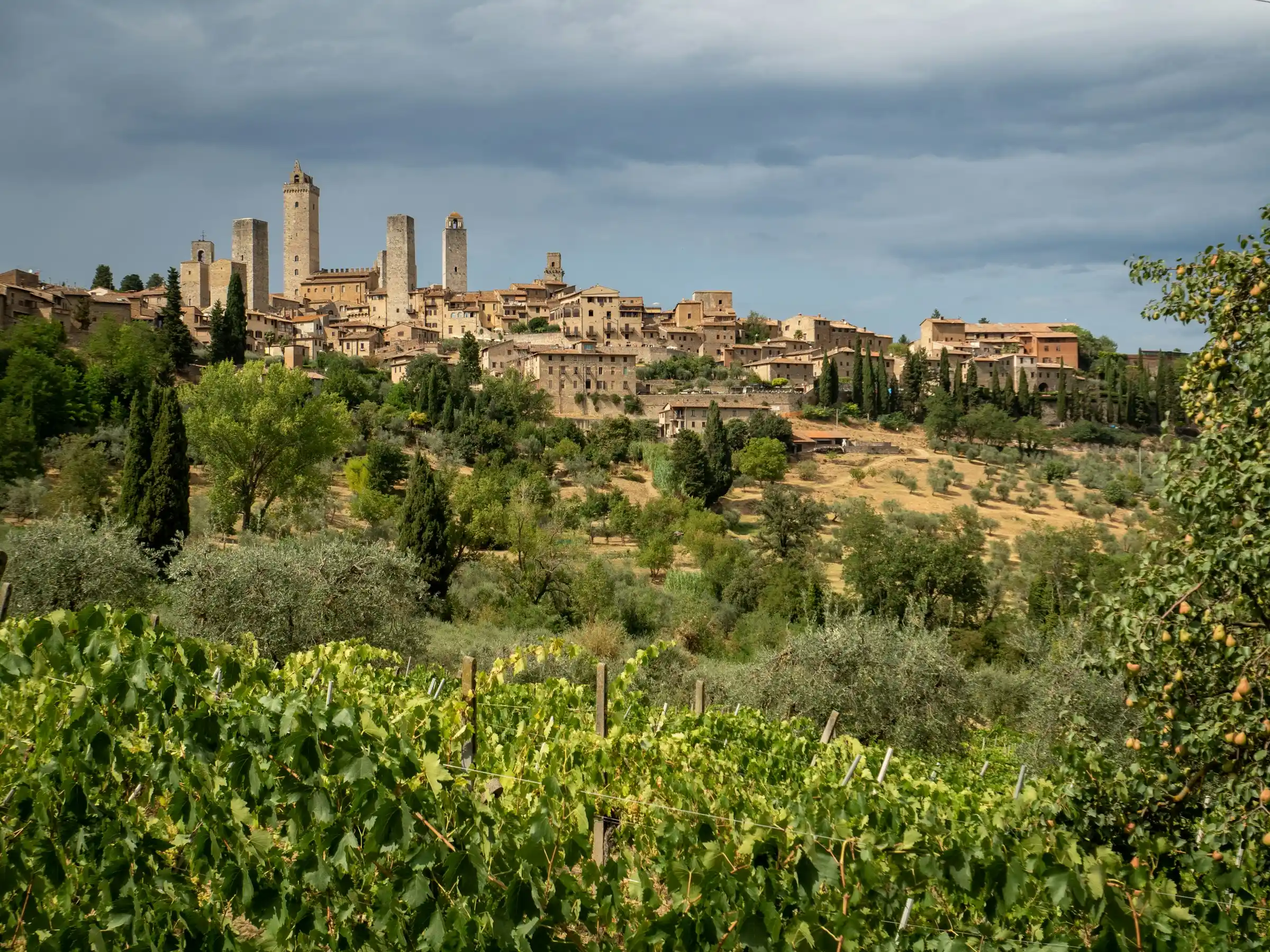
San Gimignano is a walled medieval town in Tuscany, 56 kilometres south of Florence and 38 kilometres northwest of Siena. It sits on a hilltop in the Val d’Elsa at 324 metres above sea level, and its skyline — defined by 14 stone towers that have stood since the 13th century — is recognisable from kilometres away.
The towers earned it the nickname “Medieval Manhattan.” At the town’s peak in the late 1200s, 72 towers competed for height above the rooftops, built by rival merchant families as displays of wealth and power. The 14 that survive make San Gimignano the best-preserved example of medieval tower architecture in Italy, and the reason UNESCO designated it a World Heritage Site in 1990.
Most visitors pass through on a day trip from Florence or Siena. That is a mistake. San Gimignano deserves at least half a day, and overnight guests get the town at its best — after the tour buses leave at 5 p.m. and the stone alleys empty out under warm evening light.
A brief history
San Gimignano sits on the Via Francigena, the medieval pilgrimage route from Canterbury to Rome. By the 10th century, the town was thriving on the traffic — pilgrims needed food, lodging, and supplies, and the families who provided them grew wealthy. That wealth funded the towers.
Tower-building in San Gimignano was part competition, part defence, part status symbol. The Ardinghelli and Salvucci families — Guelph and Ghibelline rivals — drove the height race through the 12th and 13th centuries. A 1255 ordinance capped new towers at the height of the Torre Rognosa (51 metres), but the Salvucci twins were already above that limit. At the town’s zenith in the late 1200s, as many as 72 towers rose above a population of roughly 13,000 people.
The Black Death of 1348 killed a large portion of the population and ended San Gimignano’s independence. The weakened town submitted to Florence in 1353. From that point, it stagnated economically — and that stagnation preserved it. While other Tuscan towns modernised, tearing down medieval structures and rebuilding in Renaissance style, San Gimignano could not afford to. The 14 surviving towers exist because the town was too poor to replace them.
The saffron trade, once the town’s economic backbone (saffron was worth more than gold by weight), declined after the plague. Vernaccia wine production continued through the centuries and remains a pillar of the local economy. Tourism, driven largely by the UNESCO designation in 1990, is now the dominant industry.
What to see
Piazza della Cisterna
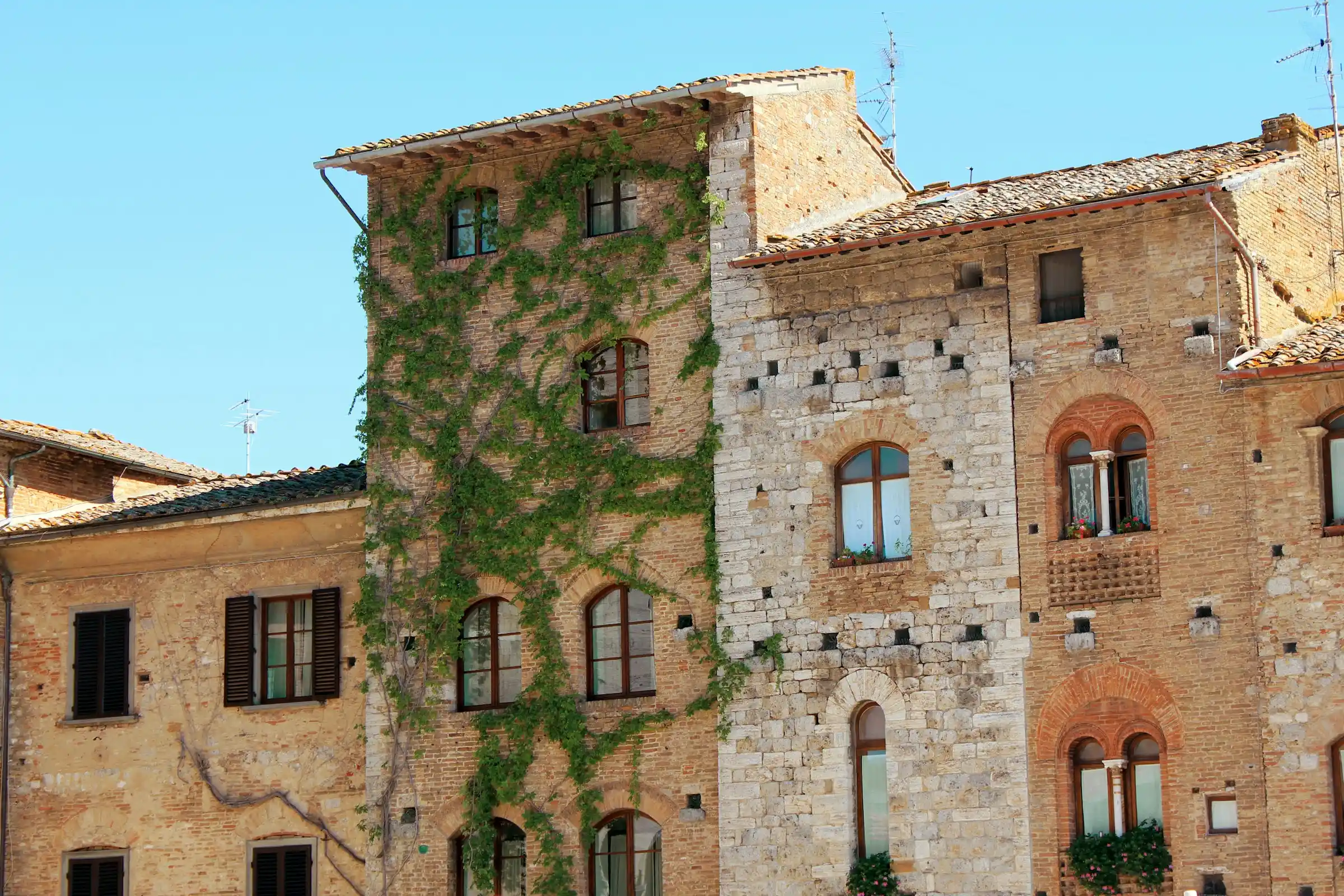
The triangular main square, paved in herringbone brick and centred on a 1287 stone well (cisterna). The surrounding palazzi — Palazzo Tortoli, Palazzo Ridolfi, the twin Salvucci towers — date from the 13th and 14th centuries. This is the postcard shot. Arrive before 9 a.m. or after 5 p.m. for photos without crowds.
Piazza del Duomo
Connected to Piazza della Cisterna by a short walkway, this is the civic and religious heart. The Collegiata (cathedral), Palazzo Comunale (town hall), and the Torre Grossa — the tallest surviving tower at 54 metres — all face this square.
The Collegiata
The Romanesque cathedral’s plain exterior gives nothing away. Inside, the walls are covered in frescoes. The left wall depicts Old Testament scenes by Bartolo di Fredi (1367). The right wall shows New Testament scenes attributed to the workshop of Simone Martini. The Chapel of Santa Fina, painted by Domenico Ghirlandaio in 1475, is the highlight — two lunettes showing the life and death of a local saint, considered among the finest Renaissance frescoes outside Florence.
Entry costs €6 (combined ticket with other museums available). Open daily except during services.
Torre Grossa
The only tower open to the public. The 218-step climb rewards you with a 360-degree view of the Val d’Elsa, the Chianti hills, and on clear days, the towers of Siena. The tower is inside Palazzo Comunale, which also houses the Civic Museum — the entry ticket (€9, or €15 for the San Gimignano Pass covering all civic museums) includes both.
Palazzo Comunale and Civic Museum
The Sala del Consiglio contains Lippo Memmi’s Maestà (1317). Upstairs, the Pinacoteca displays works by Filippino Lippi, Benozzo Gozzoli, and Taddeo di Bartolo. The wedding chamber frescoes by Memmo di Filippuccio — unusually candid depictions of medieval married life — are worth seeking out.
Parco della Rocca
The ruins of a 14th-century fortress at the highest point of town. Most visitors skip it, which is exactly why you should not. The park is quiet, shaded by olive trees, and offers the best panoramic views of the towers and the surrounding countryside. There is a small playground for children. Entry is free.
The city walls
San Gimignano’s walls stretch 2,176 metres around the old town. While you cannot walk the full circuit on top of the walls, sections near the gates are accessible, and a walking loop around the exterior takes 30 to 40 minutes through olive groves with views back toward the towers.
Chiesa di Sant’Agostino
One of San Gimignano’s hidden gems — a 13th-century church at the quiet northern end of town. The apse contains a fresco cycle by Benozzo Gozzoli (1464–65) depicting the life of Saint Augustine — 17 scenes that are among the best-preserved Gozzoli works in Tuscany. Far fewer visitors make it here, so you can study the frescoes in near-silence. Free entry.
Food and wine
San Gimignano’s food is rooted in the Val d’Elsa terroir. Three things define the local table: Vernaccia wine, saffron, and the gelato that put a small-town gelateria on the world stage.
Vernaccia di San Gimignano
Italy’s first DOC wine (designated 1966), upgraded to DOCG in 1993. Vernaccia is a dry white — crisp, minerally, with notes of almond and citrus. It is best paired with the local pecorino cheese, white truffle dishes (in season from October to December), and seafood. Most restaurants in town pour it by the glass (€4 to €7). The Vernaccia Wine Experience inside the Rocca fortress offers tastings and educational displays.
Gelateria Dondoli
Sergio Dondoli has won the Gelato World Championship multiple times. His shop on Piazza della Cisterna draws a permanent queue. The signature flavours — Crema di Santa Fina (saffron cream), Champelmo (pink grapefruit and sparkling wine), Vernaccia sorbet — use local ingredients. Expect to wait 10 to 15 minutes in peak season. Worth it.
Saffron
San Gimignano has grown saffron since the 13th century — it was once more valuable than the town’s wool trade. Local restaurants use it in risotto, pasta, and desserts. You can buy small pouches of Zafferano di San Gimignano DOP from shops along Via San Giovanni. It makes a compact, lightweight souvenir.
Where to eat
The restaurants along Via San Giovanni (the main tourist street) are generally more expensive and less interesting than those on quieter side streets. For a sit-down meal, expect €15 to €30 per person for a primo and a glass of Vernaccia. Most restaurants add a coperto (cover charge) of €2 to €3.
How to get there
From Florence
By car: take the Firenze–Siena superstrada (SGC) south, exit at Poggibonsi Nord, then follow signs for San Gimignano (10 km of winding country road). Total drive time: 60 to 75 minutes. By bus: SITA/Autolinee Toscane bus 131 runs from Florence (Autostazione near Santa Maria Novella) to Poggibonsi, then transfer to line 130 to San Gimignano. Total journey: 90 to 120 minutes. Buses run roughly every hour.
From Siena
By car: 45 minutes via the SGC and Poggibonsi. By bus: direct line 130 from Siena bus station, 60 to 75 minutes, runs several times daily.
By train
San Gimignano has no train station. The nearest station is Poggibonsi-San Gimignano, served by Trenitalia regional trains from Florence (35 minutes) and Siena (25 minutes). From the station, bus line 130 reaches San Gimignano in 20 minutes.
Parking
The historic centre is a ZTL (restricted traffic zone) — no private vehicles allowed. Four public car parks surround the walls:
- P1 (Giubileo): closest to Porta San Giovanni, the main entrance. Fills first. €2.50/hour.
- P2 (Bagnaia): south side, slightly lower. Good alternative when P1 is full. €2/hour.
- P3 (Montestaffoli): north side near Porta San Matteo. Less busy. €1.50/hour.
- P4 (Parcheggio Vecchie Mura): below the walls, connected by escalator. €6 flat rate for the day.
In summer, arrive before 10 a.m. to guarantee a spot in P1 or P2. After midday, P3 and P4 are your best bet.
When to visit
San Gimignano is a year-round destination, but the experience varies sharply by season.
- Spring (April–May): the best overall months. Wildflowers in the surrounding hills, comfortable temperatures (15 to 25°C), moderate crowds. The Ferie delle Messi medieval festival runs in mid-June.
- Summer (June–August): hot (30 to 38°C), crowded, and expensive. Tour buses arrive in waves between 10 a.m. and 4 p.m. If you visit in summer, go early morning or stay overnight to enjoy the evening.
- Autumn (September–October): grape harvest season. Vineyard landscapes turn gold and red. Truffle season begins in October. Crowds thin after mid-September. Temperatures are pleasant (18 to 28°C).
- Winter (November–March): quiet, cold (3 to 12°C), and atmospheric. Some restaurants and shops close. The town feels medieval in a way that summer crowds erase. Accommodation is 30 to 50 percent cheaper.
How much time to spend
A half-day (3 to 4 hours) covers the two main squares, the Collegiata, Torre Grossa, and Gelateria Dondoli. A full day adds the Civic Museum, Sant’Agostino, the city walls walk, a wine tasting, and a proper lunch. An overnight stay lets you experience the town after the day-trippers leave — the difference between daytime and evening San Gimignano is dramatic.
Day trips from San Gimignano
If you are using San Gimignano as a base, several Tuscan towns are within easy driving distance:
- Volterra: 30 km, 40 minutes. Etruscan ruins, alabaster workshops, and a Roman theatre. Less touristy than San Gimignano.
- Siena: 38 km, 45 minutes. The Piazza del Campo, the Duomo, and the Palio horse race (July 2 and August 16).
- Colle di Val d’Elsa: 13 km, 20 minutes. A quieter hill town known for crystal production.
- Monteriggioni: 20 km, 25 minutes. A tiny walled village mentioned in Dante’s Inferno.
- Chianti wine region: the Castellina in Chianti and Greve in Chianti are 30 to 40 km east. Wine estates offer tastings, many by appointment only.
Budget
San Gimignano is cheaper than Florence or Siena but not a budget destination. Here is what a typical day costs per person:
| Item | Cost (EUR) |
|---|---|
| San Gimignano Pass (all civic museums + tower) | €15 |
| Collegiata entry | €6 |
| Gelato at Dondoli | €3–5 |
| Lunch (primo + wine) | €15–25 |
| Wine tasting | €10–20 |
| Parking (4 hours) | €6–10 |
| Day trip total | €55–80 |
| Overnight (mid-range hotel) | €80–150 |
If you are looking for more affordable travel destinations, San Gimignano works best as a day trip from a cheaper base like Poggibonsi or rural agriturismo.
Practical tips
- Crowds: San Gimignano receives over 3 million visitors per year. The main streets between 10 a.m. and 4 p.m. in summer are shoulder-to-shoulder. Arrive early, stay late, or visit in the shoulder season.
- Siesta: many shops close between 1 p.m. and 3:30 p.m. Use this time for lunch, the park, or the city walls walk.
- Shoes: the streets are cobblestoned and steep in places. Wear flat, sturdy footwear.
- Power plugs: Italy uses Type L and Type C outlets. If you are travelling from outside Europe, check our European power plug guide.
- Insurance: if you are visiting as part of a longer European trip, make sure you have travel insurance that covers Italy. Read our guide on whether travel insurance is worth it.
- Solo travel: San Gimignano is safe and walkable. For general advice, see our solo travel tips.
Photography spots
San Gimignano is one of the most photogenic towns in Italy. Here are the best vantage points:
- The approach road from Poggibonsi: about 2 km before the town, the road crests a hill and the full skyline appears — all 14 towers against the Tuscan hills. This is the classic establishing shot. Pull over at the small layby on the right.
- Parco della Rocca: the fortress ruins offer an elevated, unobstructed view of the towers from inside the walls. Best in late afternoon when the stone catches warm light.
- Torre Grossa summit: the only tower you can climb. The 360-degree panorama from the top captures rooftops, countryside, and the other towers at eye level.
- Piazza della Cisterna: the triangular square with the stone well. Shoot from the southwest corner for the well in the foreground and the towers rising behind it.
- Via San Giovanni at dawn: the main street is deserted before 8 a.m. The narrow medieval corridor with towers looming overhead works best with no crowds and long shadows.
- The olive groves outside Porta San Matteo: walk 5 minutes outside the northern gate for a rural perspective — towers rising above stone walls, framed by olive trees and cypresses.
Festivals and events
San Gimignano hosts several annual events that can shape your visit — either as a reason to come or a heads-up about crowds and price spikes.
- Ferie delle Messi (mid-June): a medieval festival recreating 14th-century life. Costume parades, flag-throwing, jousting, and market stalls. The town fills up — book accommodation months ahead.
- San Gimignano Estate (July–August): an outdoor arts festival with concerts, theatre, and film screenings in Piazza della Cisterna and Parco della Rocca. Most events are free.
- Vernaccia Wine Festival (February): tastings, food pairings, and winery open days across the Vernaccia di San Gimignano DOCG zone. A quieter alternative to summer visits.
- Saffron harvest (late October–November): the Crocus sativus fields bloom purple in the surrounding hills. Some farms offer guided harvest experiences — you pick the flowers at dawn, then extract the stigmas by hand.
Where to stay
Accommodation inside the walls is limited and fills quickly in summer. Hotels and B&Bs within the historic centre typically cost €100 to €200 per night in high season, dropping to €60 to €100 in winter. The advantage of staying inside is the evening atmosphere — from 5 p.m. to 9 a.m., the town belongs to its overnight guests.
Agriturismi (farm stays) in the surrounding countryside offer better value, more space, and views of the towers from a distance. Expect €70 to €150 per night. You will need a car. Many have pools, serve breakfast with their own olive oil and jams, and some offer cooking classes or wine tastings on-site.
Poggibonsi (10 km east) has budget hotels and a train station. It is not charming, but it is functional and well-connected. If San Gimignano is just one stop on a broader Tuscan itinerary, Poggibonsi makes a practical, affordable base.
Frequently asked questions
Is San Gimignano worth visiting?
Yes. It is the best-preserved medieval tower town in Italy and a UNESCO World Heritage Site. The architecture, frescoes, and Tuscan landscape make it one of the most visually striking small towns in Europe. The key is timing — visit early morning, late afternoon, or overnight to avoid the worst of the crowds.
How long do you need in San Gimignano?
A minimum of 3 to 4 hours covers the main squares, the Collegiata, and the tower climb. A full day allows for museums, wine tasting, and a proper meal. An overnight stay is ideal for experiencing the town after the day-trip crowds leave.
How do I get from Florence to San Gimignano?
By car: 60 to 75 minutes via the Firenze–Siena superstrada, exiting at Poggibonsi Nord. By bus: SITA/Autolinee Toscane from Florence to Poggibonsi, then transfer to line 130 (90 to 120 minutes total). By train: regional train to Poggibonsi-San Gimignano station (35 minutes), then bus 130 (20 minutes).
Is there parking in San Gimignano?
Yes. Four public car parks (P1 through P4) surround the walls. Prices range from €1.50 to €2.50 per hour, with P4 offering a flat €6 daily rate. The historic centre is a ZTL — no private vehicles allowed. Arrive before 10 a.m. in summer to get a spot close to the gates.
What is San Gimignano famous for?
Its medieval towers. Of the original 72, fourteen survive and define one of the most recognisable skylines in Tuscany. The town is also known for Vernaccia wine (Italy’s first DOC white), saffron, and Gelateria Dondoli’s world-championship gelato.
What is the best time to visit San Gimignano?
April, May, September, and October offer the best combination of weather, manageable crowds, and reasonable prices. Spring brings wildflowers; autumn brings the grape harvest and truffle season. Summer is hot and crowded. Winter is quiet and atmospheric but some businesses close.
Can you visit San Gimignano as a day trip?
Yes. It is a common day trip from Florence (75 minutes by car) or Siena (45 minutes). Budget 3 to 4 hours minimum for a meaningful visit. If possible, stay overnight — the town transforms after 5 p.m. when the tour buses leave.
Do you need to book tickets in advance?
No. Tickets for the Collegiata, Torre Grossa, and the Civic Museum are available at the door. There are no timed entry slots. The San Gimignano Pass (€15) covers all civic museums and the tower — buy it at the Palazzo Comunale ticket office.