It is one of the most common questions about Angkor Wat, and the answer surprises people: the temple is both, at different points in its history. It was built as a Hindu temple and is now a Buddhist one, and you can still see traces of each faith carved into its walls. This short guide explains how Angkor Wat started, how it changed religion over the centuries, and what you will actually see of both Hinduism and Buddhism when you visit today.
The short answer
Angkor Wat was built in the early 12th century as a Hindu temple dedicated to the god Vishnu. Over the following centuries, as the Khmer Empire turned to Buddhism, the temple was gradually converted, and today it is an active Buddhist site. So if you want one line: it was Hindu first, and it is Buddhist now. The more interesting part is how and why the change happened.
Built as a Hindu temple
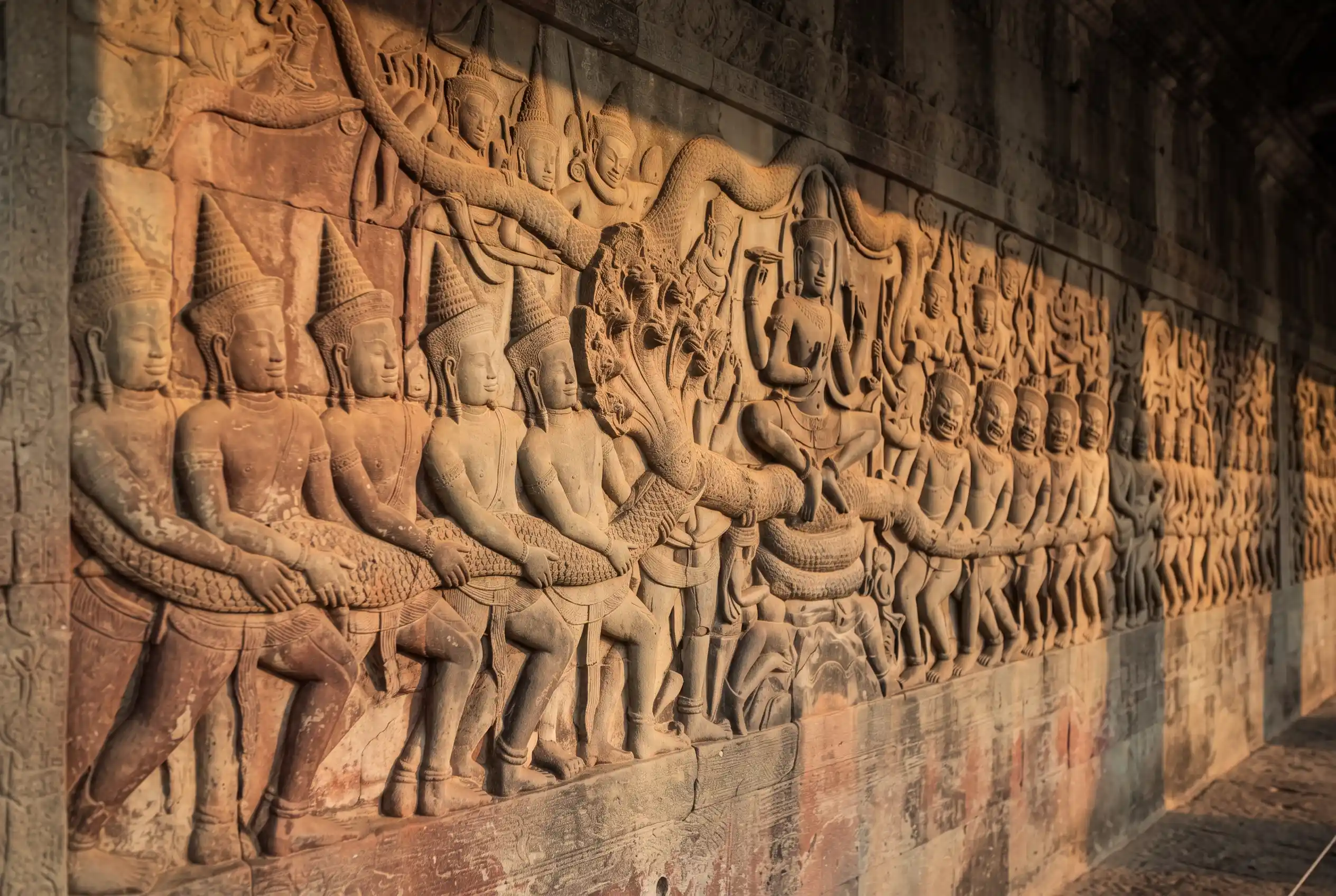
Angkor Wat was commissioned by King Suryavarman II, who reigned from about 1113 to 1150, and dedicated to Vishnu. That was itself unusual, because most Khmer state temples honoured Shiva, which tells us how important Vishnu was to this king. The whole design is a model of the Hindu universe. The five central towers represent the peaks of Mount Meru, the mythical home of the gods, and the wide moat around the temple stands for the cosmic ocean that surrounds it. The long galleries are carved with scenes from the Hindu epics, the Ramayana and the Mahabharata, and with the famous Churning of the Sea of Milk, in which gods and demons stir the ocean to produce the nectar of immortality.
One more clue points to its Hindu origins. Angkor Wat faces west, which is unusual for a temple and is associated with Vishnu and with the dead. Many scholars believe Suryavarman II intended it to serve as his own funerary temple as well as a house for the god.
How it became Buddhist
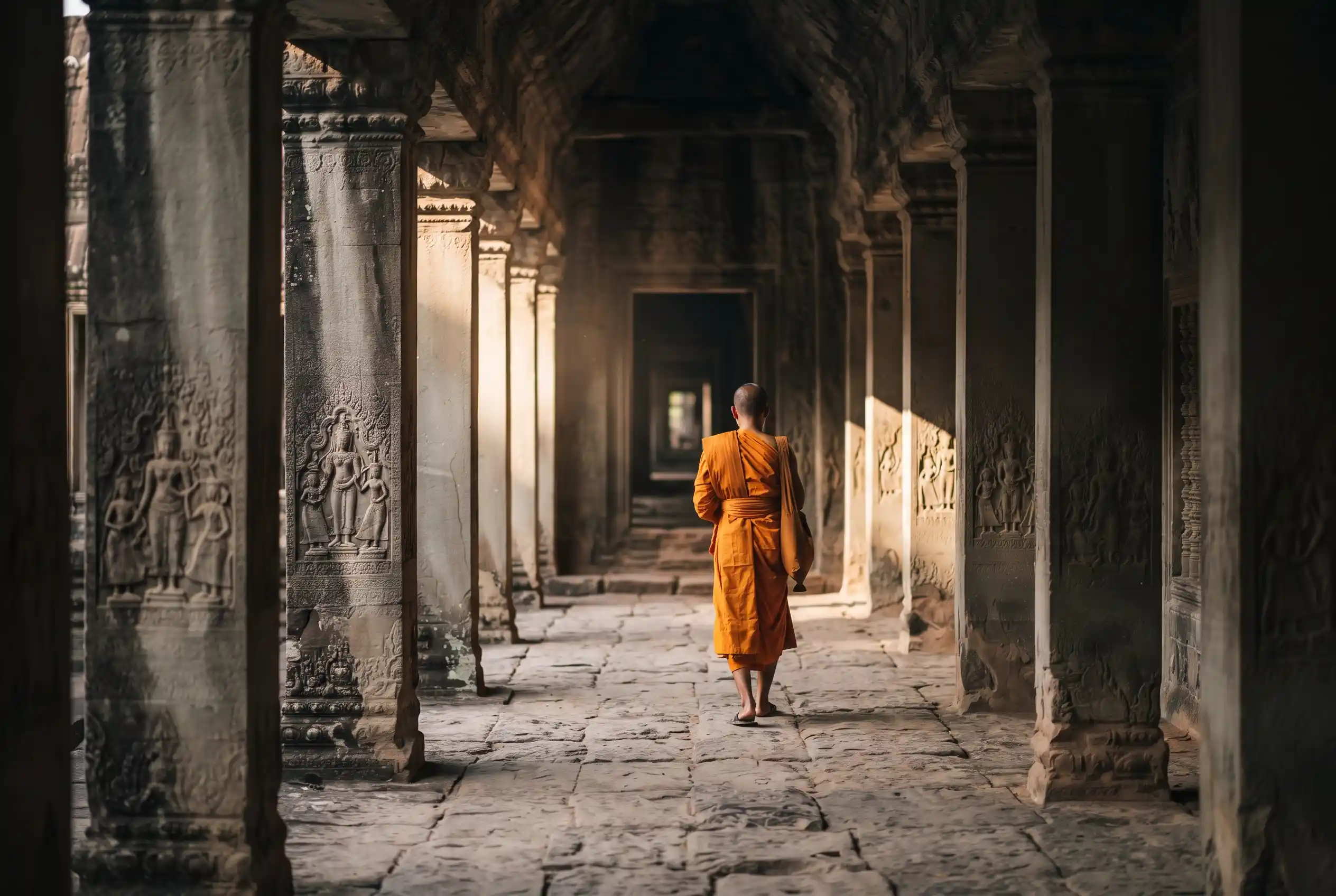
The shift did not happen overnight. Within decades of Angkor Wat’s completion, the next great king, Jayavarman VII, was a devout Mahayana Buddhist who filled Angkor with Buddhist temples such as the Bayon and Ta Prohm. The empire as a whole moved toward Buddhism, and from around the 13th and 14th centuries Theravada Buddhism, the branch still dominant in Cambodia today, took hold.
As that happened, Angkor Wat was adapted for Buddhist worship. Buddha images were added, and in places Hindu figures were recarved or replaced. There was even a brief Hindu backlash in the 13th century under Jayavarman VIII, when many Buddhist images across Angkor were defaced, followed later by a Buddhist restoration. Through all of it, Angkor Wat was never truly abandoned as a place of worship, which is one reason it survived in better condition than many other temples.
Angkor Wat today
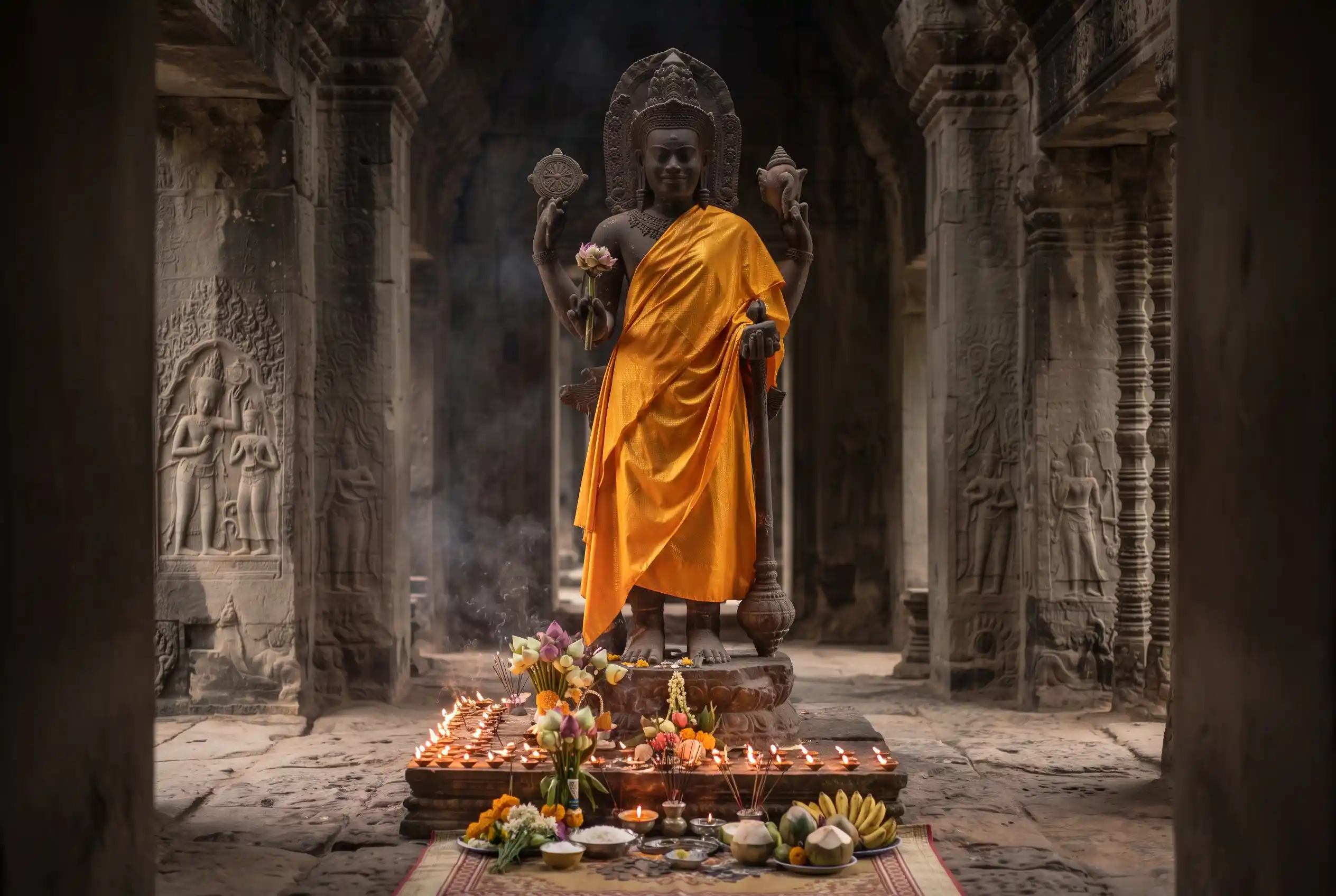
Today Angkor Wat is a living Theravada Buddhist temple. Saffron robed monks walk its galleries, locals come to pray and leave offerings, and Buddha statues draped in cloth sit in its chambers. In the western entrance stands a tall statue of Vishnu, thought to have been the temple’s original central deity, which is now worshipped in a Buddhist setting, with incense and gold leaf. It is a neat symbol of the whole story: a Hindu god, still honoured, inside a Buddhist temple.
Seeing both faiths when you visit
When you go, you can read the layers for yourself. Walk the outer galleries to see the Hindu epics in the bas reliefs, look for the west facing orientation and the Mount Meru towers, then notice the Buddha images and the active shrines where people worship now. For the full practical guide to the temple, the pass, and the wider park, see our guide to Angkor Wat, and for its atmospheric Buddhist neighbour, our guide to Ta Prohm. To compare it with the great Buddhist monument of Java, read our guide to Borobudur, and for living Hindu temples in Southeast Asia, see Bali’s temples. For official background, see the UNESCO listing for Angkor.
Frequently asked questions
Is Angkor Wat Hindu or Buddhist?
Both, at different times. It was built in the early 12th century as a Hindu temple dedicated to Vishnu, and over the following centuries it was converted to Buddhism as the Khmer Empire changed faith. Today it is an active Theravada Buddhist temple.
Why was Angkor Wat dedicated to Vishnu?
King Suryavarman II, who built it, was a devotee of Vishnu, which was unusual because most Khmer kings favoured Shiva. The temple’s west facing orientation, linked to Vishnu, suggests it may also have been intended as his funerary temple.
When did Angkor Wat become Buddhist?
Gradually, from the late 12th century onward. King Jayavarman VII promoted Mahayana Buddhism across Angkor, and Theravada Buddhism took hold from around the 13th and 14th centuries. Angkor Wat was adapted for Buddhist worship during this long shift and has remained Buddhist since.
Can you see Hindu carvings at Angkor Wat?
Yes. The outer galleries are carved with Hindu epics, including the Ramayana, the Mahabharata, and the Churning of the Sea of Milk. The five towers represent Mount Meru from Hindu cosmology. These sit alongside later Buddha images, so both faiths are visible.
Is Angkor Wat still used for worship?
Yes. Angkor Wat is an active Theravada Buddhist temple, with monks, shrines, and worshippers leaving offerings. A statue of Vishnu, believed to be the original central deity, still stands at the western entrance and is venerated today.