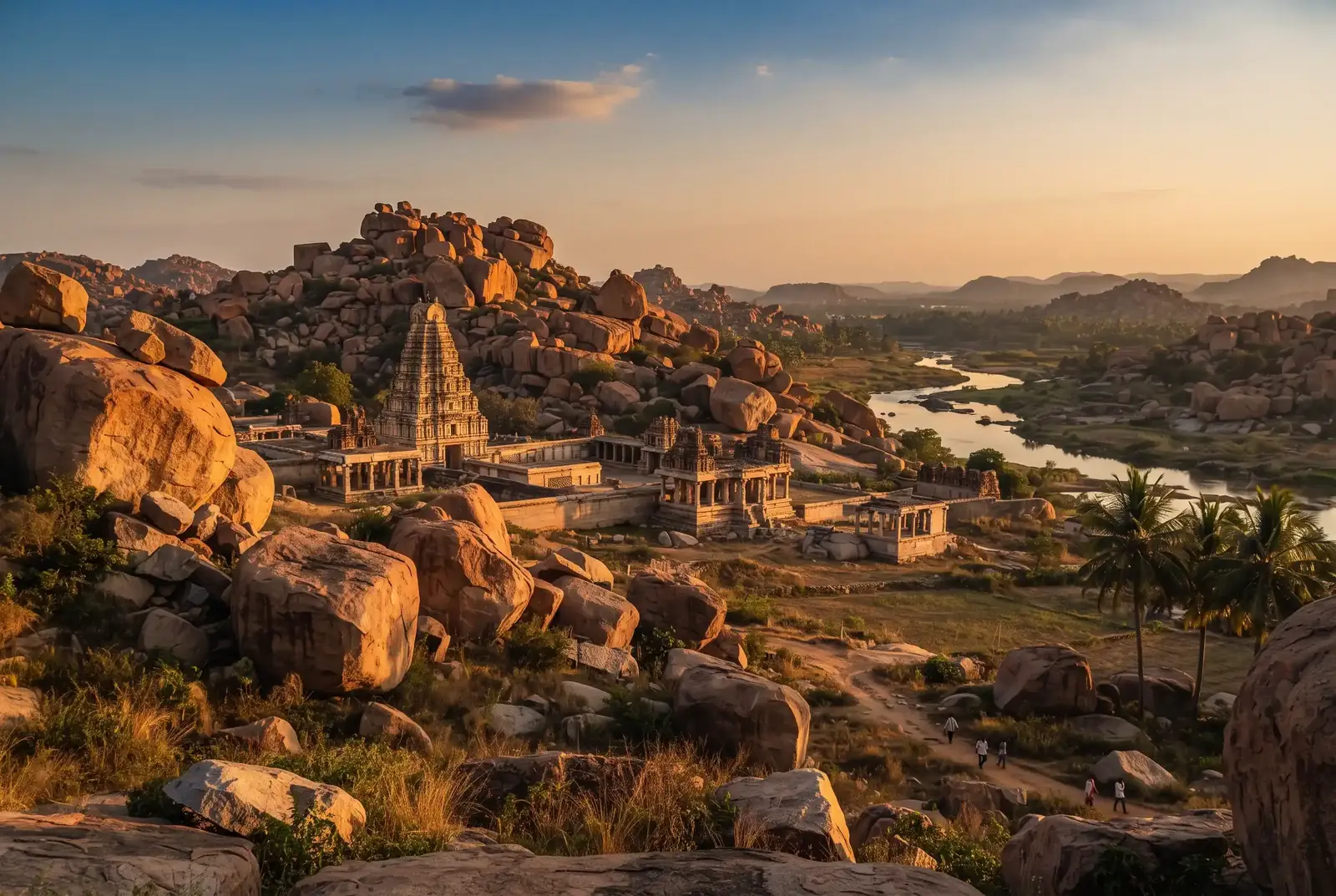
Hampi is one of those rare places that lives up to every photograph. Once the capital of the Vijayanagara Empire, it is now a vast, dreamlike landscape of temples, bazaars and boulder-strewn hills — a UNESCO World Heritage Site you explore on foot and by bicycle over a couple of unhurried days. This self-guided tour of the best places to visit in Hampi covers the unmissable monuments, a practical two-to-three-day itinerary, and how to get there.
The monuments you cannot miss
- Vittala Temple — the crown jewel, home to the iconic stone chariot and the famous musical pillars that resonate when tapped. It is reached by a short electric-cart ride from the entrance and carries a small ticket.
- Virupaksha Temple — the living heart of Hampi, dedicated to Shiva and still in active worship, with a towering gopuram that is the area’s tallest landmark. Its chariot festival each spring draws thousands.
- Hampi Bazaar — the long colonnaded market street in front of Virupaksha, once a thriving trading row and now a corridor of ruins leading towards the Vittala complex.
- Hemakuta Hill — a cluster of early temples just above the bazaar, and a superb, easy spot for sunset.
- Matanga Hill — the high point of the ruins and the classic sunrise climb, with a panorama over the whole landscape for those willing to tackle the steps.
- The Royal Enclosure — with the elegant Lotus Mahal, the grand Elephant Stables, and the stepped Queen’s Bath, showing the empire’s courtly side.
- Hippie Island (Virupapur Gaddi) — across the Tungabhadra river, a laid-back enclave of cafés, paddy fields and budget stays with a very different pace.
A self-guided 2–3 day itinerary
Day 1: Start at Virupaksha Temple and walk the length of Hampi Bazaar in the cooler morning, then spend the afternoon among the Hemakuta Hill temples and stay for sunset there.
Day 2: Reach Vittala Temple early, before the heat and crowds, for the stone chariot at its best. Afterwards explore the Royal Enclosure, Lotus Mahal and Elephant Stables, hiring a bicycle or auto to cover the distances between clusters.
Day 3: Climb Matanga Hill for sunrise, then cross the river in the afternoon to Hippie Island or the riverside Hanuman temple for a relaxed final day. Two to three nights is the right amount of time to see Hampi without rushing.
| Day | Plan |
|---|---|
| Day 1 | Virupaksha Temple and Hampi Bazaar in the cool morning; Hemakuta Hill temples in the afternoon and sunset |
| Day 2 | Vittala Temple early; then the Royal Enclosure, Lotus Mahal and Elephant Stables by bicycle or auto |
| Day 3 | Sunrise on Matanga Hill; afternoon across the river on Hippie Island or at the Hanuman temple |
How to get there and when to go
The nearest major railway station is Hospet Junction (Hosapete), about 30–40 minutes from Hampi by auto-rickshaw, and well connected by train. By air, Hubballi (HBX) is the closest airport at around a three-hour drive, while Bengaluru is a longer six-hour road journey. Buses also run from Bengaluru, Hubballi and other cities. The best months are October to February, when days are pleasant; avoid the fierce summer heat and the monsoon. Time your visit around the Hampi Utsav festival, usually in January or February, for extra colour, and confirm current temple timings and entry fees on arrival as they vary.
Pairing Hampi with more of India? See our guides to the living root bridges of Meghalaya and the Pushkar Camel Fair, and reach Hospet smoothly with our guides to seat availability and PNR status.
Getting around and practical tips
Hampi’s monuments are spread across a wide area, so decide early how you will cover the ground. The sacred centre around Virupaksha is walkable, but reaching Vittala, the Royal Enclosure and the hills is far easier by bicycle, moped or auto-rickshaw — all easy to hire locally. The site splits into two sides divided by the Tungabhadra river: the temple side near Hampi Bazaar, and the quieter Hippie Island opposite. A small boat crosses between them, but it stops running around sunset, so plan your return before dark rather than getting stranded on the far bank.
Carry cash, as card acceptance and working ATMs are limited once you are among the ruins. The days get very hot, especially from the heat of late morning onward, so start at sunrise, carry water, and rest in the shade through the middle of the day. Dress modestly for the living temples — covered shoulders and knees — and remove shoes where required. Keep an eye on your belongings around the monkeys at Virupaksha and Hemakuta, which are bold about grabbing food and bags.
Frequently asked questions
What are the must-see places in Hampi?
The Vittala Temple with its stone chariot and musical pillars, the living Virupaksha Temple, Hampi Bazaar, Hemakuta and Matanga hills for sunset and sunrise, and the Royal Enclosure with the Lotus Mahal and Elephant Stables.
How many days do you need in Hampi?
Two to three days is ideal. That lets you cover the sacred centre and bazaar, the Vittala temple, the royal monuments, a hilltop sunrise or sunset, and a relaxed crossing to Hippie Island without rushing.
What is the nearest railway station to Hampi?
Hospet Junction (Hosapete) is the closest major station, about 30–40 minutes from Hampi by auto-rickshaw and well connected by train. The nearest airport is Hubballi, around a three-hour drive away.
What is the best time to visit Hampi?
October to February, when days are pleasant for exploring on foot and by bicycle. Avoid the intense summer heat and the monsoon. The Hampi Utsav festival, usually in January or February, adds extra colour.
How do you get around Hampi?
On foot for the sacred centre, and by bicycle, moped or auto-rickshaw for the wider ruins, which are spread out. An electric cart links the Vittala temple entrance, and a river crossing reaches Hippie Island.